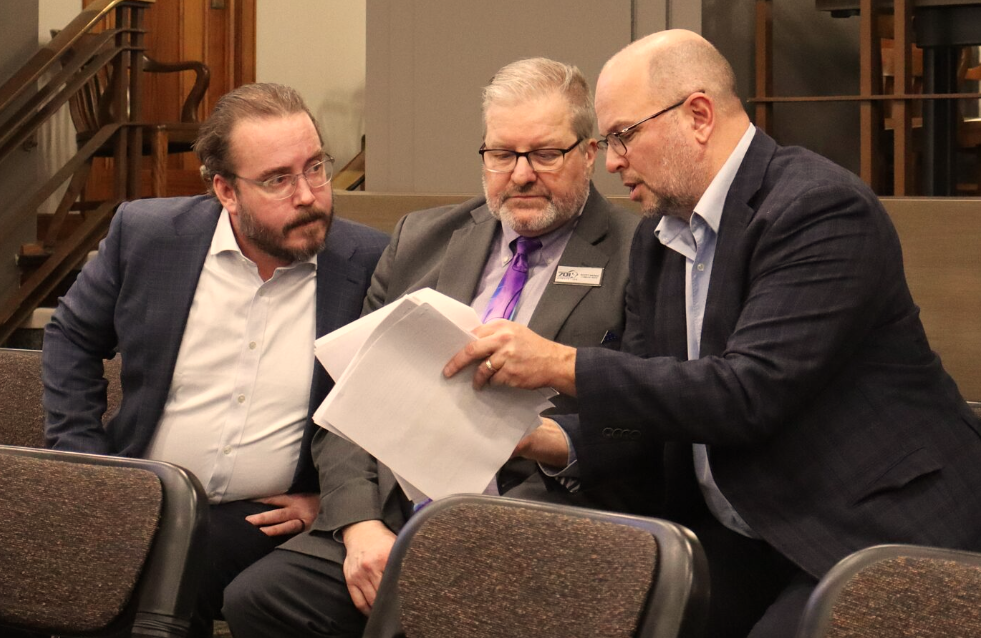
Rep. Mike Motschenbacher, right, is also the executive director of the North Dakota Gaming Alliance. Pictured here: The Republican lawmaker from Bismarck reviews hearing handouts next to Scott Meske, center, lobbyist for the North Dakota Gaming Alliance, and Rudie Martinson, executive director of the North Dakota Hospitality Association, during an administrative rules hearing on charitable gambling on Feb. 18, 2026, at the North Dakota Capitol. The hearing was outside of a legislative session. (Photo by Michael Achterling/North Dakota Monitor)
BISMARCK, N.D. (North Dakota Monitor) – A Bismarck-area lawmaker says he is “completely separated” during the legislative session from his job heading a trade group for charitable gambling, a critical topic and burgeoning area of state law in recent years.
An ethics expert said Rep. Mike Motschenbacher could do more to better navigate the two jobs and potential conflicts of interest. A Democratic-NPL leader said he hasn’t been totally transparent with voters and should recuse himself from certain bill votes.
Motschenbacher, R-Bismarck, is seeking a second four-year term for District 47, an area of north Bismarck. Since late 2020, he has been the executive director of the North Dakota Gaming Alliance, which calls itself “your voice for all those in the charitable gaming industry in North Dakota.”
Charitable gambling is an ongoing topic in front of the Legislature following the proliferation of electronic pull tabs since 2018. The Legislature has dealt with many gambling-related bills, including regulations, since Motschenbacher was first elected in 2022.
Motschenbacher said he visited with the secretary of state, Ethics Commission and attorney general’s office before he first put his name on the ballot. He takes a four-month, unpaid leave of absence from his job during the regular biennial session and does not sponsor or speak on gambling-related legislation, he said. The Gaming Alliance hires a lobbyist, Scott Meske, who handles legislative matters, he said.
“I am completely separated. I concentrate solely on the issues that are important to District 47 and the state of North Dakota. I don’t do any lobbying or anything like that, so I have done everything that was asked of me and even above and beyond, I would say,” Motschenbacher said in an interview with the North Dakota Monitor.
He has not recused himself from votes on gambling-related bills, saying he does not uniquely or personally benefit from the legislation.

Motschenbacher hasn’t been upfront with voters about his job, said Bob Valeu, the Bismarck-Mandan Democratic-NPL director. He cited a District 47 GOP mailer that lists details and credentials for all three candidates, but did not include Motschenbacher’s Gaming Alliance job. He also pointed to Motschenbacher’s candidate statement of interest, which lists his principal occupation as a “professional” for the Gaming Alliance.
“It’s just so frustrating that there isn’t more disclosure and accountability with regards to potential ethical questions on a member of the Legislature voting on legislation that directly or indirectly impacts the association that he works for,” Valeu said.
Motschenbacher said his campaign website lists his Gaming Alliance job, which he said “just wasn’t pertinent to the mailer we put out.”
“I’m not hiding behind it. Everybody knows what I do,” he said.
Motschenbacher clearly realizes he has an issue and is trying to deal with it, said Dennis Cooley, a professor of philosophy and ethics, and director of the Northern Plains Ethics Institute at North Dakota State University.
“That’s always a positive in regards to talking about somebody’s action and character,” he said.
But Cooley wondered what direction the Gaming Alliance lobbyist takes from Motschenbacher.
“What he’s doing on its face looks fine, but as I said, it depends on whether or not there’s anything going on at all with him instructing that lobbyist, so when he steps away, is it a clean step away?” Cooley said.
Motschenbacher said Meske “is pretty much on his own during the session” as to lobbying and provides information on bills to lawmakers. Meske will ask him questions and give updates, he said.
The Gaming Alliance has a board that develops policy positions and directions for Meske before the session, Meske said. Motschenbacher is involved in that as executive director, Meske said.
“That’s standard,” Meske said.
Meske said he gives the Gaming Alliance weekly updates and testimony during the session. When the session starts, Motschenbacher is not involved, Meske said.
“During the session, it’s like, nothing. If I see him in the hallway, I say, ‘Hey, how’s it going?’ but there’s no other interaction with that,” Meske said.
In the Legislature’s interim period, Meske will handle matters if the Gaming Alliance has a position on rules or is asked to testify, he said.
Earlier this year, Meske testified on behalf of the Gaming Alliance at a rules hearing of the state Gaming Commission. Motschenbacher sat in the audience and talked with Meske at times. Motschenbacher said he was being paid by the Gaming Alliance at the time, and sat in on the meeting to see how it went.
“I don’t want to be construed as trying to influence anybody because I do know I have my legislative duties and I separate them completely from my professional duties,” he said.
The next month, Motschenbacher testified on behalf of his association at a meeting of a panel reviewing state boards and commissions, in which he expressed support of keeping the Gaming Commission. The panel, which includes other lawmakers, initially recommended eliminating the Gaming Commission but later changed course and indicated the commission would be studied in the upcoming legislative session.
Motschenbacher said normally Meske would have made the presentation as the organization’s lobbyist, but he was unavailable, so Motschenbacher did it in his official Gaming Alliance capacity. He didn’t speculate on whether his testimony helped the Gaming Commission.
Meske said, “I’m disappointed that this continues to be an issue, the fact that people criticize his position that he is employed by, just because he’s a legislator, and the only reason the issue is coming up is because it’s charitable gaming.”
In 2025, Motschenbacher voted for bills that would have lowered tax rates for charitable gambling, and would have restructured the state Gaming Commission to include groups that operate charitable gambling. Neither bill ultimately passed. The Gaming Alliance lobbied for both bills.
The same year, he also voted against a bill opposed by the Gaming Alliance that sought to restrict which organizations qualify to conduct charitable gambling. The bill passed the Senate but was overwhelmingly defeated in the House.
Motschenbacher cited a rule that lawmakers with personal or private interests in legislation must disclose their situation to the House, which then decides whether to allow the member to abstain from voting — but such interests are defined as “directly, individually and uniquely” affecting the legislator.
“I do not benefit whatsoever, personally or uniquely, by any bill I vote on,” he said. He gets no paycheck or bonus, but would recuse himself if a bill did uniquely benefit him, he said.
Motschenbacher might be following the law, but perhaps the law isn’t what it should be, one of his opponents said.
“I mean, if he’s working for an organization that essentially benefits from the passage of certain things or from the failure of certain bills, then whether that’s impacting him directly is still in my mind a conflict,” Democrat Rosann Jacobs-Fode said.
Valeu wondered how Motschenbacher would vote on a likely bill to regulate charitable organizations owning bars.
“Is he going to vote on the basis of his employer, or is he going to vote on the basis of what his constituents want?” Valeu said.
The ethical thing to do would be for Motschenbacher not to vote on legislation that would directly benefit the Gaming Alliance, Valeu said.
Cooley said a person doesn’t have to have money going into his or her pocket to have a conflict of interest. He suggests lawmakers consider how certain votes might look to their constituents. Does it look like self-dealing, for instance? And what do Motschenbacher’s constituents want him to do, he added.
Motschenbacher said every other lawmaker who works could be portrayed as having a conflict, given the “citizen legislature” North Dakota has.
“I would say I’m less conflicted just because of the fact that I take a four-month leave, and I don’t deal with gaming whatsoever during the session,” he said.
Motschenbacher’s Gaming Alliance job is in an inherently controversial business, Cooley said. That’s different from farming, teaching and other occupations Motschenbacher said could present conflicts for lawmakers in those professions.
Jacobs-Fode, a teacher and one of the Democrats running for House, said she has questioned voting on education-related bills. How would she approach voting on a teacher pay raise, she wondered.
“I totally understand the conflict that Mike is in and the difficulty of it, because I feel like I’m going to find myself in a similar boat. So it’s about following the law, making sure that we’re being as ethical as we possibly can be and double-checking ourselves,” she said.
House Majority Leader Mike Lefor, R-Dickinson, said each legislator is responsible for assessing possible conflicts on bills. He pointed out that a number of lawmakers recused themselves in the 2025 session, more than in years previously.
“My two cents would always be, ‘When in doubt, be open, be transparent,’” he said.
Last year, other lawmakers routinely recused themselves from bill votes, citing employer ties to the topic or business with the state government. The House and Senate often excused lawmakers but also allowed some to vote.
There’s more understanding to be done regarding conflict procedures in legislative rules and visiting with the Ethics Commission, Lefor said.
Motschenbacher said he met with Ethics Commission Executive Director Rebecca Binstock three times “to make absolute sure that I am doing things correctly.”
Binstock said she met with him in 2023 but didn’t recall specifics. The Ethics Commission can’t function as lawmakers’ attorneys but can educate them on what the law says, Binstock said. It’s common for lawmakers, especially new ones, to ask questions, she said.
Motschenbacher has not ever sought an advisory opinion or “anything formal” from the ethics panel, Binstock said.
Motschenbacher said he has never heard from the Ethics Commission about complaints against him.
State laws on legislative lobbying, including registration and what activities define lobbying, don’t apply to lawmakers.
Even when wrong information is given in a House floor debate, he doesn’t rise to correct it “just due to how I’m hamstrung on this,” he said.
Motschenbacher previously was a registered lobbyist for the Gaming Alliance until mid-2022 and for the North Dakota Hospitality Association and Citizens for Responsible Government until 2009.
Motschenbacher’s daily Gaming Alliance duties include dealing with memberships, listening to concerns in the industry and meeting with people all around the state, he said.
The Gaming Alliance gets most of its revenue from membership dues and assessments, according to the organization’s tax filings. The organization highlights on its website that its accomplishments include killing bills that would have restricted charitable gambling.
Motschenbacher confirmed he earns a $65,000 salary from the Gaming Alliance. His legislative salary was $34,926 last year, according to Legislative Council.
Motschenbacher is running with former Bismarck School Board President and past Bread Poets owner Jon Lee. Jacobs-Fode and fellow Democrat Cole Montoya also are running for the two District 47 House seats. Independent candidate Andrew Alexis Varvel suspended his House campaign but will still appear on the ballot.




Comments