Photo provided by NRCS North Dakota
By Susan Samson-Liebig, State Soil Quality Specialist, NRCS North Dakota
NRCS employees from across the country reviewed cover crop performance and soil health principles during the national Soil Health Division’s Cover Crops for Soil Health Training, held Sept. 1–3 at the USDA‑ARS Northern Great Plains Research Laboratory in Mandan, N.D. Field sites included the ARS Long‑Term Agroecological Research (LTAR) site, the Bismarck Plant Materials Center, and Menoken Farm, a nationally recognized demonstration site. The visits offered hands‑on learning across landscapes in different stages of soil‑health recovery and highlighted how cover crops are being integrated into regional cropping systems.
The three‑day training featured classroom instruction, root‑architecture demonstrations with fifteen cover crop species, and participant presentations on integrating cover crop systems into conservation practices nationwide.
At USDA‑ARS, Dr. Mark Liebig, Research Soil Scientist, discussed development of the widely used Cover Chart and guided participants through the LTAR field site to examine crops and soils under various treatments. Dr. Andrea Clemensen, ARS Research Biologist, provided an overview of plant secondary metabolites and ongoing research exploring connections between soil health and human health across the three USDA‑ARS units in North Dakota.
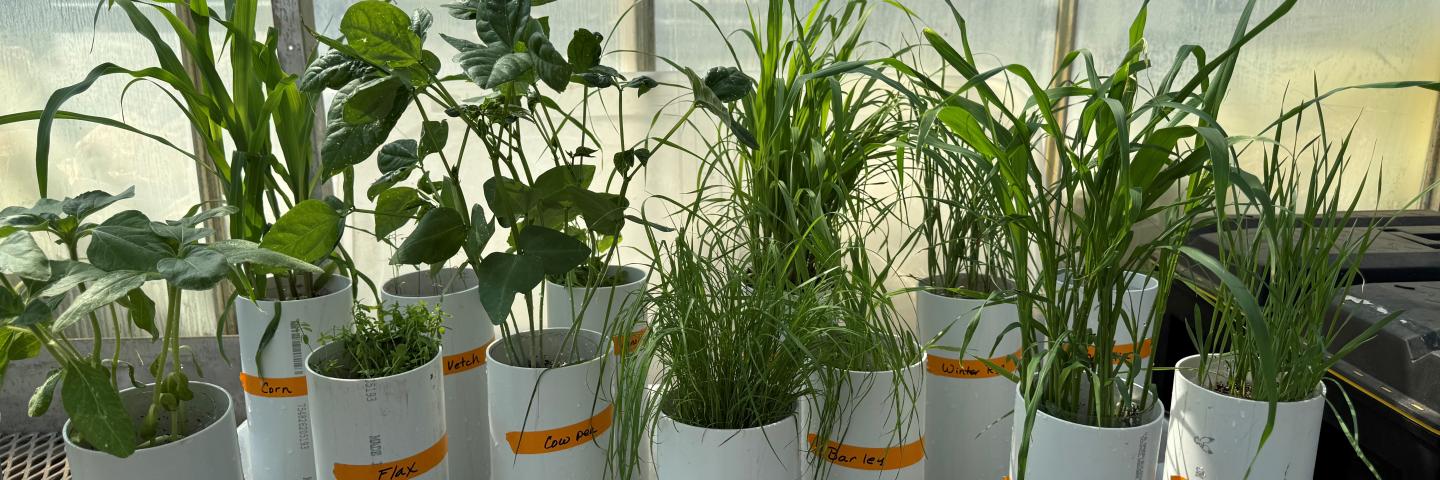
A new hands‑on demonstration added an innovative element to this year’s training. Sixteen different cover crop species were grown for six weeks in the ARS greenhouse using plastic tubing set inside PVC pipe, allowing participants to examine root development in a controlled environment. The setup, designed and tested by Brent Gustafson and Susan Samson‑Liebig, provided a clear look at how species differ in root depth, architecture and early‑season growth.
The demonstration gave attendees a rare opportunity to compare root systems side‑by‑side—from fibrous grasses to tap‑rooted broadleaves—and reinforced how below‑ground traits influence soil aggregation, moisture use and biological activity. The greenhouse tubes also helped illustrate why species selection matters when designing mixes for grazing, soil structure or nutrient cycling. The experiment was a successful addition to the field‑based training, offering a practical visual complement to the root‑architecture and cover‑crop chart discussions held later in the week.
At the Plant Materials Center, instructors introduced participants to a variety of cover crop plots, including a 12‑species mix blending radishes, sunflowers, rye residue, sorghum, flax and other broadleaf plants. Staff demonstrated how strategic species combinations support pollinators, manage moisture and build soil structure. Attendees examined shovel samples comparing heavily tilled soil with healing and fully recovered profiles, offering a tangible look at how no‑till systems accelerate biological improvement. The tour also included paired fields showing different stages of recovery: one seeded heavily with broadleaves, and another newly converted from tillage and mowing into no‑till.
At Menoken Farm, a 150‑acre teaching site founded in 2009, participants reviewed practices that rely on biological processes rather than commercial fertilizers or insecticides. During opening remarks, Darrell Oswald, District Manager for the Burleigh County SCD, highlighted the site’s rain gardens, arboretums and high tunnels, all designed to demonstrate regenerative practices.
Jay Fuhrer, Conservationist at Menoken Farm, led a hands‑on demonstration illustrating how “energy hitting the green plant moves into the soil” and how carbon carries the sun’s energy, forming the foundation of soil building. Instructors emphasized strategic species selection, noting that soybeans’ non‑fibrous roots do little to improve soil aggregation unless paired with fibrous‑rooted crops—underscoring the importance of root architecture in planning mixes.
Participants also examined Menoken Farm’s 15‑way cover crop mix, seeded in late June to support winter grazing and maintain living roots throughout the growing season. Cool‑season crops seeded in April had already been grazed in July, demonstrating how planned grazing cycles reinforce soil health while maximizing forage—a practical example of integrated grazing.
Attendees traveled from eleven states, underscoring national interest in enhancing conservation planning with field‑tested soil‑health approaches. The event reinforced NRCS’s effort to expand soil‑health planning nationwide, giving employees firsthand experience with practices they can incorporate into conservation programs and producer guidance.



Comments