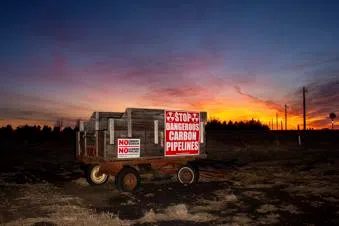
A wagon covered in signs protesting the installation of a Summit Carbon Solutions pipeline stands on a farm in Lake County, S.D., on Monday, March 10, 2025, in one of the counties that the pipeline would cut through. (AP Photo/Nicole Neri)
AMES, Iowa (North Dakota Monitor) – Summit Carbon Solutions, the Iowa company that had targeted North Dakota as the destination of its carbon dioxide pipeline, announced Wednesday that an updated route will instead travel to a storage site in Wyoming.
Summit’s announcement indicated its pipeline would run through Iowa and Nebraska to Wyoming, with no mention of North Dakota and South Dakota. A spokesperson said North Dakota, South Dakota and Minnesota “remain important for our company.”
North Dakota had issued permits for both the pipeline and an underground storage area northwest of Bismarck, which both face legal challenges.
The company has been unable to secure a pipeline permit in South Dakota, where it met significant landowner resistance.
Summit said the new route has been “refined” and it is smaller in scope than the $8 billion project that would have included more than 2,000 miles of pipeline to connect 57 ethanol plants, in five states, to a storage facility in North Dakota. The new route will connect to 27 ethanol plants in Iowa.
The project intends to capture carbon from the fermentation process at ethanol plants along the route.

Tharaldson Ethanol near Casselton was the only North Dakota ethanol plant to sign on to the project.
The project had support in North Dakota from some corn growers who felt the project would boost the ethanol industry and the farmers who supply the ethanol plants with corn.
But some North Dakota landowners and environmental groups opposed the project, citing safety and property value concerns. Some landowners are not opposed to the project but alleged Summit would not negotiate with them in good faith.
“For the folks that this could have helped, it’s too bad that Summit used the tactics that they did,” said Troy Coons, chair of the Northwest Landowners Association. “This one caused an uprising in multiple states with so many people being offended and their constitutional rights being threatened.”
Both the pipeline route and underground storage permits have been challenged in North Dakota courts. Two district court judges have determined the underground storage permits and the law they were issued under are unconstitutional, casting the project’s future into question. Both decisions are expected to be appealed to the North Dakota Supreme Court.
Derrick Braaten, a Bismarck attorney representing landowners in both lawsuits, said Summit’s apparent willingness to continue fighting legal battles in North Dakota may suggest a desire to keep the company’s route options open moving forward.
“I think that it’s possible they’re going to continue to fight and see if they can win these fights on the constitutional issues,” Braaten said. “There’s at least a chance that there’s a long game where they’re still going to try and develop the current route” to North Dakota.
A Summit spokesperson said the permits and easements the company owns in North Dakota, South Dakota and Minnesota “provide valuable optionality for future phases” of the project.
“We remain committed to building systems that support economic growth and long-term U.S. energy production,” said Sabrina Zenor, spokesperson for Summit, in a statement.
Summit seeks to take advantage of federal tax credits for carbon sequestration.
Summit’s statement on Wednesday indicated that the carbon dioxide it transports to Wyoming could be used in enhanced oil recovery. The technology uses a gas such as carbon dioxide to rebuild pressure in oil reservoirs and could double the amount of oil that can be produced.
“Seems like a tremendous lost opportunity for North Dakota,” said Ron Ness, president of the North Dakota Petroleum Council. “Projects that help ag and energy and create revenue streams for landowners are rare.”
Oil companies in North Dakota are moving forward with pilot projects to try to make the technique economically viable.
Todd McMichael, a landowner near Kindred, opposed the project but signed an easement with Summit because he said his family could not afford a potential legal battle with the company.
He said he and neighbors who signed easement agreements have already been paid by Summit. He said he had not been notified by Summit of its change in plans.




Comments