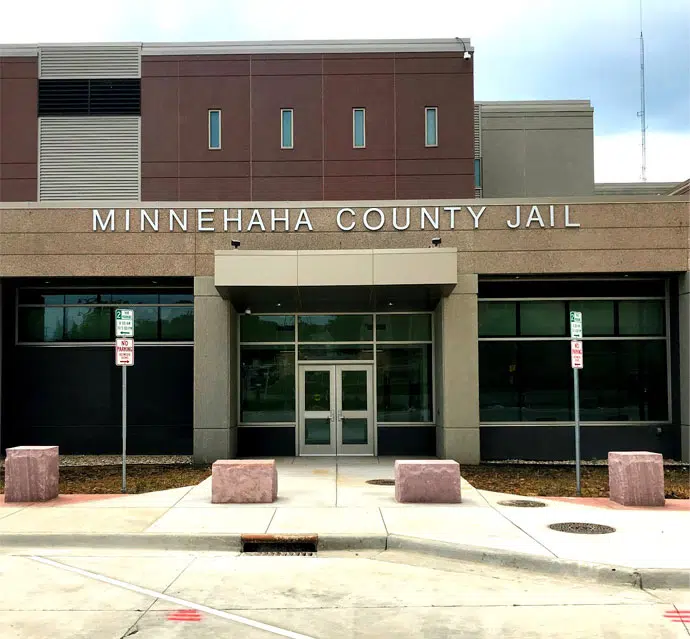
"Minnehaha County Jail"
PIERRE, S.D. (South Dakota Searchlight) – South Dakota will hire more parole officers, expand monitoring to nights and weekends, and make it easier to send people on parole back to prison, Gov. Larry Rhoden announced last week.
Five parole officers will be assigned to an enhanced compliance unit, Rhoden announced in a Thursday news release, and five new officers will be hired to backfill those positions.
The Department of Corrections will also “enhance the severity of sanctions” for people on parole who commit certain misdemeanor offenses, including driving under the influence, or simple assault and weapons violations. The Board of Pardons and Paroles, meanwhile, will “process revocations” more quickly and hold revocation hearings more frequently.
Some changes are just starting, but adjustments to revocation policy began a week ago, the release said, and the state has “nearly doubled” the number of revocations since.
Shooting sparks criticism and action
Law enforcement has criticized the state’s parole policies for years, before Rhoden’s term in office began in 2025.
The governor’s announcement came in the wake of a shooting, the second in as many years to injure a Sioux Falls police officer. The officer in Sioux Falls was ambushed and shot on Monday by someone on state-supervised parole, according to the Minnehaha County Sheriff’s Office, which is leading the investigation. The officer is in stable condition.
The man accused of shooting the officer was sentenced to 10 years in prison in 2022, with three years suspended, for drug possession and grand theft. He was released in late 2024, and police issued an “attempt to locate” order for him in the run-up to his encounter with police earlier this week. He’s now charged with attempted murder of a law enforcement officer and aggravated assault, among other charges.
Thirteen months ago, another person on parole allegedly shot and wounded another officer in Sioux Falls before leading law enforcement on a multi-county pursuit that ended with still more shots fired at state troopers. The man was convicted of attempted murder of a law enforcement officer in Union County last month; his case in Sioux Falls is pending.
On Tuesday, Minnehaha County Sheriff Mike Milstead told reporters at a news conference that he was angry about continued violence and a spate of criminal incidents linked to people on parole. It’s an issue he and other Sioux Falls law enforcement leaders have addressed repeatedly in recent years, as state officials wrestled with debates on new prisons, rehabilitation and repeat offense rates.
The 400-bed jail in Sioux Falls held 112 people who are on parole on Tuesday, Milstead said. Nine have been charged with murder or manslaughter, and dozens have been charged for offenses like rape, aggravated assault, robbery, firearms offenses or abuse of a minor.
Only eight were being held on parole violations and not new charges.
Milstead said he felt like “a broken record” about “people on parole committing violent acts in our community.”
Sioux Falls Mayor Paul TenHaken voiced similar frustration in a Facebook post Tuesday, noting that Sioux Falls police arrested 80 people on parole in March.

Rhoden addressed the issue on Thursday during an event in Sioux Falls. He said conversations began in Deadwood last week during an impromptu meeting with law enforcement officers and had been ongoing daily ever since.
“We’ve heard feedback from some of the law enforcement that they were very pleased with the outcome,” Rhoden said. “To this point, we’re not finished. We’re on the front end of getting a handle a bit on this and providing some real solutions.”
Once the state hires the five new officers, the prison system will have 59 parole officers and four parole supervisors, according to the Department of Corrections. On average, each agent will have 56 cases, which is 12 fewer than the 10-year high of 68 per agent in 2020.
The average number of people on parole in South Dakota has grown by around 1,000 in the past 10 years, an increase of 45%. The number of parole officers, counting the five new positions announced this week, has grown by 19, an increase of 48%.
West River work already in motion
Some movement on the issue had happened by the time the officer was wounded in Sioux Falls.
A few hours before Rhoden announced the parole changes, the Rapid City Police Department and Pennington County Sheriff’s Office announced the initial results of an interagency parole task force launched two weeks ago to address concerns on the western side of South Dakota.
The task force, which also includes state and federal law enforcement, is focused on “identifying and apprehending parole absconders, parolees with active warrants, and parolees who have been involved in recent criminal activity.”
The group’s work has led to the arrest of 40 people so far on a variety of “parole violations, new offenses and outstanding warrants,” the joint news release said. Eighteen of the people arrested since April 15 were on parole, and local law enforcement not directly connected to the task force arrested another 17 in that time frame, according to the news release.

The man accused of shooting the officer in Sioux Falls and a woman who was with him and who is also on parole, had been on the radar of state law enforcement since April 20, the day police say they were involved in a stabbing at a Rapid City apartment.
Questions on sanctions, parole policy remain
The state already has had a team in place to address parole concerns since January of 2023. The Department of Corrections began to form the Absconder Apprehension Unit, which includes representatives from Sioux Falls and Rapid City, in mid-2022 in response to a record number of people on parole ducking supervision.
When the group began its work, 470 were classified as absconders. That term applies when someone loses and avoids contact with a parole officer. The DOC lists absconders on its website under its “most wanted” section.
Of the 3,800 people on parole as of this week, 115 are classified as absconders. Last fall, the Department of Corrections announced that the number of absconders had fallen below 100.
The Department of Corrections’ sanctioning policies have evolved over time, with some of the more significant changes coming in 2013. Lawmakers that year passed a reform package that leans on community supervision and substance use treatment, but critics like former Speaker of the state House of Representatives Steve Haugaard have argued the state never funded the programs to make it work.
Milstead said many in law enforcement point to the reform package as the starting point for the parole system struggles. It put more pressure on counties to deal with criminal justice issues, he said, and the state hasn’t stepped up with enough support to match the need.
This year, he noted, after voting to fund a new men’s prison during a special session in September, lawmakers defeated a bill that would have put $2.7 million toward a leadership program that teaches inmates skills for success outside prison.
“Government just has a terrible record of not following up on providing what they thought was going to happen,” Milstead said.
Changes in accountability ‘almost an overnight thing’
The sheriff said he appreciates Rhoden’s actions this week, particularly his decision to add five more parole officers than the state had in its budget for the current fiscal year.
On Thursday, he said, more than 40 people had been booked into his jail on parole holds — meaning they aren’t charged with new crimes — in the past 48 hours. Typically, fewer than 10 people are jailed in Sioux Falls on parole holds at any given time.
“It’s been almost an overnight thing,” Milstead said.
But he also said that the changes are “a start” to a conversation that lawmakers need to continue — and be ready to back up their promises with resources.
“The start of a solution coming in the same week a parolee attempted to murder a police officer?” Milstead said. “I guess I’m glad it’s happening. I wish it would have happened earlier.”




Comments