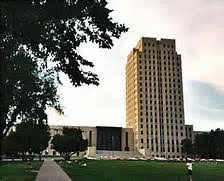
The North Dakota Capitol building
BISMARCK, N.D. (North Dakota Monitor) – Home addresses of North Dakota legislative candidates and public officials would be confidential records under a bill draft being developed by a legislative committee.
The bill would apply to a broad array of candidates and officials, from school board members to the governor, who could opt in to have their address treated as confidential information by government agencies.
The proposal discussed Wednesday grew out of discussions on how to improve the security of legislators and other officials that have been ongoing since the shootings of two Minnesota lawmakers last June.
Senate Minority Leader Kathy Hogan, D-Fargo, suggested tabling the bill draft until the next meeting of the interim Legislative Procedure and Arrangements Committee to give lawmakers more time to consider possible unintended consequences.
“This is a pretty significant change in public records, and I think we understand why it needs to happen, and I believe many states are doing this,” Hogan said. “But it’s a fascinating question, isn’t it, are there unintended consequences?”
Some lawmakers expressed concerns that making residential addresses confidential could weaken oversight and inadvertently allow someone to win an election while living outside the district. House Minority Leader Zac Ista, D-Grand Forks, suggested looking at how other states enforce that residency requirement.
“If we make it harder for the public, directly or through the media, to enforce our rules, I think the punishment for violating them has to become stricter and steeper,” Ista said.
The current form of the bill would give election officials access to the confidential residential addresses for, among other things, checking residency at a voting location and looking to see whether a candidate lives in the district they are running in.

Secretary of State Michael Howe said there are candidates who have filed for the 2026 election in districts they do not currently reside in. That would not be information that’s visible to the public if this bill becomes law.
“That’s something the Legislature will have to weigh, the security concerns versus being transparent to the public,” Howe said. “So we’re not perfect in the Secretary of State’s office. No filing office is perfect. But what if we were to miss something and the public isn’t aware?”
Howe said anyone running for office has to sign a legally binding affidavit of candidacy. That document includes a promise to meet all legal requirements for the position by the time they take office, such as the residency requirement. They are not legally required to live in that district when they declare their candidacy, and the Secretary of State’s Office doesn’t check for compliance after the election.
“We’re not out there knocking on someone’s front door to make sure that they are living where they say they’re living on their affidavit of candidacy,” Howe said. “If someone has a complaint, they would go through the judicial process.”
His office already provides candidates an opportunity on most official forms to include a mailing address in place of a residential address for use on public-facing websites such as those for campaign finance reporting and statements of interests.
Of the 168 legislative and statewide candidates on the 2026 ballot, 13 opted to have a post office box listed on the statement of interests that are available online, according to the North Dakota Monitor’s review of the documents. Lawmakers have previously discussed how, in rural areas, everyone already knows where they live.
Legislators’ personal address information has already been removed from the legislative website, said Emily Thompson, the Legislative Council’s legal division director.
The bill would apply to residential addresses for all candidates, defined in existing state law as anyone holding public office or seeking election to one.
“Of course, it’s the committee’s discretion if they want that to be that broad. That’s how it’s written currently, to include candidates as well as those sitting legislators,” Thompson said.
Residential addresses for some positions, such as judges and prosecutors, are already confidential.
Committee members postponed action on the bill draft until the next meeting. The committee could advance the proposal to the 2027 legislative session. It would not affect the 2026 election cycle.




Comments