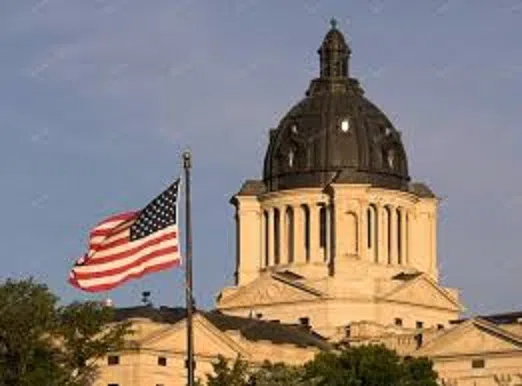
State Capitol in Pierre
By: Makenzie Huber
PIERRE, S.D. (South Dakota Searchlight) – South Dakota lawmakers have introduced at least 28 bills directly addressing property taxes so far this legislative session, with more expected to be filed. Several have been considered by lawmakers already.
The session started earlier this month and continues until March. Before the session began, the Legislature’s Comprehensive Property Tax Task Force recommended 19 proposals in October, some of which haven’t been introduced yet.
Gov. Larry Rhoden is supporting a bill, filed at his request, to allow counties to implement a half-percent sales tax to use for property tax relief.
Democratic legislative leaders told members of the media on Thursday that their members plan to introduce their own property tax relief proposal soon.
Senate Assistant Majority Leader Carl Perry, R-Aberdeen, compared past efforts to reduce property tax burdens to a game of Whack-A-Mole, adding that dozens of ideas will challenge lawmakers to find consensus.
“It’s going to be tough to get things exactly right, but we’re going to work at it,” Perry said.
State government does not receive property tax revenue. It relies primarily on sales taxes, as do cities, although cities also receive some property tax revenue. Counties and schools are reliant on property taxes. Property taxes paid by homeowners in the state have grown nearly 70% in the past 10 years, putting pressure on elected officials to stem the tide.
Some ideas — including one from U.S. Rep. Dusty Johnson, R-South Dakota, one of four Republican candidates for governor — would capture money from next year’s scheduled increase in the state sales tax rate to reduce property taxes. The Legislature and then-Gov. Kristi Noem reduced the rate from 4.5% to 4.2% in 2023, but scheduled the reduction to sunset in 2027.
Senate President Pro Tempore Chris Karr, R-Sioux Falls, proposed a bill this week that would keep the state sales tax rate at 4.2%. Karr said a higher sales tax rate would further harm taxpayers already complaining of property tax burdens.
He compared using sales taxes to fund property tax relief — which would involve everyone paying more sales taxes to reduce property taxes, even if they don’t own property — to feudalism. The medieval system relied on peasants working for landowners, or lords.
“No matter how bad we want property tax relief, no matter how bad it’s needed, that’s not right,” Karr said. “The ends don’t justify the means.”
Addressing the effects of last year’s adopted legislation
Lawmakers and Rhoden adopted a multifaceted piece of property tax relief legislation last year. It capped countywide residential assessment growth for five years, exempted some home improvements from affecting assessments, expanded eligibility among disabled and elderly people for relief programs, and capped the extent to which local governments can utilize new construction and growth to increase tax collections.
Sen. Randy Deibert, R-Spearfish, introduced a bill this year to raise the cap on new construction and growth from 3% to 5%.
Heath VonEye, deputy city administrator for Harrisburg, told lawmakers during the bill’s Senate Taxation Committee hearing that the law restricts communities growing at rates higher than the cap, limiting their ability to “let that new growth fund itself.” Those communities include cities in the Sioux Falls metropolitan area — including Tea and Harrisburg — and cities in the Black Hills area, such as Custer.
VonEye told lawmakers that the collective loss in revenue between 2027 and 2031 in Harrisburg due to the current cap would be nearly $3 million, assuming the city would continue growing at 10%.
That loss of revenue means the costs of paying for infrastructure, water and sewer, fire stations or more police officers patrolling the city “get pushed onto” and “inadvertently hurt” existing homeowners, VonEye said.
The city would be able to recoup about $800,000 if the cap was raised to 5%.
Other supporters of the bill said too stringent caps could lead local governments to exercise their right to “op out” of state limits on property tax growth, or cut services. Lobbyists with schools, cities and counties warned lawmakers of the “unintended consequence” last year.
The bill passed with a 6-1 vote, though some lawmakers on the committee questioned why they signed off on a new growth cap last year at all.
“I don’t know that there should be a cap,” said Sen. Tamara Grove, R-Lower Brule. “I don’t know what we accomplished in that part.”
The bill now goes to the Senate.
Bills working their way through the system
Some of the property tax bills that are still alive include the following:
- Senate Bill 85 would require elections for schools to exceed property tax limits.
- House Bill 1168 would provide a property tax credit to pay for private school or homeschool expenses.
- House Bill 1172 would terminate excess property tax levies approved by school districts older than 2002.
- House Bill 1218 would create a new commercial property category for taxation.
- House Bill 1241 would increase the property valuation limit for a property tax relief program for veterans and surviving spouses.
- Senate Bill 12 would provide missed property tax refunds from years prior for veterans and surviving spouses.
- Senate Bill 20 would appropriate $425,000 to provide property and sales tax refunds to low-income South Dakota residents who are elderly or disabled.
- Senate Bill 96, recommended by Gov. Larry Rhoden, would allow counties to implement a half-percent sales tax and use the revenue for property tax relief.
- Senate Bill 118 would put at least $100 million a year of state sales tax revenue toward a homeowner tax rebate program, and Senate Bill 125 would create the “homeowner tax reduction fund” to provide the rebates.
- Senate Bill 126 would increase the valuation limit for a property tax relief program for disabled veterans and surviving spouses.
- Senate Bill 144 would create a new property tax assessment freeze for older South Dakota residents.
- Senate Bill 161 would repeal property tax exemptions for health care facilities.
- Senate Bill 196 would increase the income limits for the state’s property tax assessment freeze program.
- Senate Bill 199 would create a new property tax relief fund and transfer 25% of the annual increase in general fund revenue to the fund.
- Senate Joint Resolution 504 would put a constitutional amendment on November’s general election ballot to allow mobile sports betting, with 90% of tax revenue be used for property tax relief.
- Senate Joint Resolution 505 would put a constitutional amendment on November’s general election ballot to limit the annual assessed valuation increase of property to 2% and cap property taxes at 1% of a property’s assessed value.
- Senate Joint Resolution 506 would put a constitutional amendment on November’s general election ballot to reset and limit property taxes to a flat rate until the sale of a property.
Failed bills
Senate Majority Leader Jim Mehlhaff, R-Pierre, introduced Senate Bill 99, which would transition public education funding from property taxes to sales taxes. The bill would have raised the state sales tax rate from 4.2% to 6.8% and removed the sales tax on food, but it failed in a committee on a 6-1 vote.
Representatives with the state Bureau of Finance and Management, South Dakota Retailers Association and South Dakota Farm Bureau Federation spoke against the bill.
Sen. Susan Peterson, R-Sioux Falls, said the bill tried to accomplish “too much all at once.”
“We might find ourselves in a bit of a conundrum in how we implement this,” Peterson said.
Other bills that have failed or stalled include:
- House Bill 1032, which would have eliminated the three-year limit to implement unused property tax increase requests for local governments.
- House Bill 1036, which has been tabled, would limit annual valuation increases for owner-occupied and nonagricultural properties.
- Senate Bill 58, which would have set property tax mill levies to zero.




Comments