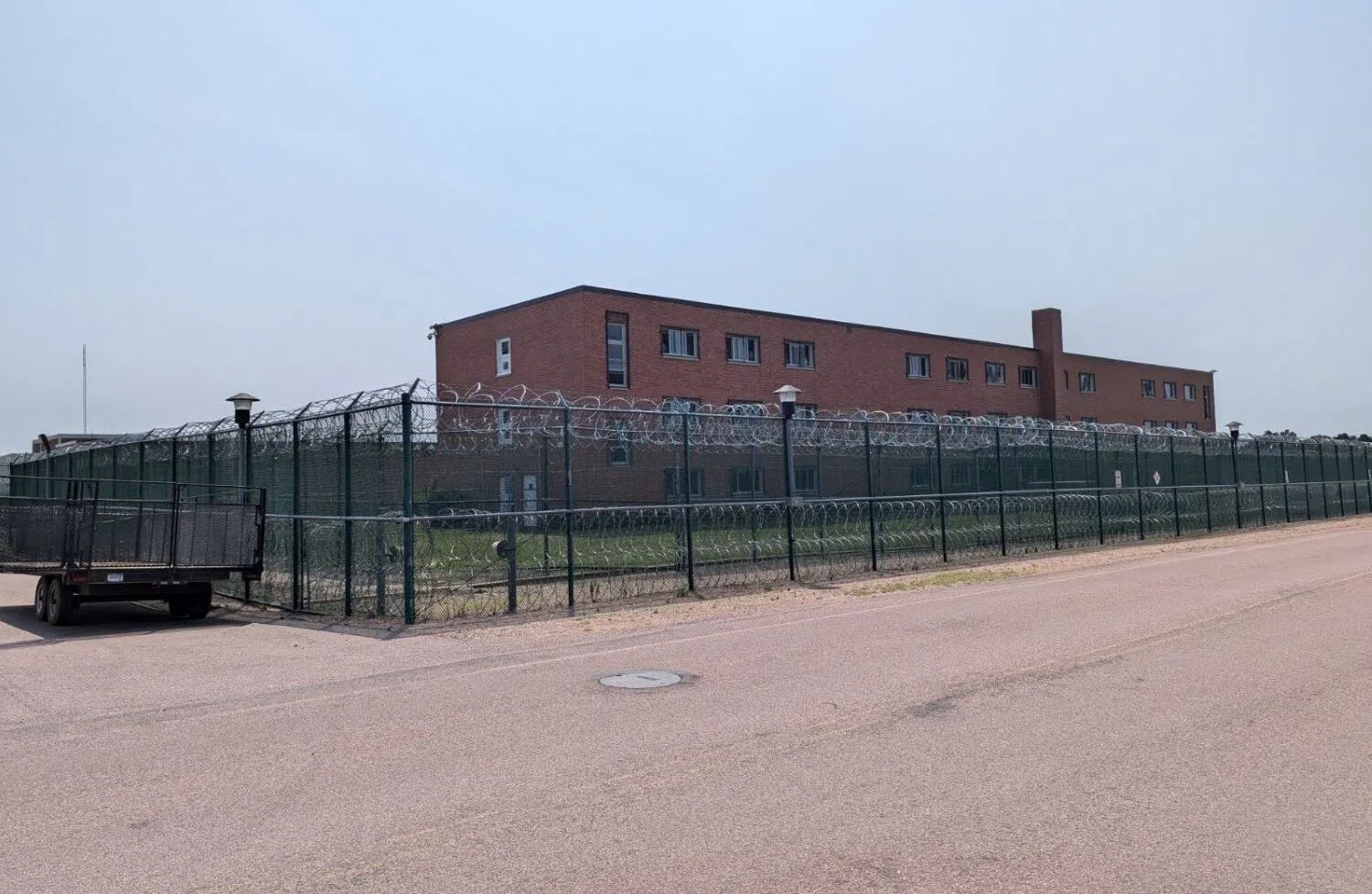
Mike Durfee State Prison in Springfield, South Dakota, on July 10, 2024. (John Hult/South Dakota Searchlight)
SIOUX FALLS, S.D. (South Dakota Searchlight) – Paul Cooper remembers when the crank radios showed up in Leavenworth.
By then, he’d done time in South Dakota’s state prisons, where inmates used electrical outlets to light up and smoke bits of paper soaked with synthetic drugs commonly known as “K2” or “spice.”
Things were different at the federal prison in Kansas.
The cells didn’t have outlets, Cooper said. The best way to spark a fire for a drug fix was to pull batteries from electronics, like alarm clocks or radios, and reverse engineer heat by connecting the batteries’ positive and negative ends with wire, aluminum foil or a gum wrapper.
To quash drug use, Cooper told South Dakota Searchlight, federal prison officials brought in solar-powered alarm clocks and crank-powered radios.
“None of that works,” Cooper said. “You’re talking about the most innovative people in the world. All you did when you gave these guys crank radios in the federal prison system was give them a rechargeable lighter.”
The anecdote highlights an intractable challenge of prison management: Any security measure meant to tamp down drug use must contend with a highly motivated group of inmates, many of whom arrive in prison as addicts, whose desire to get high or make money selling drugs is durable enough to hold up under the weight of institutional pressure.
In interviews with South Dakota Searchlight, a former prison warden, a former corrections secretary and a county sheriff who oversees a jail all agreed that policing narcotics inside their institutions is a challenge that never ends.
South Dakota’s had a particularly challenging year. The state has logged eight suspected or confirmed overdose deaths in 2025 inside its state prisons, a figure that leapfrogs the annual tally for any calendar year in recent memory. The count also outpaces surrounding states, even those with larger prison populations.
Cooper can’t imagine a prison system free of drugs. But he can picture one with fewer overdose deaths.
If South Dakota wants to improve things inside the walls, he said, the state should pour its time and treasure into addiction treatment.
“If you take away the addicts,” he said, “the dealers have no drugs to sell.”
‘What are you supposed to do in the meantime?’
Cooper is sober today. He runs a restaurant in southwest Sioux Falls and is serving out the remainder of his supervised release term. But he also spends a lot of time thinking about the safety of the inmates he used to call neighbors.
In April, he testified at a meeting of a state task force wrestling with the decision to build a new men’s prison. Lawmakers and the governor ultimately chose to approve the project, but Cooper said drug treatment and job training would serve the state better than a new building.
When Cooper offered his testimony, most of 2025’s prison overdoses — seven suspected or confirmed as K2-related, one from methamphetamine — hadn’t happened yet.
Some of the dead are people Cooper knew and, he said, needed support to stay clean and turn their lives around.
Cooper got support from his older brother, Ryan Vanden Hoek, who’s also a former South Dakota prisoner. Vanden Hoek and another former inmate named Steve Harrison now host a Sioux Falls-based podcast called “Unconfined Conversations.” It’s meant to encourage inmates and parolees to do right by themselves and others, but also to educate the public on what works and doesn’t in South Dakota’s prisons.
Vanden Hoek sees the availability of chemical dependency treatment as a major shortfall. Inmates rarely get a shot at treatment until near the end of their prison term, he said.
“It’s hard to expect somebody to make great personal changes when all you have for treatment is six to eight weeks in the last two years of your sentence,” Vanden Hoek said. “What are you supposed to do in the meantime?”
Department of Corrections spokesman Michael Winder said in an email that there’s no policy forcing inmates to wait. But he also wrote that treatment slots are “subject to available space in a program.”
During a presentation to the prison task force in April, Behavioral Health Chief Justin Elkins displayed a slide on substance abuse treatment that illustrated the system’s crunch for space.
“The basic gist from this page,” Elkins said, “is that there’s over 700 individual offenders in Sioux Falls who are waiting for substance use disorder treatment.”
That figure represents about half the Sioux Falls inmate population.
‘You’ve got just a bunch of hurt guys here’
Sam Lint, who’s serving a life sentence in the South Dakota State Penitentiary, would like to see more rehabilitation and peer support groups, more classes in general and more mental health programming specifically.
Lint said he and his fellow inmates often spend years dulling childhood trauma with drugs before they get to prison.
“There’s an urge, there’s been nothing introduced to us to intervene, so you just use the maladaptive coping skills you used as a child,” Lint said. “You’ve got just a bunch of hurt guys here, and the prison keeps hurting our families more and more, taking away our stuff and putting up barriers to communication.”
Some of what Lint calls barriers came during efforts to limit drug trafficking in prison, but he said such moves can also fuel addictive behaviors. Things like the temporary shutdown of texting in the spring of 2024, limits on the number of calls inmates can make in a day and the loss of in-person visits at the penitentiary since Father’s Day have worsened inmates’ sense of isolation, he said.
He’s also grown frustrated with the number of unit-wide lockdowns prisoners have experienced over the past few years.
One lockdown in 2024 lasted more than a month. During lockdowns, inmates are confined to their cells, including during meals and times when they might have in-person coursework or programming.
“You have guys who are making the conscious choice every day to get up, stay sober, go to class, go to work, go to church, go to groups, to just keep their head down and do their thing,” Lint said. “And then one day you wake up and the door doesn’t open because you’re getting punished for somebody else’s behavior.”
Between the frustration, boredom and underlying addictions, Lint said there are plenty of people who’ll say yes to K2, overdose risk be damned.
“We’re a prison full of all-day weed smokers who don’t have access to weed, right?” Lint said. “So yeah, people know the risks and roll the dice.”
Winder, the Department of Corrections spokesman, said in an email that it does not track the number of lockdowns in its facilities.
Drug use responses
Harrison, one of the ex-inmate podcasters, said correctional policies that have changed in the past decade or so can encourage drug use.
When Harrison got to prison more than two decades ago, people caught getting high would go into a cell designed for disciplinary segregation. So would those found to have helped them get drugs. If prison staff or volunteers were involved, he said, they’d also face consequences.
Nearer to the end of his term, Harrison said, things got lax. Since his departure, he said, he keeps hearing from friends inside that things have gotten even less strict.
Word has spread, Harrison said.
“When you’ve got somebody who’s struggling, somebody who’s addicted and what have you, they start to talk amongst themselves,” Harrison said. “They tell other people, ‘Hey, they’re not locking people up for smoking.’ It perpetuates the usage.”
Vanden Hoek suspects that’s because a spike in prison violence has made it more difficult to keep space for drug users and dealers in disciplinary cells.
The state’s most recent annual statistical report says prison assaults on staff spiked to a five-year high in fiscal year 2025, with 142. Twenty-two of those assaults caused serious injuries. Inmate-on-inmate fights between males were at a five year high, as well, at 447. Of those, 49 caused serious injuries.
Winder said the agency would not specify how many disciplinary or isolation cells are available. He said those caught using or suspected of using drugs are placed on “restrictive housing” status, meaning they’re confined to their cells for 22 hours a day.
Restrictive housing, Winder wrote, is “a condition of confinement, not a physical location.”
But Lint, the current inmate, said 22 hours of lockup is a common condition for people who don’t have jobs on the inside, regardless of drug infractions. He said there are fewer than 50 isolation cells overall in Sioux Falls, and that a portion of them are reserved for inmates in protective custody.
Gov. Larry Rhoden, during a recent press conference about a new women’s prison currently under construction in Rapid City, said he is confident in new Department of Corrections leader Nick Lamb.
He pointed to scanners the prison system purchased to scan for drugs hidden in body cavities. He’s also targeted rehabilitation programming, pledging $1.5 million from a fund he controls to support a diesel mechanic training program on the penitentiary campus and appointing a 30-member rehabilitation task force to study ways to reduce repeat offenses and improve programming.
At a recent task force meeting, Lamb said he’s visited all of the state’s prisons and held listening sessions with staff members. Soon, he said, he intends to do the same with inmates.
“I’m going to be happy to listen to their concerns, especially with programming, what interests they have, and what they think will benefit them,” Lamb said.
Mentorship encouraged
The value of mentorship is something Vanden Hoek, Cooper, Harrison and Lint all see as key to turning things around. Long-term inmates who’ve figured things out ought to be encouraged to guide young people, they say, even if those long-timers are in prison for serious crimes.
Former Department of Corrections Secretary Denny Kaemingk hired an ex-inmate named Michael Standing Soldier to work with the most hardened prisoners about a decade ago. At the time, Kaemingk said Standing Soldier, a former troublemaker who came to prison with a long-term sentence for a violent crime, could relate to people in a similar predicament.
Standing Soldier has since died, but Vanden Hoek and Harrison each remember him as a force for good at the penitentiary.
Willingness to meet inmates where they’re at and respond to their needs as individuals are pillars of what Vanden Hoek calls “moral leadership.”
Group punishments and lockdowns are signs of its absence, he argued, and he sees the overdose deaths as an outgrowth of that.
“When there are things like empathy and kindness and morality on behalf of the administration, where they simply want to do what’s best for everybody, you aren’t going to see things like this happening,” he said.




Comments