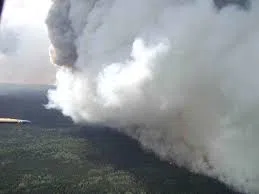
file photo (CJOB Radio, Winnipeg)
WASHINGTON (AP) – Republican lawmakers are blaming Canada for not preventing and containing wildfires, whose smoke has fouled the air in several states this year. In letters expressing outrage and indignation, they’re demanding more forest thinning, prescribed burns and other measures.
They warned the smoke is hurting relations between the countries and suggested the U.S. could make it an issue in tariff talks. But they don’t mention climate change, caused primarily by burning fossil fuels like coal and gas. Scientists say that’s a glaring omission that also ignores the U.S. contribution to heat-trapping gases that help set the stage for more intense wildfires.
The sternly worded statements and letters are filled with indignation and outrage: Republican U.S. lawmakers say Canada has done too little to contain wildfires and smoke that have fouled the air in several states this summer.
“Instead of enjoying family vacations at Michigan’s beautiful lakes and campgrounds, for the third summer in a row, Michiganders are forced to breathe hazardous air as a result of Canada’s failure to prevent and control wildfires,” read a statement last week from the state’s GOP congressional delegation, echoing similar missives from Republicans in Iowa, New York, North Dakota, Minnesota and Wisconsin.
They’ve demanded more forest thinning, prescribed burns and other measures to prevent fires from starting. They’ve warned the smoke is hurting relations between the countries and suggested the U.S. could make it an issue in tariff talks.
But what they haven’t done is acknowledge the role of climate change — a glaring and shortsighted omission, according to climate scientists. It also ignores the outsized U.S. contribution to heat-trapping gases from burning fossil fuels like coal and gas that cause more intense heat waves and droughts, which in turn set the stage for more destructive wildfires, scientists say.
“If anything, Canada should be blaming the U.S. for their increased fires,” said Jennifer Francis, a climate scientist at the Woodwell Climate Research Center in Cape Cod, Massachusetts.
On Tuesday, the Canadian government announced almost $46 million in funding for wildfire prevention and risk assessment research projects. But Corey Hogan, parliamentary secretary to the federal energy and natural resources minister, said international cooperation is needed.
“There’s no people that want to do more about wildfires than Canadians,” Hogan said. “But I think this also underlines the international challenges that are brought on by climate change … we need to globally tackle this problem.”
The country has “been fighting wildfires in this country at unprecedented rates since 2023,” when Canada saw its largest wildfire on record, said Ken McMullen, president of the Canadian Association of Fire Chiefs. This year’s first fire started in April, one of the earliest on record, and 2025 is now the second-worst year.
As of Thursday, more than 700 wildfires were burning across the country, two-thirds of them out of control, with more than 28,000 square miles (72,520 square kilometers) burned in 4,400 wildfires so far this year, according to the Canadian Interagency Forest Fire Centre. That’s almost five times the surface area that’s burned so far in the U.S. this year. Most wildfires are started by people, sometimes on purpose but mostly by mistake, though McMullen said lightning is the culprit in many of Canada’s fires, especially in remote areas.
McMullen said he has no interest in debating the role of climate change, but data show that something has changed. Sloughs and basins have dried up and water that once lapped at people’s back doors in Canada’s lake communities now is often hundreds of feet away.
“People can make up their own mind as to why that is,” he said. “But something clearly has changed.”




Comments