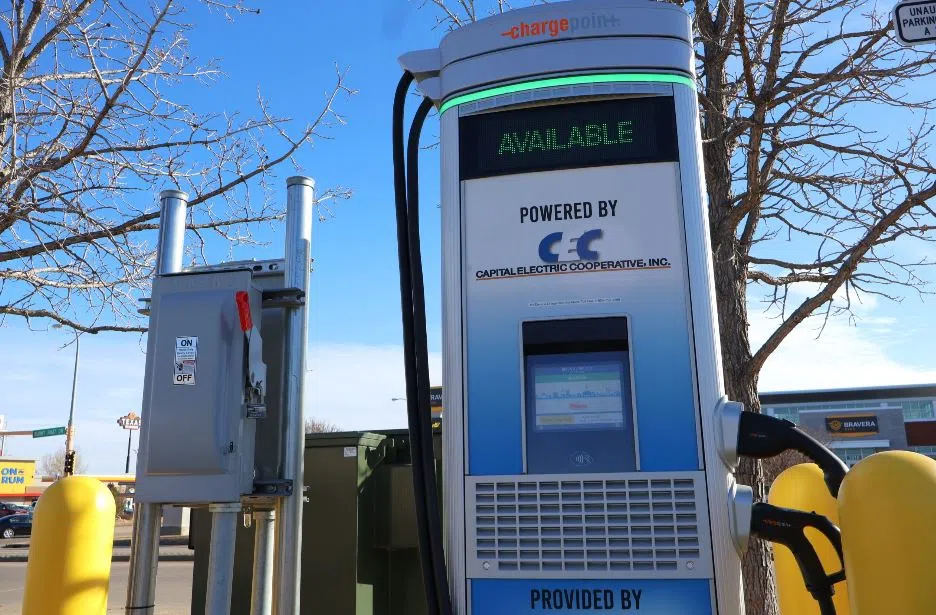
An electric vehicle charging station sits ready for use in Bismarck on Feb. 19, 2024. (Michael Achterling/North Dakota Monitor)
BISMARCK, N.D. (North Dakota Monitor) – North Dakota, a state of meteorological extremes, also has disparate views on the environment, a new poll suggests.
A statewide survey released Tuesday by the North Dakota News Cooperative gathered opinions on topics such as climate change, electric vehicles and capturing and storing greenhouse gas emissions.
“We found that opinions on environmental issues have become highly politicized,” Trevor Smith, chief research officer at WPA Intelligence, which conducted the North Dakota Poll, said of the results.
The poll shows 43% of voters in the state see climate change as a “serious problem and poses a real threat,” while 34% do not. By political party preference: 87% of Democrats identify climate change as a serious problem. About 45% of independents and 26% of Republicans agree that it’s a serious problem.
North Dakota, being in the middle of the continent, is prone to some of the most extreme weather in the world, says Daryl Ritchison, director of the North Dakota Agricultural Weather Network.
While North Dakota is in the middle of a very mild winter, it also was marked by some extreme temperature changes during January. He said southwestern North Dakota went from lows of nearly 40 below to highs in the mid-60s in a couple of weeks, a more than 100-degree difference.
But he doesn’t point to climate change for those downs and up.
“Personally, it’s called the weather,” said Ritchison, who also is interim state climatologist. “We just live in a very extreme climate.”
The federal Environmental Protection Agency estimates that North Dakota’s growing season is about 30 days longer than it was a century ago and the average temperature has warmed by more than two degrees.
But Ritchison said some of the data gathering sites have been “contaminated” by such things as inconsistent use of instruments or where they are placed. He said in North Dakota, the best data on the growing season is in the Bismarck area, and he said that shows very little change in the growing season.
Carbon capture
A project by Summit Carbon Solutions to capture greenhouse gas emissions in five states and store it underground in western North Dakota has brought a lot of attention to carbon capture and storage. But the poll shows many North Dakotans have yet to form an opinion on the topic.
In the poll, 40% of responders did not take a position on the issue. Overall, only 16% of all voters say capture and storage of emissions will reduce the effects of climate change while 27% say it will have no effect.
On party lines, 36% of Democrats say capturing carbon emissions and storing them underground will reduce the effects of climate change while 37% of Republicans say it will not.
Summit is still working to gain government approval in North Dakota and other states. While Summit says it has secured about 80% of the route through voluntary easements in North Dakota, there remain some landowners who are adamantly opposed.
That project would focus on permanent storage of carbon emissions, but geologist Kathy Neset said capturing carbon for use in North Dakota’s oilfields is key to the future of North Dakota’s oil and gas industry.
She admits there is some mistrust of pipeline companies.
“I think people have been soured and it will be remedied by facts,” she said.
Shannon Straight of the Badlands Conservation Alliance said he is more interested in natural carbon storage through protecting grasslands for ranchers.
“We don’t talk about their efforts enough,” he said of ranchers, adding he would like to see the state do more to carry on the legacy of Theodore Roosevelt. “I’d love to see the state take a larger role in conservation.”
Electric vehicles
The poll showed North Dakotans have little interest in purchasing electric vehicles.
Overall, 85% of the respondents are unlikely to buy an electric car or truck the next time they purchase a vehicle.
Hybrid vehicles show a little more promise. For hybrid vehicles, 71% are unlikely to buy while 18% are not.
Seventy-five percent of respondents are not confident that there will be enough charging stations in North Dakota to support large numbers of electric vehicles.
For Straight, the impact of electric vehicles may not come so much from their use as from western North Dakota becoming a potential source of rare earth metals that need to be mined to support battery production.
“We at the Badlands Conservation Alliance are certainly going to monitor that,” Straight said.
The poll of 500 eligible voters was taken Feb. 4-6 with a margin of error of plus or minus 4.4%.



Comments