In the spring, fisheries biologists have
a small window of time to collect the northern pike and walleye eggs that are
eventually stocked in North Dakota lakes as fingerlings in May and June.
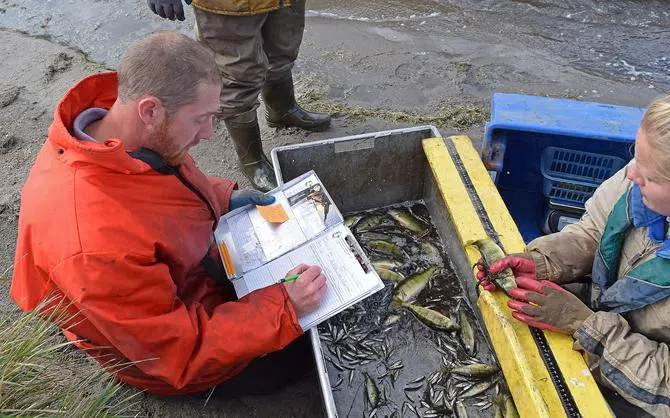
In the fall, those same biologists
revisit many of the waters where fish are stocked to see how those fingerlings
are faring.
State Game and Fish Department fisheries
management section leader Scott Gangl shared some insight into this fall fish
reproduction survey in a recent edition of the Game and Fish weekly webcast,
Outdoors Online. “Our biologists sample a lot of our lakes around the state
looking for young-of-the-year fish, fish that were either stocked or reproduced
this year,” Gangl said, “and it gives us an index of how well those stockings
took … how well those fish survived into the fall, or whether there was any
natural reproduction on some fish species.”
Gangl says angler use is a factor in determining
which lakes are surveyed, as biologists can’t get to all of the more than 400
lakes in one year. “Some of our heavily fished lakes are a priority, because
this information really factors into what they’re stocking next year, what
their plans are for the future,” he said. “Or they might have a new lake that
they just stocked for the first time this year.
“We like to see how well our stocking
success is from this year. It tells us, did we have a really good year class?
Was there good survival?” he said. “Or if we know that there’s good survival
this year, we might be able to take a year off next year. Or if we know that
there’s good survival on a new walleye fishery, we can kind of monitor how fast
those fish are growing.”
Something in which anglers are always
interested is the reproduction/stocking success on the state’s “Big 3” fishing
waters – Lake Sakakawea, Devils Lake, and Lake Oahe/Missouri River. Here’s a
preliminary assessment of those waters.
Lake Sakakawea
“It looks like Sakakawea might have a fairly good
number of walleye out there. I haven’t seen information on the other species
yet, but we had high water this summer and I think conditions in Sakakawea were
pretty good for a lot of fish.”
Devils Lake
“It looks like their young-of-the-year walleye catches
were pretty much close to the long-term average. The downside to Devil’s Lake,
they’re not seeing much for young-of-the-year perch, and we could use a perch
year-class up there.”
Missouri River/Oahe
“The one good-bad thing that they found is fairly good
numbers of (naturally produced” young-of-the-year walleye (on Oahe). And I say ‘good-bad’
because everybody likes walleye, right, but there’s not a lot of forage in Lake
Oahe … I think anglers who fish Lake Oahe are probably familiar with the fact
that there’s a lot of smaller fish in the system. They have been there for a
few years and they’re not growing. We don’t need another year-class of walleye
out there right now, but it looks like there might be one coming up.”