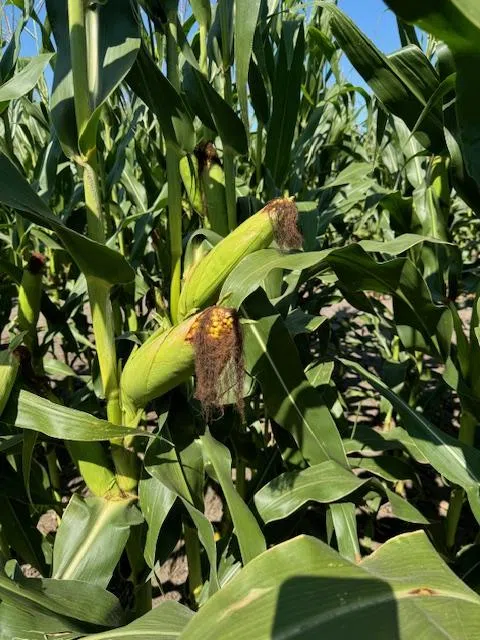
Photo: Rusty Halvorson/KFGO Ag News
Corn planted area for all purposes in 2026 is estimated at 95.3 million acres, down 3 percent or 3.45 million acres from last year. Compared with last year, planted acreage is expected to be down or unchanged in 37 of the 48 estimating States.
Soybean planted area for 2026 is estimated at 84.7 million acres, up 4 percent from last year. Compared with last year, planted acreage is up or unchanged in 20 of the 29 estimating States.
All wheat planted area for 2026 is estimated at 43.8 million acres, down 3 percent from 2025. If realized, this represents the lowest all wheat planted area since records began in 1919. The 2026 winter wheat planted area, at 32.4 million acres, is down 2 percent from the previous estimate and down 2 percent from last year.
Of this total, about 23.1 million acres are Hard Red Winter, 5.79 million acres are Soft Red Winter, and 3.54 million acres are White Winter. Area expected to be planted to other spring wheat for 2026 is estimated at 9.42 million acres, down 6 percent from the 2025 estimate. Of this total, about 8.78 million acres are Hard Red Spring wheat.
Durum planted area for 2026 is expected to total 1.95 million acres, down 11 percent from the previous year.
Crop Comments
Corn: Growers intend to plant 95.3 million acres of corn for all purposes in
2026, a decrease of 3 percent from last year. Compared with last year,
planted acreage is expected to be down or unchanged in 37 of the 48
estimating States. Acreage decreases of 300,000 acres or more from last year
are expected in Illinois, Iowa, Minnesota, Nebraska, North Dakota,
South Dakota, and Wisconsin.
Record high acreage is expected in Nevada and Washington. Record low acreage
is expected in Connecticut, Massachusetts, Pennsylvania, and Rhode Island.
Barley: Producers intend to seed 2.35 million acres of barley for the 2026
crop year, up 2 percent from the previous year. In Montana, the largest
barley State, acreage is expected to increase by 3 percent from last year.
Record low acreage is expected in Utah.
Winter wheat: The 2026 winter wheat planted area is estimated at 32.4 million
acres, down 2 percent from the previous estimate and down 2 percent from last
year. Of the total planted acreage, approximately 23.1 million acres are
Hard Red Winter, 5.79 million acres are Soft Red Winter, and 3.54 million
acres are White Winter. If realized, California, Nebraska, and Virginia will
have record low planted areas.
Durum wheat: Area expected to be seeded to Durum wheat for 2026, is estimated
at 1.95 million acres, down 11 percent from 2025.
Other spring wheat: Growers intend to plant 9.42 million acres of other
spring wheat, down 6 percent from 2025. If realized, this represents the
lowest other spring wheat planted area since 1970. Of this total, about
8.78 million acres are Hard Red Spring wheat. Planted area in North Dakota,
the largest spring wheat-producing State, is estimated at 4.70 million acres,
down 8 percent from last year.
Hay: Producers intend to harvest 50.1 million acres of all hay in 2026, up
1 percent from 2025. Record low all hay harvested area is expected in
Connecticut, Delaware, Illinois, New Hampshire, and Pennsylvania.
Canola: Producers intend to plant 2.69 million acres in 2026, up 15 percent
from last year’s planted area. If realized, planted area for the Nation will
be the second largest on record. Compared with last year, planted area is up
or unchanged in all seven of the major canola-producing States. Planted area
in North Dakota, the leading canola-producing State, is up 15 percent from
last year and will represent the second highest area on record, if realized.
Planted area in Idaho is estimated at 100,000 acres and will be a record
high, if realized.
Soybeans: Growers intend to plant 84.7 million acres in 2026, up 4 percent
from last year. Compared with last year, planting intentions are up or
unchanged in 20 of the 29 estimating States. Increases of 300,000 acres or
more are anticipated in Arkansas, Iowa, Kansas, Mississippi, Nebraska,
South Dakota, and Wisconsin. If realized, the planted acres in Wisconsin will
be the largest on record.
Sunflower: Growers intend to plant 1.39 million acres in 2026, an increase of
8 percent from last year’s planted area. Planted area in North Dakota is
expected to increase 11 percent from last year to 640,000 acres. Record low
planted area is expected in California.
Area intended for oil type varieties, at 1.29 million acres, is up 9 percent
from 2025. Area intended for non-oil varieties, at 91,500 acres, is down
8 percent from last year and will represent the lowest acreage on record for
the Nation, if realized. Record low planted acreage for non-oil type
varieties is expected in Colorado and Minnesota.
Flaxseed: Growers intend to plant 230,000 acres of flaxseed in 2026, a
decrease of 7 percent from 2025. Planted acreage in Montana is expected to
increase 54 percent from the previous year. If realized, this will be the
first time that Montana has planted more acres than North Dakota since the
data series began in 1920. Planted acreage in North Dakota is expected to be
down 35 percent from 2025.
Sugarbeets: Area expected to be planted to sugarbeets for the 2026 crop year
is estimated at 1.06 million acres, down 1 percent from 2025.
Dry edible beans: Growers intend to plant 1.24 million acres in 2026,
down 10 percent from the previous year. Idaho is the only State, among the
seven program States, expected to increase planted acres.
Chickpeas: Growers intend to plant 499,000 acres of chickpeas, down 7 percent
from the previous year. Planted area for small chickpeas is estimated at
116,000 acres. Area expected to be planted for large chickpeas in 2026 is
estimated at 383,000 acres.
Lentils: Growers intend to plant 832,000 acres in 2026, down 22 percent from
the previous year. Compared with last year, planted area in Montana, the
largest lentil-producing State, is expected to decrease by 210,000 acres.
Dry edible peas: Growers intend to plant 1.17 million acres in 2026,
up slightly from the previous year. A record high area planted is expected in
Montana.
Source: USDA




Comments