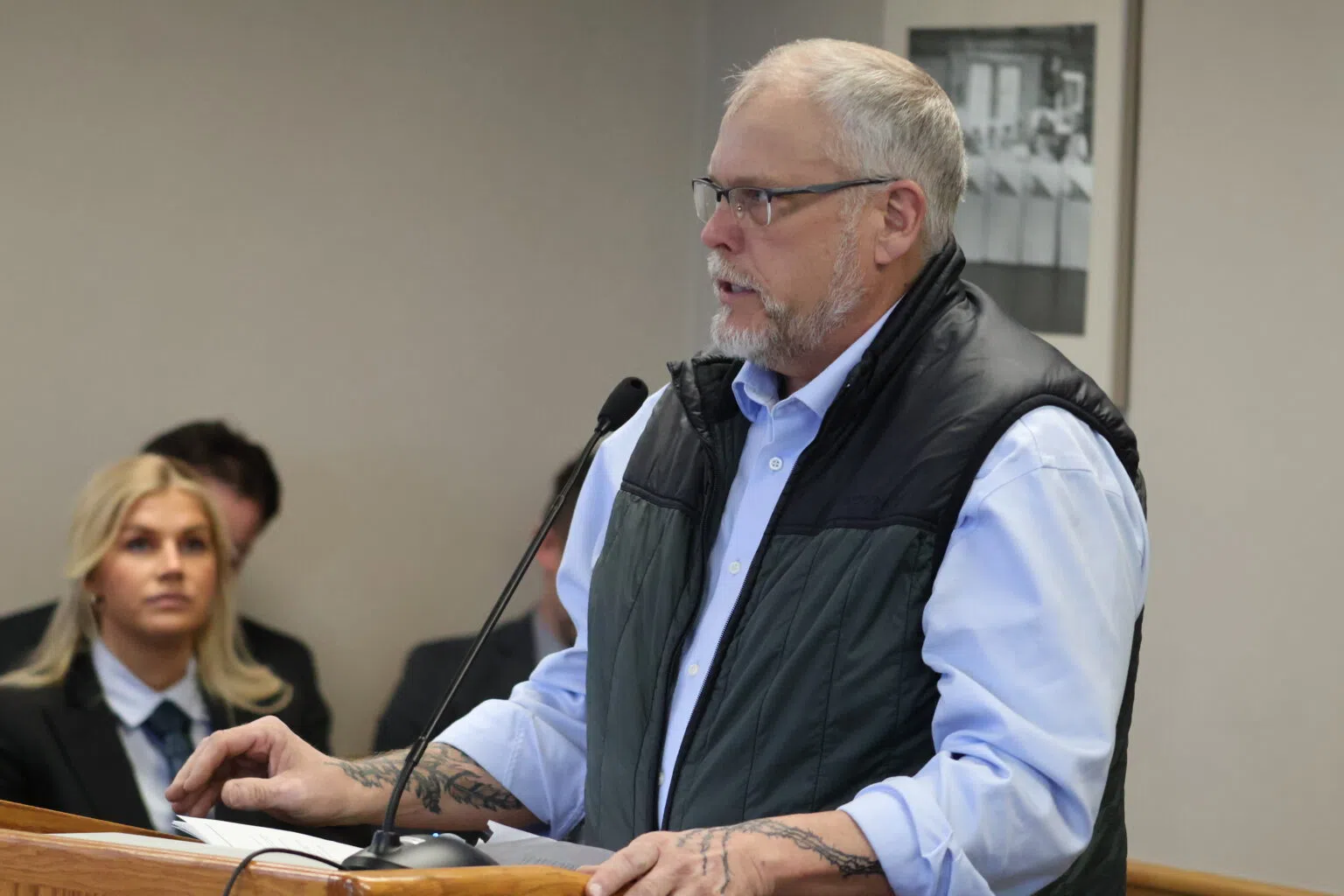
Kurt Swenson, a North Dakota landowner, speaks during a legislative hearing on March 27, 2025, in Bismarck. (Photo by Mary Steurer/North Dakota Monitor)
By: Jacob Orledge
BISMARCK, N.D. (North Dakota Monitor) – A North Dakota judge has revoked Summit Carbon Solutions’ permits for underground carbon dioxide storage, ruling parts of the state law they were issued under is unconstitutional, in another blow to the company’s plans for a carbon pipeline network.
The latest ruling was issued in response to an appeal by a group of landowners who object to the state’s attempt to force them to participate in Summit’s project, which would store carbon dioxide under their land against their will.
“This decision stands as an important victory not only for our family, but for all North Dakota landowners who believe that private property rights and constitutional protections still matter,” said Kurt Swenson, one of the landowners.
The decision written by South Central Judicial District Judge Jackson Lofgren is the second time this winter a North Dakota judge has reached the conclusion that the 2009 state law violates the state’s constitution. The law authorizes regulators to permit the storage of carbon dioxide beneath the property of nonconsenting landowners.
“The district court just reversed the Industrial Commission’s decision,” said Derrick Braaten, the landowners’ attorney in this case. “What that means is it essentially dismissed and invalidated the decision from the Industrial Commission to issue all these permits to Summit.”
Northeast Judicial District Judge Anthony Swain Benson released a similar decision in December in a related lawsuit, filed by the Northwest Landowners Association, that directly challenged the law’s constitutionality.
“While this case presents the issue in the context of an administrative appeal, the Court largely reaches the same conclusion,” Lofgren wrote in the decision. “Because the findings and conclusions of the NDIC are not sustained by the North Dakota Constitution, they must be reversed.”
Attorney Drew Wrigley said the North Dakota Legislature carefully weighed the interests of all private property owners who would be directly impacted by the law when it was proposed in 2009.
“They crafted this legislation mindful of their constitutional and stewardship responsibilities to all affected,” Wrigley said in a statement. “We are carefully reviewing the district court decision and will chart a path toward a final resolution of this important public policy issue.”
Summit’s planned $8 billion project would gather carbon dioxide emissions from ethanol plants in five states and bring it to North Dakota to be stored underground. The planned 2,500-mile pipeline network would include Tharaldson Ethanol near Casselton.
The project would inject the carbon dioxide into pore space, cavities in underground rock formations where emissions can be trapped, under 90,000 acres of land in parts of Oliver, Mercer and Morton counties. Approximately 92% of the landowners in the project area have voluntarily signed leases giving permission for their pore space to be used.
The Industrial Commission approved permits for the project in December 2024 and issued administrative orders that forcibly included the pore space of nonconsenting landowners in the project area, a process known as amalgamation. Carbon dioxide, once injected underground, will emanate outward and cross property lines without regard for whether the owner of the surface has signed a lease.
The 2009 law gives the Industrial Commission the power to authorize the use of this pore space over the landowners’ objections if at least 60% of the affected landowners have agreed to the project. It also states the agency must ensure the landowners “are or will be equitably compensated” as a condition of issuing the permit.
Lofgren determined this violates two protections afforded to private property owners when the government decides to take their property for public use. He pointed out the North Dakota Constitution guarantees property owners the right to have compensation determined in a jury trial and also requires the compensation be paid before the property is taken.
The judge ruled the Industrial Commission’s decision to approve Summit’s permits is reversed because it relied on a law now determined to be unconstitutional.
“As it stands right now, Summit no longer has any permits to do carbon sequestration in North Dakota,” Braaten said.
The court rejected the state’s arguments that the law is constitutional under legal precedent crafted to ensure shared resources, like oil reservoirs, are developed efficiently. That legal doctrine, Lofgren wrote, limits a property owner’s right to “capture” a resource that is shared with their neighbors, such as water or an oil reservoir that crosses property lines.
The judge determined that is fundamentally different from this case, where Summit is seeking to permanently store a substance, carbon dioxide, under the property. There is no resource being captured and therefore the legal doctrine cited by the state, known as correlative rights, does not apply.
The decision is the latest setback for Summit’s plans to construct a carbon pipeline with North Dakota as the destination. The company has received the requisite permits for the pipeline route in North Dakota, Iowa and Minnesota and Nebraska has no state permitting authority for carbon pipelines.
But the company has faced significant opposition in South Dakota. The state passed a law in 2025 prohibiting the use of eminent domain for carbon pipelines. Iowa’s legislature is considering a similar bill. Summit is also facing a legal challenge to its Iowa permit, in addition to the two lawsuits in North Dakota.
A Summit spokesperson said Tuesday the company is reviewing the decision and evaluating next steps.
“Summit has already leased a significant amount of pore space in the project area and will continue working to ensure we can access our permitted storage,” the company said in a statement. “This project remains critically important to strengthening markets for ethanol and corn producers while supporting long-term energy security.”
Braaten expects the case to be appealed to the state Supreme Court, whether by the state or by Summit. Attorneys for the state have previously said they plan to appeal in the Northeast Judicial District case as well.
Braaten said it is possible the two cases could be consolidated for purposes of the appeal.
Swenson said the conflict with Summit and state regulators has taken an “immense emotional and financial toll” on his family since they were first approached by a representative of the company in 2021. He’s asking for an apology from the Department of Mineral Resources and the Industrial Commission for the way landowners who didn’t consent to the project have been treated.
“While this decision represents an important affirmation of constitutional rights, it does not erase what our family has endured over the past five years,” Swenson said. “The process administered by the NDIC and the Department of Mineral Resources was marked by an atmosphere of hostility toward the very citizens it is meant to serve.”




Comments