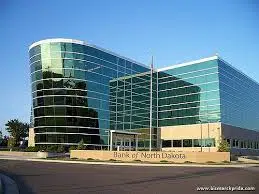
Bank of North Dakota
By: Jacob Orledge
BISMARCK, N.D. (North Dakota Monitor) – The Bank of North Dakota is on track to launch the state’s first stablecoin next September, pending a review by state officials later this month.
The state-owned bank announced in October it is developing a stablecoin, branded as the Roughrider Coin, for use in North Dakota’s banking system. Executives hope the digital currency, which will be tied to the value of the U.S. dollar, will streamline financial transactions between banks.
The Bank of North Dakota will present an analysis to the North Dakota Industrial Commission, which has oversight of the bank and has to approve the stablecoin initiative, at the board’s March 25 meeting. Kelvin Hullet, one of the bank’s executives, said part of the presentation will be made during the public portion of the meeting, while some of the discussion is expected to be in a closed-door executive session.
The analysis will include how the Roughrider Coin will be utilized in the state’s banking system, a risk assessment and the necessary safeguards, as well as cost projections for the initiative.
The bank is on track to launch a pilot program with local financial institutions in September if the Industrial Commission votes to move forward after reviewing the analysis.
CEO Don Morgan said the Roughrider Coin is the first example of the bank “picking our spot” in the world of FinTech, shorthand for the evolving industry of financial technology.
Stablecoin is a type of cryptocurrency that can facilitate instant money transfers and streamline bank-to-bank transactions.
The Genius Act, signed into law by President Donald Trump in July, began the creation of a federal regulatory framework. This provided certainty and safeguards that have made it possible for mainstream financial institutions to consider using it, Bank of North Dakota executives have said.
Federal law requires each stablecoin in circulation to be matched by a U.S. dollar or equivalent, such as a short-term U.S. Treasury note, held in reserve by a financial institution. That’s why stablecoin is not subject to the volatile price swings of bitcoin and other popular digital assets.
This digital currency is created on demand as the need arises. When the owner of the stablecoin wants to redeem it, the stablecoin is deleted and taken out of circulation.
The Bank of North Dakota is envisioning stablecoins to primarily be used in bank-to-bank transactions and facilitate money transfers in minutes that currently take days to complete via conventional methods.
Not everyone in the financial world is convinced stablecoin is necessary. Neel Kashkari, president and CEO of the Federal Reserve Bank of Minneapolis, was asked about stablecoin during an event in Fargo last month.
He said is not convinced that it is necessary, and that stablecoin isn’t capable of doing anything more than money transfer apps such as Venmo and PayPal can do.
Kashkari said stablecoin may make it easier to send money to a foreign country, but the recipient still has to exchange it for their own country’s currency. He said it would only make transfers cheaper if other countries adopt it as a usable currency.
“So what they’re really saying is, if everybody in the world uses the same currency or the same payment platform, all these frictions go away. But all the other countries are not going to abandon their own monetary policy,” Kashkari said, referring to stablecoin generally, and not North Dakota’s proposal.
Agriculture Commissioner Doug Goehring, a member of the Industrial Commission alongside Gov. Kelly Armstrong and Attorney General Drew Wrigley, urged the bank to proceed with caution last fall.
The Bank of North Dakota is planning to host its semiannual Banking Beyond Boundaries forums to introduce the state’s banking executives to new financial technology topics. The first is scheduled for April 6-8 in Fargo and will focus on stablecoins and other digital assets.
Future forums will highlight tokenization and embedded banking in October and bitcoin in May 2027.
“We continue to watch this space for opportunities,” Morgan said. “We’re measuring them through, what is the risk profile? Does it fit our mission?”



Comments