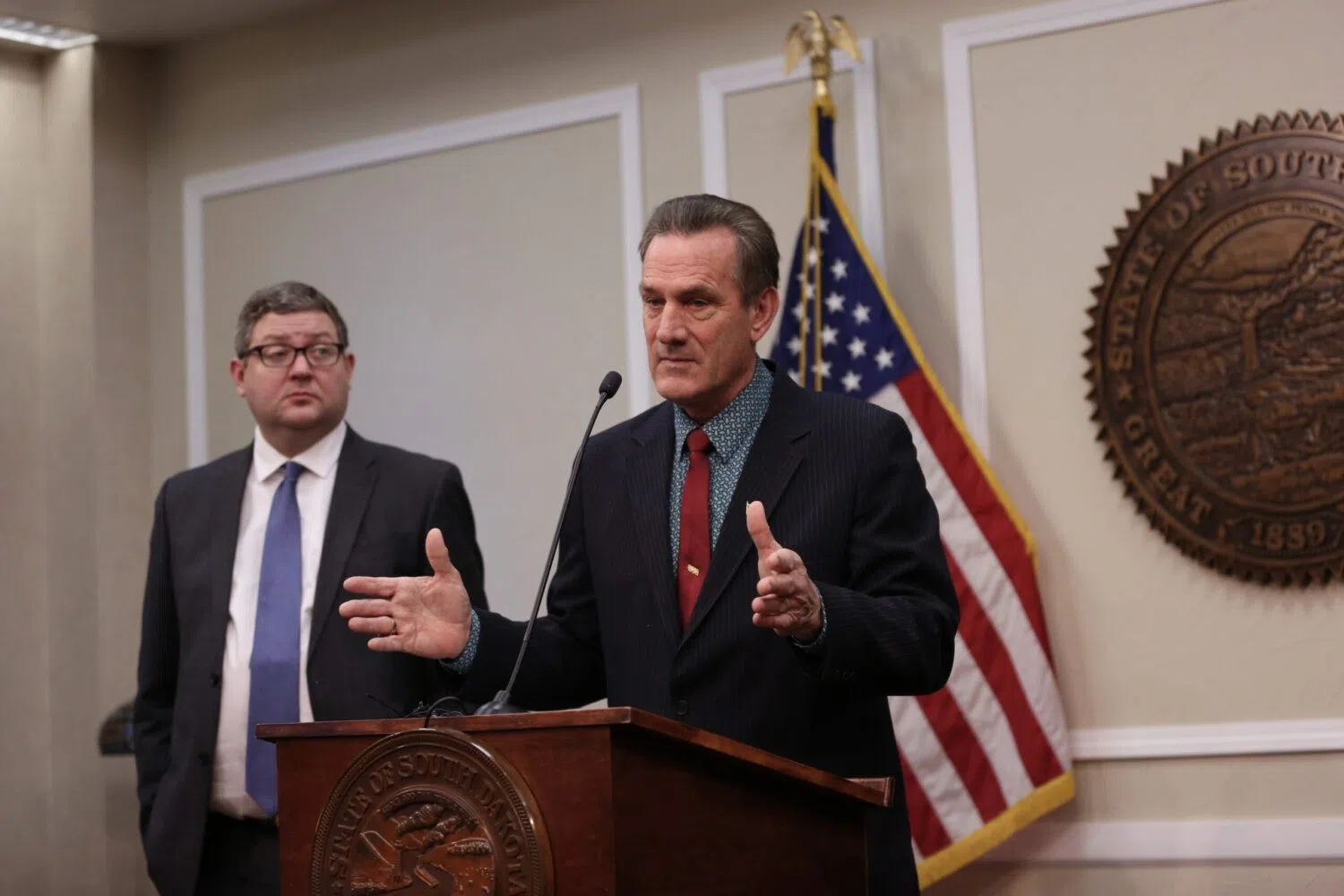
South Dakota Republican Gov. Larry Rhoden speaks during a press conference Feb. 6, 2025, at the Capitol in Pierre with Lt. Gov. Tony Venhuizen. (Seth Tupper/South Dakota Searchlight)
By: Meghan O’Brien
PIERRE, S.D. (South Dakota Searchlight) – A new page on South Dakota Republican Gov. Larry Rhoden’s website shows how much homeowners would save on property taxes if lawmakers approve his optional half-percent sales tax for counties.
He didn’t say, though, how much more the average person would spend on sales taxes.
Bureau of Finance and Management Commissioner Jim Terwilliger took a shot at answering a question about that Thursday from South Dakota Searchlight.
In his personal situation, with a four-person family, Terwilliger figured he would spend an additional $160 in sales taxes each year. He said the average property tax savings statewide would be about $660, netting approximately $500 in savings.
That’s if his county decides to enact a sales tax, the proceeds of which would have to be applied to homeowner property tax credits. Rhoden calls his plan a “targeted approach” for areas where property valuations have skyrocketed.
“The home values in a huge percentage of the state were really unaffected,” Rhoden said. “We’re not corrupting the system to fix a three-county problem or five-county problem. We’re giving the system a chance to readjust.”
The webpage shows that homeowners in Minnehaha and Pennington, the state’s two most populous counties, would save an estimated average of $927 and $886 in property taxes, respectively.
Some lawmakers worry about the approach.
“I think the challenge with that bill is that not every county is going to need tax relief for residential purposes,” said Rep. Erik Muckey, D-Sioux Falls. “There are certain parts of South Dakota where tax relief might be necessary for other types of property, commercial or agricultural.”
The bill says sales tax collections in excess of what’s needed to offset owner-occupied property taxes would have to be used to reduce property taxes for agricultural and commercial property.
Muckey was part of a bipartisan effort for property tax relief that failed in the House earlier this week. That bill would have raised the state sales tax rate to pay for property tax relief and funding increases for state employees, schools and Medicaid providers. Muckey tried unsuccessfully to include a provision that would have eliminated state sales taxes on groceries.
House Majority Leader Scott Odenbach, R-Spearfish, has a bill moving through the Legislature that would use the eight-year market average, throwing out the high and low numbers, to set taxable values for individual properties with a goal of moderating spikes in valuations and taxes.
He said the governor’s plan might not be the last effort for tax relief, although many other bills have been defeated. Those ideas could come back later as amendments to other bills during the two remaining weeks of the legislative session.
“The ways to cut property taxes really either means you are going to cut spending,” Odenbach said, “or you find different sources of revenue to offset. Is it sales tax?”
The state currently has a 4.2% sales tax, the 36th highest sales tax rate in the country. The rate is scheduled to return to 4.5% next year, after the 2023 state Legislature temporarily reduced it.
Counties are not currently allowed to impose a sales tax. They rely on property taxes, as do public schools. Cities receive revenue from property taxes and sales taxes. The state is reliant on sales taxes. In addition to the state sales tax, cities can charge up to 2%, and another 1% on alcohol, restaurants, lodging and event tickets.



Comments