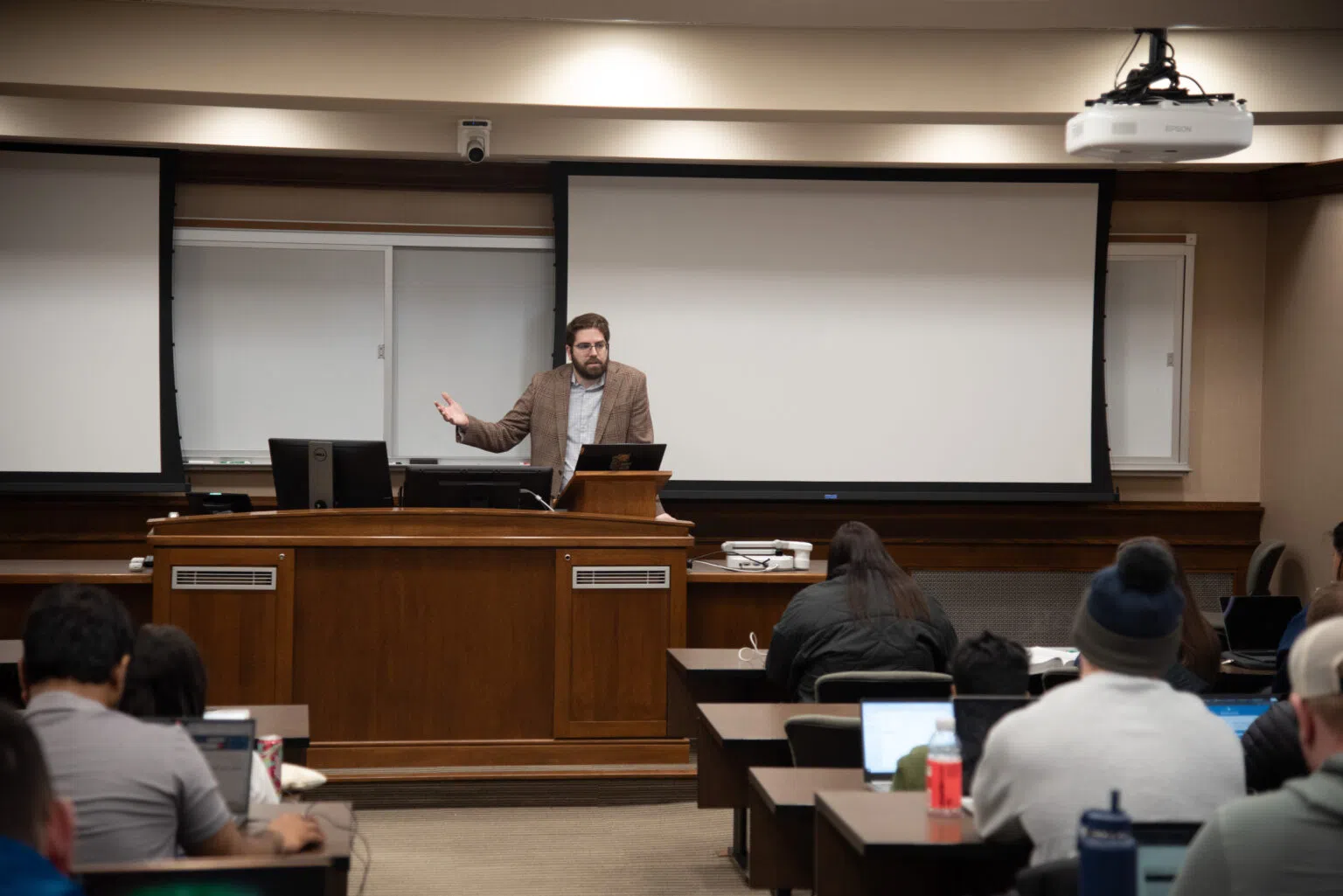
Erick Resek, director of the University of North Dakota’s new Immigration Law Clinic, teaches students on Feb. 23, 2026. (Photo courtesy of University of North Dakota School of Law)
By: Mary Steurer
GRAND FORKS, N.D. (North Dakota Monitor) – North Dakota lawmakers funded a law school clinic to help bring foreign workers to North Dakota, but the program has had to pivot amid federal restrictions on work visas.
The new service, housed at the University of North Dakota, was created partly to address the state’s chronic labor shortage. North Dakota as of December had roughly 47 available workers for every 100 open jobs, according to data from the U.S. Chamber of Commerce — the second-lowest rate of any state.
Many North Dakota businesses are interested in filling open positions by hiring foreign workers on visas, but applying for them can be cumbersome. Hiring a private lawyer can be expensive, and there are only a few full-time immigration attorneys in the state.
Lawmakers thought the clinic could help a lot of workers through that process, said Rep. Mark Sanford, who sponsored the 2025 legislation that created the program.
“It just seems logical to assist somebody who would want to come here,” the Grand Forks Republican said.
But since it opened in the fall, the University of North Dakota’s Immigration Law Clinic has received very few inquiries about employment visas, said Director Erick Resek. He said this is likely due to recent changes to federal immigration policy, including the new $100,000 filing fee for H-1B visas for skilled workers.
The program has instead focused on providing other legal services that help immigrants already in North Dakota enter the workforce, Resek said.
Cristina Menendez, a third-year law student in the clinic, said her clients include two Venezuelan nationals seeking asylum and an immigrant seeking protection under the federal Violence Against Women Act.
Menendez, whose family came to the U.S. from Cuba, has firsthand experience with the U.S. immigration system. She said one of the most rewarding aspects of working at the clinic has been helping break down communication barriers for Spanish-speaking clients.
“It’s very hard to find someone up here that can speak fluent Spanish and understand it,” Menendez said.
She said she hopes to one day open her own immigration law practice in North Dakota.
Changes to the U.S. immigration policy under the Trump administration have presented unique challenges to the clinic, said RJ Tare, another third-year law student in the program.
“It’s been an adventure of unpredictability,” he said. “Every day feels like, quite frankly, a new hurdle.”
He said several clients have been arrested by U.S. Immigration and Customs Enforcement, including asylum seekers.
“They’re trying to get a work permit, they’re trying to build a life here,” Tare, who immigrated to the U.S. from the Philippines, said. “It’s really disheartening.”
The clinic has provided roughly 200 consultations and taken 20 clients, by Resek’s estimate. He said the service has had to turn down most clients because there was no way to put them on a path toward employment, so they didn’t fall under the purview of the program set in state law.
“Every case I’ve taken on at the clinic, I’ve only taken it on if there was a possibility of getting someone employment authorization,” he said.
Resek said he and his students focus their resources on people who are “truly indigent,” and they don’t take on clients who have committed serious crimes.
The Legislature has only approved two years’ worth of funding for the clinic. Lawmakers during the 2027 session will have to decide whether to continue the program.
The clinic received $400,000 for the 2025-2027 budget cycle.
Sanford said given the unexpected circumstances facing the program, next year’s Legislature may consider changing the scope of its work.
“That is a fairly normal part of the process of legislation, that many times you have to come back and make an adjustment,” Sanford said.
Impacts to work visas
The federal government in September made H-1B visas — which are meant for skilled workers like nurses — much more difficult to obtain by raising the application fee to $100,000. Previously, each application cost between $2,000 and $5,000.
“No employer is gonna pay $100,000 per worker,” Resek said.
Resek also noted the federal government has paused immigration visas for 75 countries. Of those, 19 are subject to complete visa bans.
It’s unclear from available federal data how these policies are impacting the use of work visas in North Dakota. The most recent statistics published by the U.S. Immigration and Citizenship Services are from Dec. 31.
As of Dec. 31, the federal government had approved 47 H-1B visas for North Dakota employers during the 2026 federal fiscal year, which started Oct. 1. The biggest visa sponsors were North Dakota State University and the University of North Dakota. Last year, K-12 schools were also another leading employer of H-1B workers in the state.
The federal government approved 358 H-1B visas for North Dakota employers during the previous fiscal year, according to the agency’s website.
Phil Davis, workforce services director for Job Service North Dakota, said he hasn’t seen any decreased demand for H-2A visas, which are for seasonal agricultural workers.
“Every year, we have seen a 15% to 20% increase in the usage of this program across the state,” he said.
According to U.S. Immigration and Citizenship Services data, there were 109 new H-2A visas approved last year between Oct. 1 and Dec. 31 for North Dakota employers. Between Oct. 1, 2024, and Sept. 30, 2025, the federal government approved 1,517 new H-2A visas for North Dakota employers.




Comments