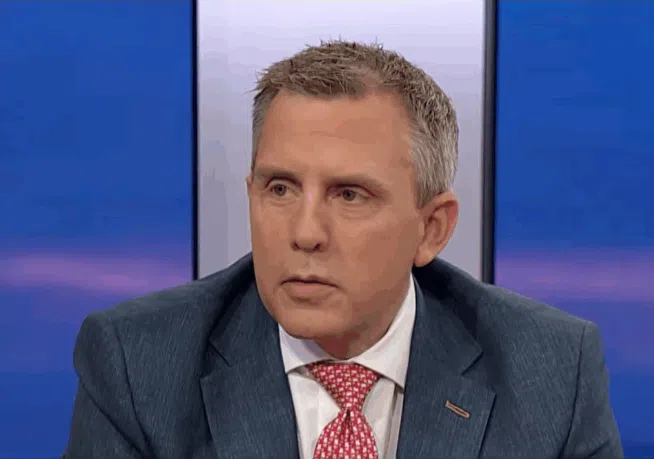
North Dakota Gov. Kelly Armstrong appears on “Ceasefire,” a weekly C-SPAN television program, alongside Gov. Matt Meyer, D-Delaware, on Feb. 20, 2026. (Screenshot from C-SPAN)
BISMARCK, N.D. (North Dakota Monitor) – North Dakota Gov. Kelly Armstrong joined other governors from around the country Saturday in calling for Congress to cement energy permitting reform in federal law.
The governors, who spoke during a meeting of the National Governors Association in Washington, D.C., represented states with varying energy preferences, from wind and solar to natural gas and coal. They all agreed that permitting those projects at the federal level needs to happen quicker, more efficiently, and not be in danger of cancellation with the election of a new president.
“We should figure out how we codify that,” Armstrong, a Republican and former member of Congress, said during a panel with the governors of Alaska, West Virginia and the Virgin Islands. “If you don’t make it energy agnostic, it doesn’t matter what project you have. They all take longer to build than four years or eight years.”
The Keystone XL pipeline, which would have transported crude oil from Canada to the United States, was canceled by President Joe Biden in 2021. President Donald Trump, during the first year of his second term, has halted permitting or frozen federal grants for several renewable energy projects.
The governors want Congress to codify permitting reform that will prevent those pendulum swings.
“Everybody craves predictability and certainty,” said Gov. Patrick Morrisey, R-West Virginia.
Creating a more efficient permitting process for all energy sources could help attract investment dollars to projects that could be canceled by the future presidential administrations, the panelists said.
“In order to have a long-term horizon for investors, you’ve got to have that long term certainty that the next election won’t whipsaw back,” said Alaska Gov. Mike Dunleavy, a Republican.
Dunleavy said his state has seen a stark difference in approaches under Trump compared to Biden. He wants to ensure those changes aren’t temporary.
“The gains that we’re making, they have to be codified into law by Congress,” he said. “We want to make sure that this is not a one and done.”
Doug Burgum, secretary of the Department of the Interior and former North Dakota governor, introduced the panel, stressing the need for more efficient energy permitting to ensure the country can keep up with China in the “AI arms race.”
“While we are ahead in the software and the technology, they are ahead of us in the electric production. So that’s the threat we’re up against,” Burgum said.
The Trump administration views losing the AI arms race to be an “existential threat,” Burgum said.
Armstrong touted North Dakota’s cold and windy winter climate as a boon for companies considering the construction of data centers in the state. Data centers require a significant amount of electricity, and that climate helps reduce the facilities’ cooling costs.
But North Dakota’s executive emphasized the need to handle the addition of data centers to a state’s power grid carefully to minimize impacts on consumers.
“You have to be smart about it. That’s the first way you’re going to lose your own constituency, is if consumers see a high price increase you’re going to lose the ability to do that,” Armstrong said. “We’ve been lucky in North Dakota, and I think it’s just being smart, responsible growth.”
Immigration
Armstrong also appeared on C-SPAN’s weekly “Ceasefire” program alongside Delaware Gov. Matt Meyer.
Federal immigration enforcement has generated significant criticism across the country. Meyer, a Democrat, said Immigration and Customs Enforcement has lost all credibility in many communities due to the agency’s actions in Minneapolis. While Armstrong said he opposes federal overreach in many areas, he added immigration enforcement is not one of them.
“We’ve worked with them in North Dakota and our local law enforcement cooperates and we don’t have any of those issues,” Armstrong said. “You might not like the tactics, but federal immigration enforcement is a federal issue.”
North Dakota’s governor stopped short of a full endorsement of those tactics when asked if he supported federal law enforcement agents’ use of masks in public to prevent identification. Armstrong said transparency by law enforcement is “always a good idea.”
“I’ve always been skeptical of federal law enforcement since 2004 when I started as a criminal defense attorney,” he said.
He acknowledged companies hire illegal immigrants in “every state,” including North Dakota. On legal immigration, Armstrong said federal immigration law hasn’t been changed since 1986, but the process for approving visas for workers like farm labor, which North Dakota relies on, has become slower and more cumbersome.
“That’s what’s really frustrating,” Armstrong said.



Comments