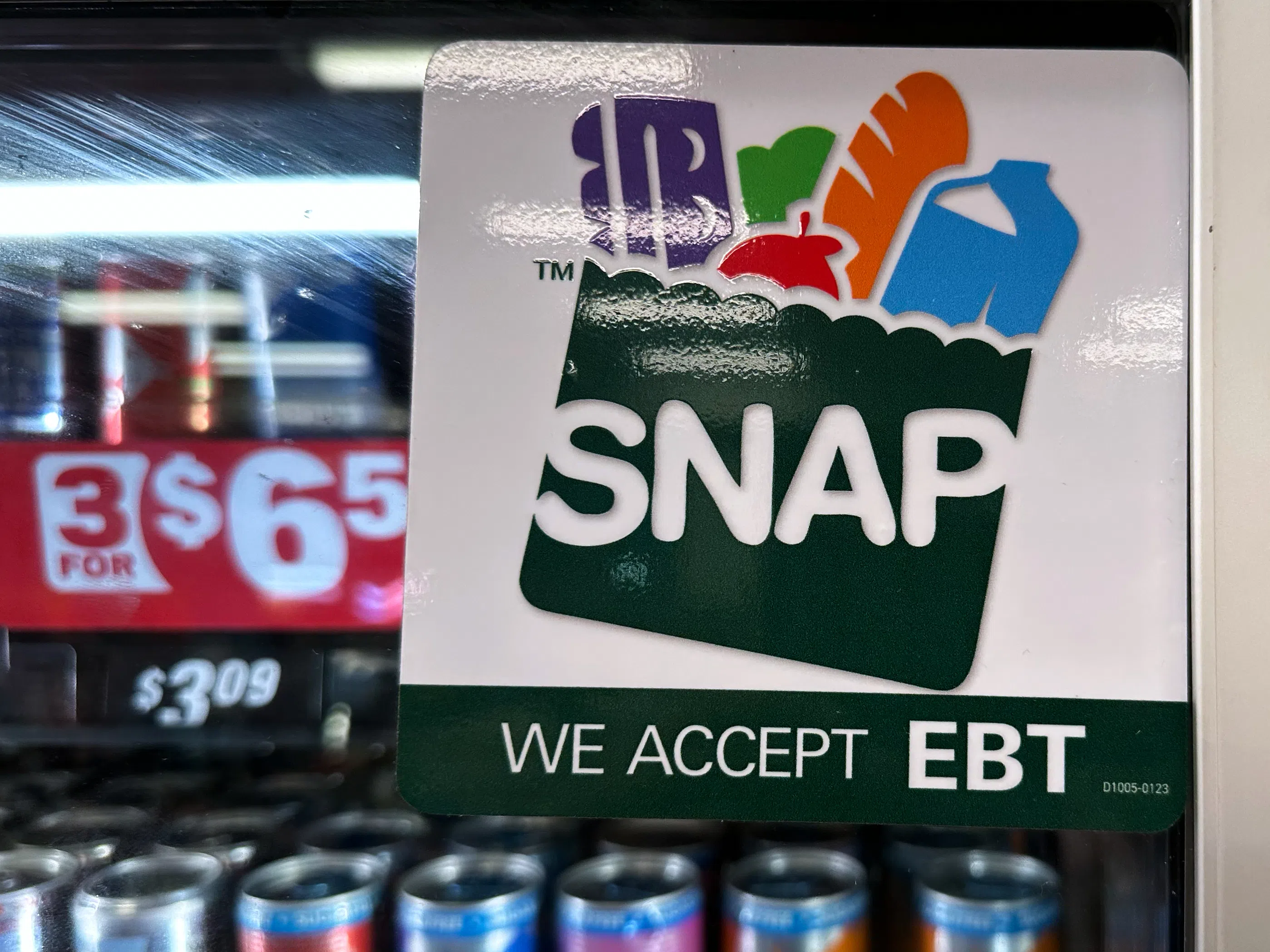
FILE - SNAP EBT information sign is displayed at a gas station in Riverwoods, Ill., Saturday, Nov. 1, 2025. (AP Photo/Nam Y. Huh, file)
By: John Hult
PIERRE, S.D. (South Dakota Searchlight) – Barring the use of food stamp benefits for soda purchases would cost South Dakota taxpayers $310,000 in the first two years, according to a fiscal impact statement released Thursday evening by the South Dakota Legislative Research Council.
The new restriction would cost the state about $248,000 a year after that — less than half what an adviser to Gov. Larry Rhoden said it might on Wednesday.
House Bill 1056, which earned the support of a Senate panel this week and the full House of Representatives the week before, would require the state to request a federal waiver allowing it to implement such a ban.
Opponents representing retailers, grocers, soda bottlers and Rhoden’s office testified against the bill in committees on both the House and Senate side.
Grocers and other retailers are concerned about the complexity of sorting sellable from unsellable items in the Supplemental Nutrition Assistance Program, or SNAP, a program commonly referred to as food stamps that lets income-eligible people buy most food items using dollars loaded monthly onto cards that function like debit cards.
Nathan Sanderson of the South Dakota Retailers Association said the definition would be a constantly moving target, as thousands of new drink products are released every year, each carrying a unique UPC code used by retailers for inventory and tracking purposes.
In order for retailers to comply, Sanderson said, the state — and retailers — would need to have a complete exclusion list that adds new beverages as they come on the market.
“This is not like flipping a switch,” Sanderson said.
Dispute over potential price tag
Rhoden’s office is concerned about the administrative costs associated with creating and maintaining those classes of unsellable items for use as guidance by retailers.
Rhoden adviser Laura Ringling said the waiver requirement would cost too much, particularly in tight budget years.
“Implementing a waiver like this in South Dakota would cost nearly half a million dollars every single year,” Ringling said Wednesday during a hearing on the bill in the Senate Health and Human Services Committee.
The bill’s sponsor, Sioux Falls Republican Rep. Taylor Rehfeldt, responded that the state would save Medicaid dollars by reducing the need for medical care associated with soda consumption-related problems like diabetes, obesity and tooth decay.
Rehfeldt also disputed the assertion of a heavy budget impact.
“States pursuing similar waivers that have had no or minimal cost include Nebraska, Oklahoma, Iowa, West Virginia, Texas and Idaho,” Rehfeldt told the committee.
Sen. Kevin Jensen, R- Canton, chairs the Senate’s health committee. He was in the majority when the committee voted 5-2 Wednesday to recommend Senate passage of HB 1056, but said a vote on the Senate floor would need to wait for a fiscal impact statement.
Initial, ongoing costs
That fiscal statement was posted Thursday.
It says the Department of Social Services would need to decide which drinks are or aren’t banned, and if HB 1056 becomes law, that the department “would field questions from retailers as to exceptions and ensure state exclusions are enforced.”
The bill defines a soft drink as “a nonalcoholic beverage that contains natural or artificial sweeteners.” Milk or milk products, rice, soy or similar milk substitutes and juices approved by the Department of Health are exempt from that definition.
Six social services employees administer the SNAP program now, the fiscal impact statement says. A seventh would be needed to deal with the waiver, at a cost of $80,600 a year including benefits. That employee would also be charged with the duty to track sales and report purchasing patterns, medical services needed, and other economic and health outcomes for SNAP recipients.
The state would need an ongoing contract with a software vendor to meet reporting obligations, the statement says, and a similar contract in Nebraska costs $250,000 a year. As with the new state employee, the federal government would cover a quarter of the cost of a vendor contract.
The program likely wouldn’t be fully up and running until state fiscal year 2028, which will begin on July 1, 2027. The first fiscal year cost, the statement said, would only include the price of the new state employee as a result.
The full ongoing annual cost for the soda ban would be $330,600, the statement says, with the state’s share being $247,950.
On Friday, Rhoden spokeswoman Josie Harms said the administration’s higher cost estimates are based on an assumption that the state would need three additional employees to coordinate with retailers and are “informed by conversations with neighboring states.”
With its fiscal note complete, HB 1056 now awaits a vote in the full state Senate. If it passes, it would be up to Gov. Larry Rhoden to sign the bill or veto it.
Rhoden said that he has “no issues with redefining whether or not soft drinks should be part of the SNAP program” during his weekly legislative press conference last week. But he said the state should not have to shoulder the costs.
“Why would we as a state take on responsibility that costs hundreds of thousands of dollars to the state to administer a federal program?” Rhoden said.
Congress should enact a nationwide policy, he added, rather than forcing states to request individual waivers.
If the bill passes the Senate and Rhoden vetoes it, a two-thirds majority vote in both chambers would be needed to override him.



Comments