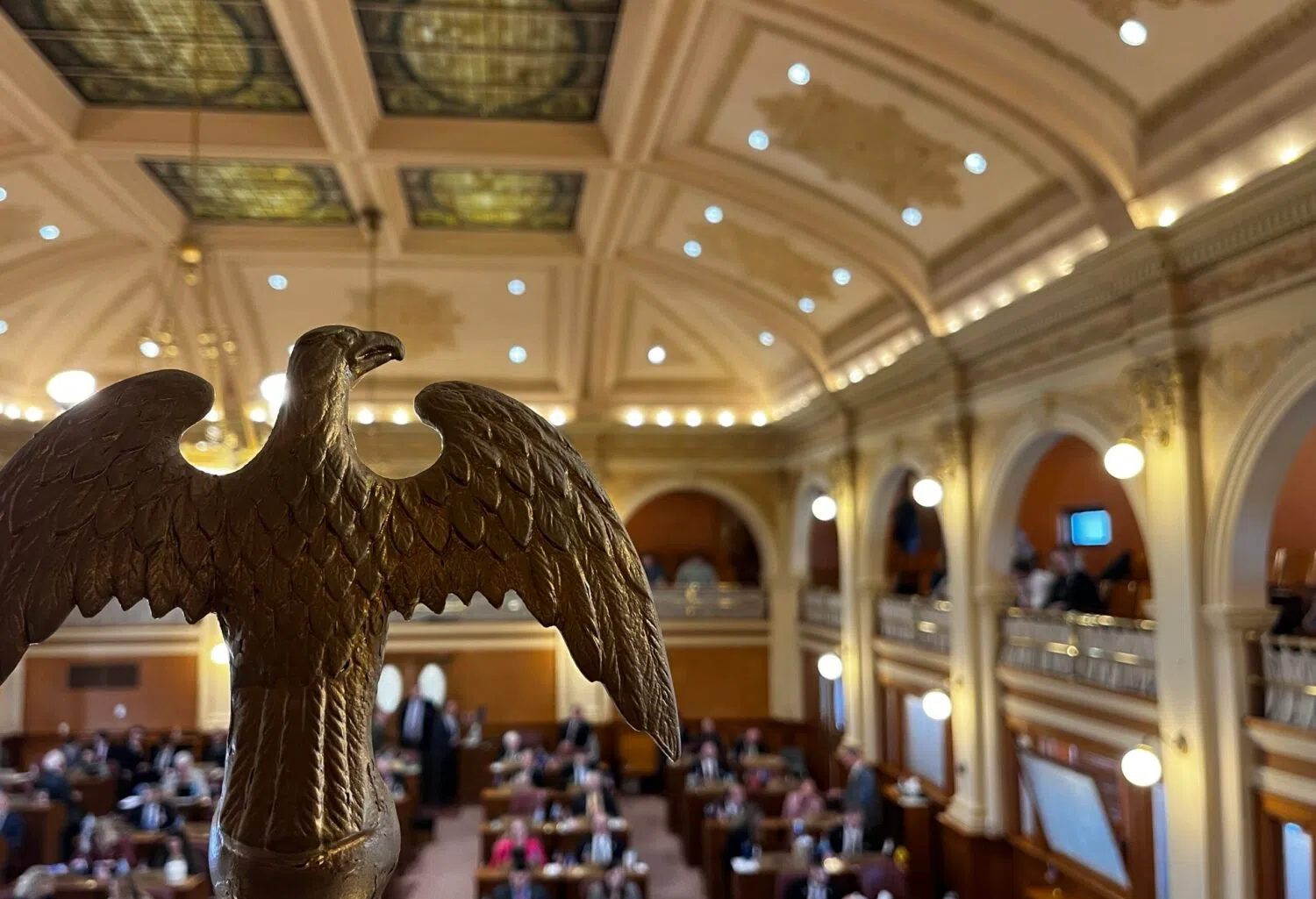
The South Dakota House of Representatives chamber at the Capitol in Pierre. (Joshua Haiar/South Dakota Searchlight)
By: John Hult
PIERRE, S.D. (South Dakota Searchlight) – A bill that would bar the practice of jailing people who can’t afford to pay sobriety program fees sailed through a South Dakota House of Representatives panel Monday morning at the Capitol in Pierre.
All 12 members of the House Judiciary Committee present for the meeting — including some lawmakers who’d opposed an earlier effort to ban the practice — endorsed House Bill 1176.
The 24-7 sobriety program lets people charged for alcohol- or drug-related offenses, often repeat drunken driving, leave jail as they await trial on the condition they submit to and pay for frequent testing to prove their sobriety.
Those who fail a test can be immediately jailed, after which they can see a judge to request another chance on the program.
It’s unconstitutional to jail people for debt in the U.S. The former state attorney general who pioneered the 24-7 program told South Dakota Searchlight in December that he always instructed the sheriffs who operate it not to incarcerate participants for failure to pay, based on those constitutional concerns.
But some participants have been jailed for nonpayment alone.
Last year, a group of them signed a settlement with Pennington County to settle a lawsuit over the practice. The county agreed to pay the primary defendant, Ricky Lee Lookingback, $10,000 in damages, and to pay $1,000 apiece to another 37 people who’d been jailed for their inability to pay.
The settlement dictates that no one can be jailed or threatened with jail time for an inability to pay. A federal judge has yet to approve the final settlement, but Lookingback, the lawyer for the class, and the county have all signed the agreement.
A South Dakota Searchlight story on the settlement inspired Rep. Peri Pourier to file the bill. The Rapid City Republican said reading the story reminded her that the issue isn’t new to the Legislature.
In 2022, a bill to bar detainment for an inability to pay cleared the House of Representatives and the Senate Judiciary Committee, but failed by one vote in the Senate.
“I took the bill that went through in 2022 and introduced it” with some final revisions from the state’s Legislative Research Council, she said.
This year’s bill aligns state law “with clear U.S. Supreme Court precedent that prohibits jailing people solely because they are poor,” Pourier said.
Her bill specifies that “no defendant may be jailed, nor a defendant’s bond or pre-trial release revoked, for failure to pay the costs and expenses of the program, unless the court finds the defendant has the present and continued ability to pay the costs and expenses of the program.”
In practice, a judge would need to hold a hearing to determine if a participant has the means to pay program fees and willfully refused to do so before jailing a person who shows up sober for testing and does not pay. The unpaid fees could be logged for payment at a later date.
Representatives for South Dakota defense attorneys and trial lawyers, as well as a lobbyist for the South Dakota Network Against Family Violence and Sexual Assault, testified in support of the bill.
In 2022, several opponents from law enforcement, including representatives from the Attorney General’s Office, testified against the change. Pourier’s bill received no opposition testimony Monday.
“I think these court cases have significantly changed the way that the 24-7 program operates in the state of South Dakota,” said Rep. Mary Fitzgerald, R-Saint Onge, who voted against the 2022 version of the bill. “I guess this will just put into statute what the state is already doing now, after these court decisions.”
Rep. Will Mortenson, R-Fort Pierre, also voted against the 2022 bill. On Monday, he said he’d reviewed Supreme Court cases on the issue of jailing the indigent and took note of who wasn’t present for Monday’s hearing.
“I didn’t hear the attorney general in here saying, ‘No, no, you’re reading it wrong, this is going to let people walk easier.’ I didn’t hear the state’s attorneys in here saying, ‘don’t do this,’ and I didn’t hear the sheriffs in here saying, ‘don’t do this,’” Mortenson said.
After the committee vote, Chairman Mike Stevens, a Yankton Republican, certified the legislation for inclusion on the House of Representatives consent calendar. The House votes on such bills in bulk and only debates them if a member requests a discussion.




Comments