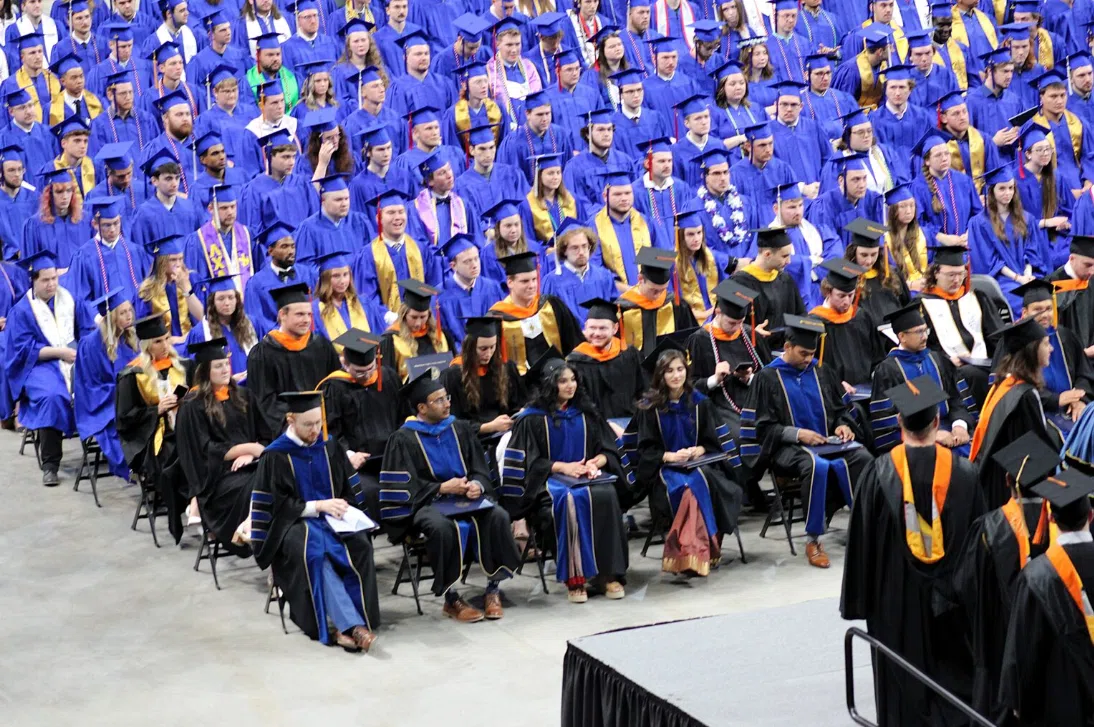
Graduates are gathered for a commencement ceremony at South Dakota Mines on May 10, 2025, in Rapid City. (Photo by Seth Tupper/South Dakota Searchlight)
RAPID CITY, S.D. (South Dakota Searchlight) – International students face plenty of questions amid federal immigration policy changes, said Beth Riley, director of South Dakota Mines’ Ivanhoe International Center.
Should they risk going home to see family, or will they be barred from returning? Will they be able to secure internships or jobs in the United States after their education?
“Some are worried that they will not be able to get their degrees,” Riley said. “This includes current students. They are worried that all the hard work and money they have spent will go to waste.”
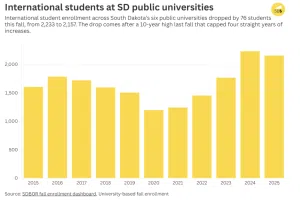
Despite those concerns, international student enrollment increased by 23 students this fall at South Dakota Mines, a public university in Rapid City. But the overall enrollment of international students across South Dakota’s six public universities dropped by 76 students, from 2,233 to 2,157. The drop comes after a 10-year high last fall that capped four straight years of increases.
The largest drops in international student enrollment this fall were at South Dakota State University and the University of South Dakota — with 35 and 94 fewer international students, respectively.
 An immigration crackdown by President Donald Trump’s administration has made it harder for international students to enter, stay and work in the country. The U.S. Department of Homeland Security, led by former South Dakota Gov. Kristi Noem, tried to deport a South Dakota Mines graduate student from India, Priya Saxena, earlier this year because of a four-year-old misdemeanor traffic violation. Saxena filed a lawsuit and convinced a federal judge to let her stay in the country and graduate.
Trump paused all immigration applications earlier this month from 19 countries the president had listed for restricted travel into the United States, a move that freezes processing for green card holders and citizenship applications. The action came after an Afghan national who was granted asylum shot and killed a National Guard member in Washington, D.C.
The Trump administration is also reportedly considering the elimination a policy that allows recent foreign graduates to work in the United States. Optional Practical Training, or OPT, allows graduates to stay for a year. Some students in science, engineering and related fields can stay for up to three years.
South Dakota fares better than the rest of the U.S.
Last year’s international student enrollment record in South Dakota was a “bright spot” compared to other states, said Rachel Banks, senior director for public policy and legislative strategy with NAFSA: Association of International Educators, formerly the National Association of Foreign Student Advisers.
“South Dakota was on an upward trajectory,” Banks said.
The roughly 3% drop in the state this fall was less than the national 17% drop in international student enrollment.
“We weren’t entirely shocked by that, given everything that happened leading up to the fall — spring visa revocations and recommendations the administration rolled out — that have a chilling effect on enrollment,” Banks said, adding that the Trump administration’s policy changes “send out a rather negative, unwelcoming message for international students.” .
The national drop in international student enrollment could result in canceled courses, Banks said, if there aren’t enough students to fill classrooms or graduate students to teach the courses.
Students’ experiences vary
Zhongfang Yuan traveled from China to the United States to study electrical engineering this fall. After the 30-year-old saw changes the Trump administration was implementing in the spring, he rushed to apply for a visa and attend South Dakota Mines.
It was surprisingly smooth, he said, only taking a few days before his visa was approved after applying in April. But it wasn’t the same for others.
A month after he applied, the Trump administration temporarily paused and then revamped the student visa interview process and brought more scrutiny to the vetting system. That led to long delays and meant many accepted students couldn’t get appointments at embassies or consulates in time for the start of the fall semester.
A friend of his, who also attends South Dakota Mines, applied for a visa weeks later and endured a longer, more stressful process.
International students impact SD economically, culturally
Kirsten Linke is the director of international student and scholar services at SDSU. Most international students pursue degrees in science, technology, engineering or math, often because they can work in the United States longer with a specialized visa extension, Linke said. That can be more appealing to potential employers.
South Dakota Mines and Dakota State University, the two public universities specializing in STEM fields, reported increased international student enrollment this year.
International students contribute to research and economic development across the state, Riley said. The students, at public and private schools, contributed $67.1 million across South Dakota during the 2024-2025 academic year, according to a report from NAFSA.
International students also increase cultural awareness among the student body on campus, Linke said. They present different worldviews, and they help other students understand how local or national issues work on a global scale.
U.S. immigration policy changes come at the same time other countries are implementing policies to attract international students. Canada, the United Kingdom, Australia and Germany have expanded post-study work rights, streamlined visa processes, and invested heavily in global education marketing, Riley said.
“As these destinations become more attractive, the United States risks losing market share in international education and, with it, a significant source of research capacity, workforce development, and long-term economic competitiveness,” Riley said.
Senator from SD supports bill to ‘Keep STEM Talent’
The United States doesn’t offer a direct path to permanent residency or citizenship for international students like other countries, Banks said — something U.S. Sen. Mike Rounds, R-South Dakota, hopes to remedy as a cosponsor of the Keep STEM Talent Act. It would offer a direct path to a green card for international students.
STEM graduate students attending U.S. universities would be able to retain their student visa status if they’re sponsored by an employer for a green card, which they can’t do currently. The graduates, along with their spouse and children, would also be exempt from employment-based green card caps if they have a job offer in the country.
“Particularly with the advancements of artificial intelligence and cybersecurity,” Rounds said in a press release, “we must keep talent in the United States and stay ahead of our near peer competitors such as China and Russia.”
The bill also includes more stringent vetting requirements and requires employers sponsoring foreign STEM graduates to recruit U.S. workers at above-average wages first.



Comments