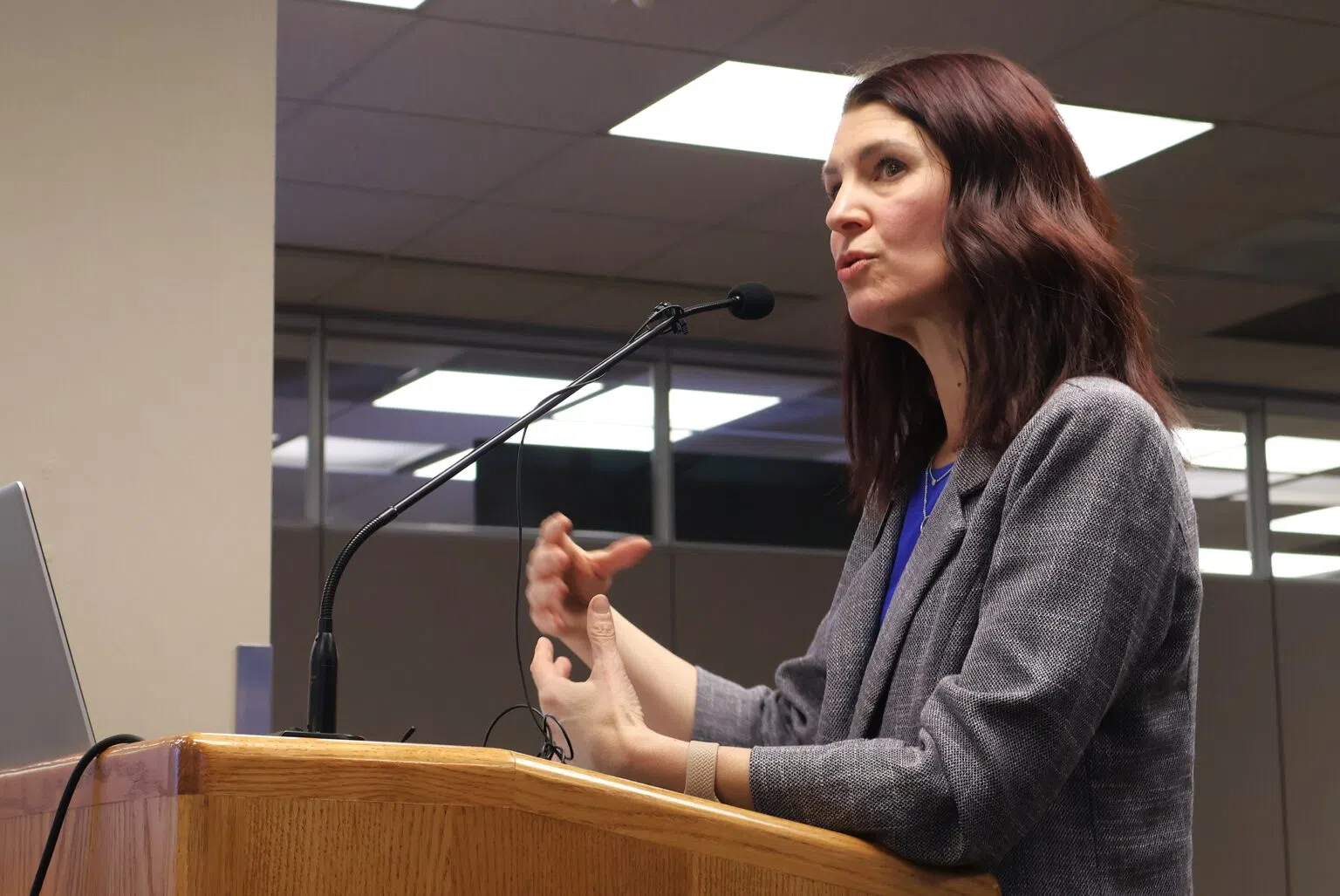
Lynelle Johnson, director of child nutrition and food distribution for the Department of Public Instruction, speaks about the cost of a free school meals program during a committee hearing on Dec. 10, 2025. (Photo by Michael Achterling/North Dakota Monitor)
BISMARCK, N.D. (North Dakota Monitor) – North Dakota legislators are preparing for the impact of a free school meals program that could be considered by voters next year.
But predicting how much it will cost the state is challenging, in part because it’s tough to know how many students would eat breakfast and lunch at school if meals are free, Lynelle Johnson, director of child nutrition and food distribution for the Department of Public Instruction, told lawmakers this week.
“We can’t predict future participation,” Johnson told members of the Budget Section Education and Environment Division.
Johnson previously estimated providing free school meals to North Dakota students would cost $140 million for two years. Since a ballot measure was proposed to put the issue to voters, Johnson looked at the numbers again and came up with a preliminary estimate of about $134 million for 2027-29.
She projects the state’s cost could grow by $6 million to $7 million every two years based on her initial estimates, though she told lawmakers she plans to continue refining her projections.
Rep. Mike Nathe, R-Bismarck, said he’s concerned about the potential growth of the program and the state’s responsibility to fund it.
“If this passes, we have to start figuring out how we’re going to do this,” Nathe said. “It’s a pretty sizable sum to do.”
The Together for School Meals coalition submitted a proposed petition to the North Dakota secretary of state on Nov. 26. The petition seeks to get an initiated measure on the ballot that proposes to add a section to the state constitution requiring all K-12 public schools to provide free breakfast and lunch to students. Private schools and tribal schools could opt in to the program.
About 66% of North Dakota students eat school lunch and about 31% eat breakfast at school, according to state estimates. Johnson expects more students to eat school meals if they are free, which is what the state saw during the COVID-19 pandemic when federal funding provided free school meals to all students.
North Dakota is reimbursed by the U.S. Department of Agriculture for meals provided to students who qualify for the federal free or reduced meal program. Last year, that amounted to more than $38 million, Johnson said.
Lawmakers expressed concerns that families will stop applying for the federal program, causing the state to miss out on the federal support.
“If it passes, wouldn’t the mentality of the family be like, ‘Well, it’s free, why would I apply?’” asked Rep. Scott Louser, R-Minot.
About 26,000 students eligible for free or reduced meals automatically qualify because their families are eligible for other federal programs, Johnson said. The federal government would continue reimbursing the state for those students. However, changes to Medicaid and the Supplemental Nutrition and Assistance Program could reduce the number of students who automatically qualify, she said.
To combat a decrease in federal funding, the state could implement strategies to encourage families to apply, such as connecting the application to other benefits the students could receive, Johnson said.
The proposed language for the ballot measure requires schools to maximize federal reimbursement and encourage families to apply for the federal program.
Another unknown is whether additional schools will participate in the National School Lunch Program if meals are free, Johnson said. Twenty-five private schools in the state participate now, with about 730 students who qualify for free or reduced meals, according to Department of Public Instruction figures. A few more private schools participated in the meal program during the pandemic when meals were free for all students, Johnson said.
Lawmakers asked Johnson to do additional research, including studying what happened in states that have already adopted universal free meals.
“There’s a lot of things we don’t know about that could really add to the tab on this thing for the state,” Nathe said.
Nick Archuleta, president of ND United, a union representing educators and public employees, said he was happy the Legislature is doing its due diligence on an important issue facing students and families.
Teachers support students being fed during the school day because it helps those students succeed, Archuleta said.
“I think anybody who has been in a classroom with a child that is ‘hangry’ understands that it’s very difficult for those kids to focus on the work in front of them when their stomachs are growling,” he said.
The North Dakota Legislature in 2023 approved $6 million in state funding to expand who qualifies for free meals up to a certain household income level. About half of that funding was used in the 2023-25 budget cycle.
Some lawmakers have questioned why more students didn’t eat free meals under the state program. Johnson told the North Dakota Monitor the $6 million was based on an estimate of how many students would qualify, which was difficult to pin down accurately.
“We don’t know how much money people are going to make,” Johnson said. “So it was an estimate of how many students we thought would qualify.”
Earlier this year, lawmakers rejected proposals to fund free school meals for all students. They did vote to expand the state program by changing the income requirements. Now a family of four earning up to $72,000 a year can qualify for free meals. The Department of Public Instruction estimates that nearly 3,000 students qualify under that program, up from last year’s total of about 1,800. The funding remains at $6 million for the two-year budget cycle.
The secretary of state approved the ballot measure petition title and returned it to the sponsoring committee to finalize by Dec. 26, said Sandy McMerty, deputy secretary of state. Once the petition is approved, the committee can begin gathering signatures. To be included in the general election ballot in November, the sponsoring committee would need to submit 31,164 verifiable signatures by July 6.



Comments