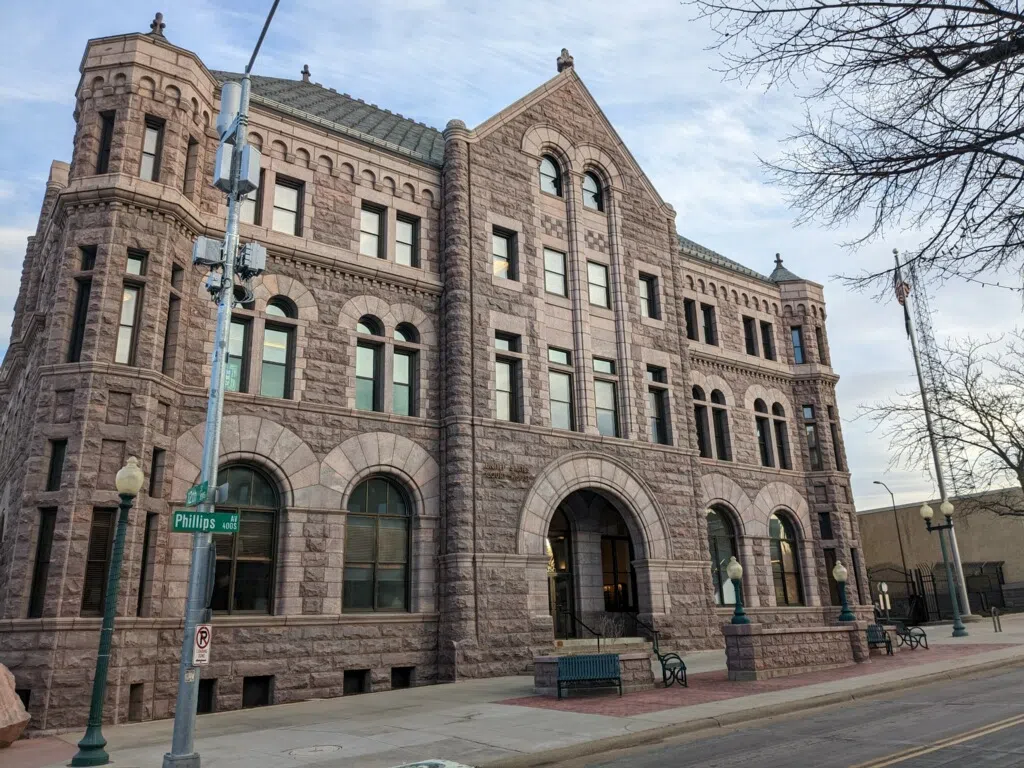
The federal courthouse in Sioux Falls. (John Hult/South Dakota Searchlight)
By: John Hult
SIOUX FALLS, S.D. (South Dakota Searchlight) — A federal judge on Wednesday granted a University of South Dakota professor’s request for a temporary restraining order, which means the university has to reinstate him for the time being and pause its effort to fire him for his social media post about the killing of Charlie Kirk.
More than 40 people showed up at a federal courthouse for a hearing on the professor’s motion. Speaking with that crowd surrounding him, and with U.S. District Judge Karen Schreier in front of him, Phillip Michael Hook’s lawyer said Hook ought to be immediately reinstated as an art professor at the university, and that the Board of Regents — which oversees the state’s public universities — should not be allowed to proceed with a Monday disciplinary hearing that could end with his termination.
Some in the audience walked into the courthouse with Hook, with whom they’d been speaking outside the courthouse in downtown Sioux Falls shortly before the hearing. Rick Weiland, a Sioux Falls activist known for his campaigns for progressive ballot measures, was among those in attendance.
A public sector employee “doesn’t forfeit the right to free speech because they happen to be a public employee,” Rapid City lawyer Jim Leach said.
Kirk, a conservative political activist and commentator, was killed Sept. 10. That same day, Hook wrote a Facebook post that used a derogatory term to describe Kirk and questioned the veracity of his supporters’ “concerns” about political violence. The Facebook page was his personal account, but noted his status as a USD professor. He deleted the post within three hours, Leach said.
South Dakota Speaker of the House Jon Hansen called for Hook’s dismissal, as did the Legislature’s Freedom Caucus. Republican Gov. Larry Rhoden said he was “shaking mad” about Hook’s post.
Hook was suspended on Sept. 12 and served a notice of his pending termination.
He was suspended because he angered powerful people in South Dakota with commentary on a “matter of public concern,” Leach said.
“Yet here, we have the government, at the highest level, punishing Professor Hook for his political speech,” he added, arguing that Speaker Hansen’s communications with USD President Sheila Gestring appeared to be all it took to set the wheels of termination in motion.
Court precedent says a public employee can be fired for speech, Leach said, but there must be evidence that the speech was disruptive to the employer. In Hook’s case, Leach said, there’s no evidence in the record — including in the termination notice — that it was.
Instead, he argued, the termination notice was an unconstitutional violation of Hook’s First Amendment rights and grounds for an immediate court order that would reinstate him and block the University of South Dakota from proceeding with its disciplinary action and barring retaliatory action.
Justin Bell, representing the Board of Regents, admitted there’s no evidence in the disciplinary or court record that Hook’s post was disruptive to the workplace. But Bell told Schreier that’s because the court record is barely more than 24 hours old. Hook filed his case on Tuesday.
Instead of immediately shutting down the Board of Regents, Bell argued, the judge should allow the case to proceed.
The post, Bell argued, generated “hundreds” of calls and emails to the school, and may have created disruption for students and faculty.
With comments “as insidious as Professor Hook’s, made in a capacity that mentions his status at the university, it’s reasonable to conclude that there’s going to be disruption” for his employer, Bell said.
To say Hook was fired because Speaker Hansen reached out to the school’s president, Bell said, downplays the impact the post had for the university in potentially alienating a yet-untallied number of students, alumni and faculty.
“All we know is that Speaker Hansen is one of the people who reached out,” Bell said.
The First Amendment, Bell argued, “does not protect speech of this nature.”
After the hearing, Judge Schreier filed a written order requiring the university and Board of Regents to temporarily set aside their decision to place Hook on administrative leave, and requiring them to reinstate him to his position at least until another court hearing on Oct. 8.
Schreier wrote that Hook qualified for a temporary restraining order because he had spoken as a citizen on a matter of public concern, which is a form of constitutionally protected speech. She also said the defendants had so far failed to produce evidence that Hook’s speech had an adverse impact on the efficiency of university operations.
Furthermore, Schreier wrote, Hook has a fair chance of prevailing in his lawsuit by showing that the actions taken against him were a form of retaliation that could chill protected speech.
At the Oct. 8 hearing, the judge will consider a longer-lasting order known as a preliminary injunction, which would keep Hook in his position at least for the duration of his lawsuit. Ultimately, Hook wants the judge to issue a permanent order that would bar the university from firing him for his social media post.



Comments