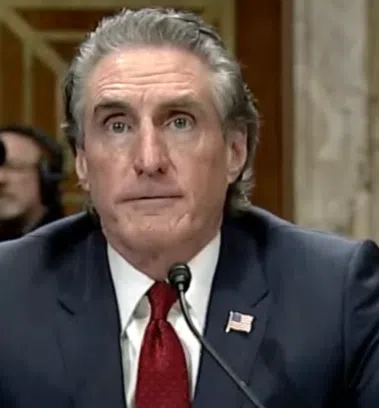
Interior Secretary Doug Burgum testifying
WASHINGTON, D.C. (North Dakota Monitor) – During Doug Burgum’s two terms as North Dakota governor, the state repeatedly sued the U.S. Department of the Interior, attempting to rip up rules that govern federal lands in his state and across the country.
Now, Burgum is poised to oversee that same department as President Donald Trump’s nominee for secretary of the interior. Those lawsuits and a host of others the state launched against the federal government, some of which are ongoing, reveal the worldview he’ll bring to a department that touches nearly every aspect of life in the West. Its agencies oversee water policy, operate the national parks, lease resources to industries including oil and ranching, provide services across Indian Country, and manage more land than any person or corporation in the nation.
During his confirmation hearing last week before the Senate Committee on Energy and Natural Resources, Burgum portrayed the Interior Department as key to geopolitical power struggles. On energy policy, he said that growing consistently available types of energy production — namely nuclear and climate-warming coal, oil, and gas — is a matter of national security; he claimed that greenhouse gas emissions can be mitigated with carbon capture technology that’s unproven at scale; and he argued that renewable energy is too highly subsidized and threatens the electrical grid.
The committee advanced his nomination to the full Senate on Thursday.
The North Dakota Monitor and ProPublica reviewed the nearly 40 lawsuits in which the state was a named plaintiff against the federal government when Burgum left the governor’s office. In addition, the review included a friend of the court briefs the state filed to the Supreme Court and Burgum’s financial disclosures and public testimony. Many of the nearly 40 suits were cases North Dakota filed or signed onto with other Republican-led states, although the state brought a handful independently. Five of the cases were lodged against the Interior Department.
Burgum is a relatively political newcomer who initially made his fortune when he sold his software company. But the cases and disclosures highlight his deep ties to the oil and gas industry, which have aided his political rise. The records also put on display his sympathy for Western states that chafe at what they believe is overreach by the Interior Department and that attack federal land management.
Notably, the litigation includes a case aimed at undoing the Interior Department’s hallmark Public Lands Rule that designated the conservation of public lands as a use equal in importance to natural resource exploitation and made smaller changes such as clarifying how the government measures landscape health. Additionally, North Dakota filed a case to roll back the agency’s rule intended to limit the amount of methane that oil companies could release, a practice that wastes a valuable resource and contributes to climate change. North Dakota also cosigned a brief in support of a controversial, although ultimately futile, attempt by Utah to dismantle the broader federal public lands system.
Burgum is considered less controversial than some other Trump nominees and is expected to gain Senate approval in the days ahead. Outdoor recreation groups and multiple tribes publicly supported his nomination, and he was lauded at his confirmation hearing by Republican as well as some Democratic senators. “If anybody is the pick of the litter, it’s got to be this man,” said Sen. Jim Justice, a Republican of West Virginia, another key fossil fuel-producing state.
Conservation groups, meanwhile, decried Burgum as an anti-public lands zealot who does oil companies’ bidding. Among them is Michael Carroll, who runs the Wilderness Society’s Bureau of Land Management campaign.
While some of the cases mirror his party’s long-running push to support the oil and gas industry over other considerations, including conservation, the litigation over public lands represents a more extreme view: that federal regulation of much of the country’s land and water needs to be severely curtailed.
Burgum did not respond to requests for comment but made clear many of his positions in public statements. A spokesperson did not answer a question on whether Burgum would recuse himself from matters about the cases his state filed.
As Burgum takes the reins at the Interior Department, Monte Mills, director of the Native American Law Center at the University of Washington School of Law, said he is watching how Burgum will work with tribes that favor conservation over natural resource extraction.
It remains to be seen if keeping the federal government’s commitments to Indian Country is a priority for Burgum, Mills said, or whether tribal issues are “only really taken up where they align with other priorities of the administration.”
hile the state’s attorney general handled the lawsuits, Burgum emphatically supported them, urging state lawmakers last spring to fully fund the legal fights. He also cited the litigation during his confirmation hearing to assure Republican lawmakers that he would increase oil and gas leasing on public lands.
While speaking to North Dakota lawmakers about federal actions, Burgum characterized the Biden administration’s environmental policies as “misguided rules and regulations proposed often by overzealous bureaucrats.” The rules, he said, pose “an existential threat to the energy and ag sectors, our economy and our way of life.”
Burgum is considered less controversial than some other Trump nominees and is expected to gain Senate approval in the days ahead. Outdoor recreation groups and multiple tribes publicly supported his nomination, and he was lauded at his confirmation hearing by Republican as well as some Democratic senators. “If anybody is the pick of the litter, it’s got to be this man,” said Sen. Jim Justice, a Republican of West Virginia, another key fossil fuel-producing state.
Conservation groups, meanwhile, decried Burgum as an anti-public lands zealot who does oil companies’ bidding. Among them is Michael Carroll, who runs the Wilderness Society’s Bureau of Land Management campaign.




Comments