
From left, the Republican candidates for governor of South Dakota: U.S. Rep. Dusty Johnson, Gov. Larry Rhoden, Aberdeen businessman Toby Doeden, and state House Speaker Jon Hansen. (Photos by South Dakota Searchlight)
BROOKINGS, S.D. (South Dakota Searchlight) — Workers waving pompoms greeted South Dakota Republican Gov. Larry Rhoden during a recent celebration for a business expansion that benefited from $15 million in state tax rebates, two days after Republican primary candidates for governor debated the state’s role in economic development.
The event for Solventum, a Minnesota-based, publicly traded company that was formerly part of 3M, marked the completion of a $220 million expansion at Solventum’s Brookings facility. The plant employs about 1,200 people who produce health care supplies, including bandaging, dressings, wraps and tapes.
State economic development officials helped the project with $15 million from the Reinvestment Payment Program. The program rebated Solventum for sales and use taxes the company paid for equipment or construction costs associated with the expansion.
CEO, Rhoden offer praise
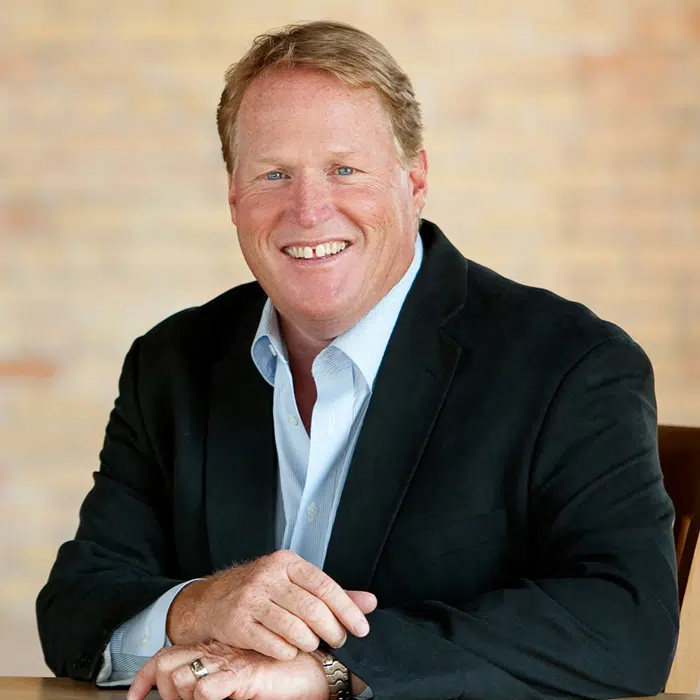
Solventum CEO Bryan Hanson attended the ribbon-cutting ceremony and praised the partnership his company has with the state and local governments. He said the company weighed other locations before choosing to expand in Brookings.
“You don’t spend hundreds of millions of dollars in a state that doesn’t embrace business,” Hanson said.
During the debate among the four Republican candidates for governor two days prior, Rhoden said such ribbon cuttings are evidence that South Dakota’s economy is doing well.
“Every week I’m going to ribbon cuttings and groundbreakings, and a lot of them were expansions or businesses that are moving here,” Rhoden said at the time.
Questions of economic development have been a balancing act for the Rhoden administration. Last year, he signed a bill into law that bans the use of eminent domain to gain land access for carbon sequestration pipelines, which stalled a proposed multi-billion-dollar pipeline that would pass through the state.
This year, Rhoden and his economic development team spent much of the recently concluded legislative session defending business incentives, such as the ones that benefited Solventum, as tools for growth. Several bills failed that would have restricted those tools.
The bills came from lawmakers who believe the state has gotten too involved with helping private businesses, or shouldn’t be involved at all.
Hansen: Current economic development model ‘unfair’
State House Speaker Jon Hansen, who is running for the Republican nomination for governor, has called the state’s economic development grants and loans “corporate welfare.”
Hansen said this week in a statement issued in response to South Dakota Searchlight questions that the difference between him and the other Republican candidates is that he opposes the state’s current economic development model. He said the model is run by state officials who use taxes collected from South Dakota businesses to “hand out the money to any big corporation of their choosing, including many who then donate back to future political campaigns.”
“I think this is unfair to our South Dakota businesses and entrepreneurs and, as we’ve seen, is a breeding ground for corruption and backroom deals,” he said.
Hansen has singled out state aid for the CJ Schwan’s company, which has benefited from $69 million in state grants and loans. One of the state officials who was involved in initial discussions with the company about its construction of a food production plant in Sioux Falls now works for the company as a vice president. Meanwhile, the chairman of the state Board of Economic Development, who abstained from matters related to CJ Schwan’s, is a member of the company’s corporate board and is involved with a corporation that rents office space to CJ Schwan’s.
Hansen, while not specifically saying whether he approved or disapproved of the Solventum aid, said he wants to focus on lower taxes, lighter regulation and a freer market to help South Dakota businesses grow on their own.
“If there are any programs that are salvageable, it will be those that are fairly available to every South Dakotan — not those massive tax giveaways where politicians and bureaucrats in Pierre pick their favored corporation to sometimes attract future political contributions,” Hansen said.
Johnson: State can do more to encourage prosperity
U.S. Rep. Dusty Johnson, another Republican candidate for governor, spoke favorably of state economic development tools in an interview with Searchlight.
“I believe South Dakota can be a great place to do business, and I’m glad these companies choose to invest in our state and our people,” he said of Solventum.
He said what’s at issue in the race for governor is not one specific economic development project, but “whether or not we’re doing everything we can to make the state more prosperous.” In conversations he’s had with businesspeople, he said, they’ve told him “we can do better.”
As evidence, Johnson cited CNBC’s 2025 ranking of the state as 35th in the nation for business.
Johnson said the state should do more for homegrown entrepreneurs, and his “Launch South Dakota” plan calls for a $2 million investment to support local business startups. The money would come from the governor-controlled Future Fund for economic development.
Doeden: State spending is ‘reckless’
Another Republican candidate for governor, Toby Doeden, issued a statement in response to Searchlight questions. While not saying whether he approved or disapproved of the Solventum aid, he criticized what he called “reckless spending” by the state, including on economic development.
“Instead of handing out massive taxpayer-funded subsidies to out-of-state corporations,” Doeden said, “we will use those funds to build out our rural health care and finally make meaningful improvements in our infrastructure.”
“We will support our homegrown small businesses and they will invest in their people and their communities,” Doeden added.
The primary election to determine the Republican nominee for governor is June 2. Announced candidates for the Democratic nomination for governor include Dan Ahlers, a former state legislator and executive director of the state Democratic Party, and Robert Arnold, a Dakota State University student who served as a legislative intern.



Comments