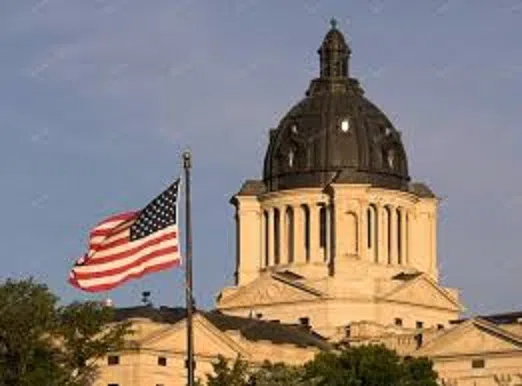
State Capitol in Pierre
PIERRE, S.D. (South Dakota Searchlight) – A new state law will require people to prove their citizenship when they register to vote in South Dakota state and local elections.
Republican Gov. Larry Rhoden signed the legislation Thursday. An emergency clause puts the law into effect immediately, before the June 2 primary election, rather than the usual July 1 effective date of new laws. The voter registration deadline for the primary election is May 18.
“In South Dakota, we do things right, especially when running our state elections,” Rhoden said in a news release. “This bill ensures only citizens vote in state elections, keeping our elections safe and secure.”
The legislation passed South Dakota’s Republican-dominated Legislature earlier this year by votes of 28-6 in the Senate and 64-3 in the House.
The South Dakota Democratic Party issued a news release Thursday condemning the new law, saying it will disenfranchise people who lack access to their birth certificate or a passport.
“This is exactly what voter suppression looks like,” the party said.
Samantha Chapman, the American Civil Liberties Union of South Dakota’s advocacy manager, said similar laws have had a chilling effect on legal voting in other states. When lawmakers adopt such a requirement, she said, “that is a government that’s actively trying to choose its own voters.”
No action required for those already registered
People already registered to vote don’t need to take any action. Nor do they need to provide proof of citizenship if they’re updating registration information like their address or political party affiliation. Someone who has changed their name and is already registered to vote also won’t need to provide proof of citizenship, according to the South Dakota Secretary of State’s Office.
New voters will be required to provide documentation of their U.S. citizenship. One of the acceptable forms of documentation is a driver’s license or nondriver identification card, if the card indicates the person is a citizen. Last year, South Dakota lawmakers adopted a law requiring driver’s licenses to reflect citizenship status.
Other acceptable forms of citizenship documentation for voter registration are a tribal ID or a legible photocopy of a birth certificate, U.S. passport, consular report of birth abroad from the U.S. Department of State, or a certificate of naturalization. Existing law also requires South Dakotans to show identification at the polls when they vote, such as a driver’s license or other approved ID.
The new law will prevent people from registering and voting on South Dakota state and local races and issues if they don’t prove their citizenship. But it allows those who fail to document their citizenship to register as a “federal voter,” eligible to vote only in presidential and congressional races.
Federal legislation, known as the SAVE Act, could change that. It would require voters to provide proof of citizenship to register for voting in federal elections. A version of the bill has passed the U.S. House, and the Senate is considering a version of the legislation while President Donald Trump demands its passage.
Opposing views from sponsor, opponent
Previously, when voters registered in South Dakota, they signed a form asserting their citizenship under the penalty of perjury. That “honor system” isn’t sufficient, said state Sen. John Carley, R-Piedmont, who sponsored the legislation.
“I think the average citizen really wants to make sure it’s just our citizens that are voting,” Carley said.

Carley also sponsored a bill adopted into law last year that clarifies a person must be a U.S. citizen to vote in South Dakota. The Legislature also voted last year to send a question to the ballot this November that will ask voters to put the same clarification in the state constitution.
The American Civil Liberties Union of South Dakota had called for Gov. Rhoden to veto the bill requiring proof of citizenship for registration. The organization said the law is “unnecessary” and “deeply harmful to the ability of South Dakotans to register to vote and participate in democracy.”
“It’s already illegal to vote in South Dakota if you’re not a U.S. citizen,” said Chapman.
People who have changed their name before registering to vote will need additional documentation to support their citizenship, Chapman said, and college students and elderly or low-income voters might not have easy access to their birth certificates or passports. The law could also impact people who have a limited time to register, she said.
“If you show up and you don’t have these documents, are you going to come back and register to vote with those documents?” Chapman said. “Every additional burden that we’re putting in place for people who are trying to simply participate in our democracy makes it less and less likely that they’ll be able to do so.”
‘A growing movement’ for verified citizenship status
South Dakota joins at least nine other states that require proof of citizenship for voter registration in some cases.
A similar law in Kansas has not been enforced since 2018 after federal courts declared it unconstitutional. It prevented more than 30,000 Kansans from voting and caused “a yearslong breakdown in communication and coordination between the DMV, the secretary of state, county election offices, and voters,” according to a report that analyzed the effects of the Kansas law.
Chapman suspects the results could be similar in South Dakota.
“We’re looking into everything that we can do to potentially ensure that all eligible voters can register to vote in South Dakota,” she said, “but our fear is absolutely that potentially we will see thousands of South Dakotans being shut out of the voting process.”
Carley said he isn’t worried about his law going the way of the Kansas law.
“It’s a growing movement across individual states, across the U.S., and the fact that it’s being discussed at the federal level also shows that,” Carley said. He said people want to be sure that voters are “those that are paying taxes, those that are living in America, those that followed the law to become citizens. I think people want that, and I don’t see any concern with a legal challenge on that.”
Another new law allows challenges to voters’ citizenship
Rhoden also approved a law earlier this year that allows voters to challenge another voter’s citizenship. That law will not affect the June 2 primary, but will be in effect for the general election Nov. 3.
The challenge must be in the form of a signed, sworn statement and must include what state law describes as “documented evidence.”
The ACLU opposed the passage of that law.
“I think that it throws into question or it makes it easier for people to throw into question anyone’s voter eligibility, based on an individual’s own perception of somebody else’s citizenship status,” Chapman said. “It just makes it a lot harder and more discouraging for folks to turn out to vote.”
Carley said the two new laws are complementary.
“The federal government is asking the states right now to review their voter rolls and scan those and check those against some databases,” Carley said. “That may help in kind of cleaning up those rolls, so that we make sure that if there are still any remaining non-citizens voting in our state elections, that gets cleaned up.”
In 2024, South Dakota officials discovered and cancelled the voter registrations of 273 non-U.S. citizens. The registrants had answered “no” on their driver’s license applications when asked if they were citizens, but were registered to vote due to human error, according to the Secretary of State’s Office. Noncitizens can obtain a driver’s license or state ID if they are lawful permanent residents or have temporary legal status, and the driver’s license application form includes a voter registration section.
One of those 273 noncitizens cast a ballot, the Secretary of State’s Office said. That was during the 2016 general election.




Comments