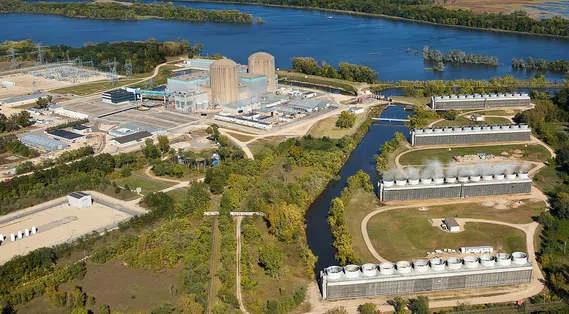
A file photograph shows the area round the Prairie Island nuclear plower plant near Red Wing, Minn.
BISMARCK, N.D. (North Dakota Monitor) – Nuclear energy is at least a decade away from coming to North Dakota, but the lawmakers studying its feasibility are already researching potential storage options for radioactive waste.
While North Dakota has no nuclear power plants, the U.S. Air Force maintains more than 100 intercontinental ballistic missiles armed with nuclear warheads in the north central area of the state, said Sen. David Hogue, R-Minot.
Hogue suggested a risk assessment to determine whether there is more or less danger to nearby populations from these nuclear weapons, operational nuclear power plants and long-term storage of radioactive waste, to help communities better understand the relative risks.
“I would be interested to know,” Hogue said.
Current law prohibits any storage of high level radioactive waste in the state. Representatives of Nucleon Energy, the Canadian nuclear power developer the state hired as a consultant, said that would have to change if policymakers hope to encourage nuclear development.
Will Bridge, chief technology officer of Nucleon Energy, said Wyoming had a similar provision in state law. It was amended in recent years to provide an exception for temporary storage of radioactive waste produced in the state. Wyoming law still prohibits storage of radioactive waste produced by power plants in other states.
Nucleon Energy will present more information at a June meeting of the Advanced Nuclear Energy committee, which includes lawmakers and representatives of state agencies and utilities, on what changes to state law would be necessary to make a nuclear power industry possible.
“We would need to address it,” said Sen. Dale Patten, R-Watford City.
In the United States, spent nuclear fuel is stored at 113 sites across 39 states, according to Nucleon’s presentation. The spent fuel is typically stored in multi-layered dry casks of stainless steel to contain the radioactivity. There are 97,000 metric tons of spent nuclear fuel in dry casks being stored in temporary on-site storage near nuclear reactors.
The storage is supposed to be temporary, pending transportation to a national underground storage repository. But that repository has never been built. The federal government’s first plan for the repository, Yucca Mountain in Nevada, has been stalled for more than a decade.
Deep underground geological storage is considered the best option for permanent storage because rock is very effective at containing radiation, and the spent fuel could be radioactive for tens of millions of years, said Rod McCullum with the Nuclear Energy Institute.
“To put it another way, if the dinosaurs had had nuclear energy, and had they disposed of the waste properly, we would never even know about it,” McCullum said.
Federal regulators have determined the dry casks that already exist will be safe for another 100 years, according to McCullum’s presentation.
“It’s stored safely where it is,” said Laura Hermann, deputy executive director of the Energy Communities Alliance, a nonprofit organization of local governments affected by nuclear development.
Asked whether there has ever been a leak or accident from one of these dry casks used for on-site storage, Bridge said there has not been one in North America.
Gary Iocco, mayor of Red Wing, a Minnesota city that hosts Xcel Energy’s Prairie Island Nuclear Generating Plant, said having the radioactive waste stored nearby has not been a problem for his community.
“We’ve had zero issues with any of the dry cask storage,” Iocco said. “I’d put one in my backyard, as they say.”
More permanent options could soon emerge. The U.S. Department of Energy has begun surveying states for interest in hosting disposal options, such as long-term repositories or fuel recycling facilities. One company is experimenting with horizontal drilling techniques, like oil and gas wells, to store the waste underground, McCullum said.
Hermann said many communities across the country have had to struggle with the consequences of legacy nuclear waste, from the Manhattan Project and other early initiatives. The Department of Energy is still involved in cleaning up 15 sites that will cost an estimated $500 billion and take up to 75 years to complete, Hermann said.

“This really is a national conversation that we’re going to continue to have,” Hermann said.
McCullum said the biggest reason the federal government has failed to build a national radioactive waste repository in Nevada is because it was a top-down government effort, rather than trying to build support for the project locally before moving forward.
“We call it moving at the speed of trust, which is what will have to happen with future nuclear waste disposal,” McCullum said.
Sen. Tim Mathern, D-Fargo, said he wonders if the committee is making the same mistake by not starting with local communities and stakeholders who would be affected by any proposal to build a nuclear power plant in the state.
“We have a lot of testimony about the finances and the storage and different types of reactors,” Mathern said. “Are we missing something to actually effectuate your suggestion?”
Community support, or lack thereof, for a nuclear power project is one of the most important elements a developer has to secure early on in the process, Bridge said.
“You certainly don’t want to push an SMR (small modular reactor) into a community that doesn’t want it,” Bridge said.
The entire process, from start to operation, can take roughly a decade. No project has been proposed for North Dakota at this time.




Comments