By: Meghan O’Brien and Seth Tupper
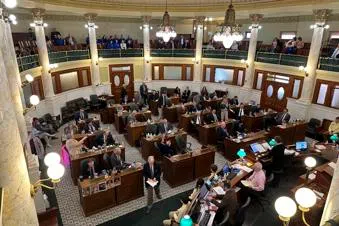
PIERRE, S.D. (South Dakota Searchlight) — After dozens of bills and months of debate about options for reducing homeowner property taxes, South Dakota lawmakers settled Wednesday on plans to use revenue from new and increased sales taxes.
State senators voted 20-13 on Wednesday in favor of the last major part of a multi-bill approach. Senate Bill 245 would capture $114 million in ongoing annual revenue from next year’s scheduled increase of the statewide sales tax rate from 4.2% to 4.5%, and would use that money to reduce local school district property taxes on owner-occupied homes. Schools fund whatever portion of their budget they can with local property taxes, and the rest of their funding comes mostly from state government.
The legislation, which now goes to the governor, would also take about $56 million from state reserves to get the effort started before the sales tax rate increase.
“This provides statewide relief,” said Senate Majority Leader Jim Mehlhaff, R-Pierre. “It spreads the tax base for how we fund education. I think it gets more people to have skin in the game funding education.”
Total sales taxes could hit 8%, senator says
Three years ago, state legislators and then-Gov. Kristi Noem approved a temporary state sales tax reduction from 4.5% to 4.2% and scheduled it to sunset in July 2027.
South Dakota currently has the 36th highest sales tax rate in the nation, averaging about 6% after optional local sales taxes are included. The statewide rate increase, combined with other legislation and local decisions, could raise the total sales tax to 8% in some areas of the state, said Senate President Pro Tempore Chris Karr, R-Sioux Falls.
“Our ‘crowning achievement’ is going to potentially raise our sales tax up to 8% in the state on communities to provide property tax relief — not to all people that are paying in these taxes, but just to some,” he said. “There has to be quality, good tax policy, and this is not it.”
Karr was referencing the possibility of new sales taxes from the other major bill in the package, Senate Bill 96. It will give counties the option to impose up to a half-percent sales tax, with proceeds used for credits to offset the county portion of property taxes on owner-occupied homes. It passed through both chambers and awaits a signature from the governor, who proposed it.
Another, separate bill awaiting the governor’s consideration would allow cities to impose additional, temporary sales taxes up to 1% to pay for specific projects, if approved by at least a 60% vote of the public.
Cities can already charge sales taxes up to 2%, plus an additional 1% on lodging, prepared food, alcohol and event ticket sales. Counties are not currently allowed to have sales taxes.
Earlier this session, Karr tried and failed to make the state sales tax rate reduction permanent. Some senators said Wednesday that they are resigned to the reality of the rate going back up.
“Accept it and move on,” said Sen. Taffy Howard, R-Rapid City. “I would much rather have that increase go to help fund education to a greater degree, and in the process help homeowners.”
The bill capturing revenue from the sales tax rate increase appears to have the support of Gov. Larry Rhoden, who endorsed a five-bill property tax reduction package last week with legislative leaders. The final version of the bill capitalizing on the sales tax increase was proposed by House Speaker Jon Hansen, one of three people running against Rhoden for the Republican nomination for governor in the June 2 primary election.
Savings on property tax, extra spending on sales tax
Lawmakers have been hearing complaints about homeowner property taxes since the COVID-19 pandemic, when a surge of in-migration and other factors drove up taxes along with home prices.
If both of the major property tax reduction bills are signed into law, South Dakota homeowners could save hundreds of dollars annually. Rhoden’s office has estimated that the money from the statewide sales tax increase will reduce homeowner property taxes 14-22%, equating to a savings of $548 on a home valued at $325,000.
In counties that adopt the optional half-percent sales tax, Rhoden’s office estimates another 10-25% property tax reduction, or an average savings of $660 per homeowner.
Consumers will also spend untold additional amounts on sales taxes. Under questioning by South Dakota Searchlight, state Bureau of Finance and Management Commissioner Jim Terwilliger estimated recently that the optional county sales tax alone would cause him to spend an additional $160 in sales taxes each year for his four-person family.
Fate of other tax bills
The state’s budget-setting committee also approved House Bill 1051 on Wednesday, which sets lower maximum property tax levies for education, by accounting for the extra state money in the education funding formula from the statewide sales tax rate increase. That will be considered by the rest of the Legislature on Thursday, the final day of the annual legislative session except for a day to consider vetoes from the governor on March 30.
Two other bills from the five-bill property tax plan failed. Those were House Bill 1323, which would have made it easier for citizen petitioners to force elections on local government decisions that increase property taxes, and House Bill 1253, which would have limited growth in taxable home valuations to 5% a year with a reset to market values every five years.
Some other property tax bills passed this legislative session, including expansions to property tax relief programs for veterans, and bills making other minor adjustments to the property tax system.
Lawmakers and Rhoden also passed a major property tax bill last year to slow property tax increases. Among other provisions, that law temporarily caps the countywide growth of taxable home values, and temporarily limits the value from new construction and growth that can be used to increase property tax collections. It also prevents some home improvements from causing higher home valuations.



Comments