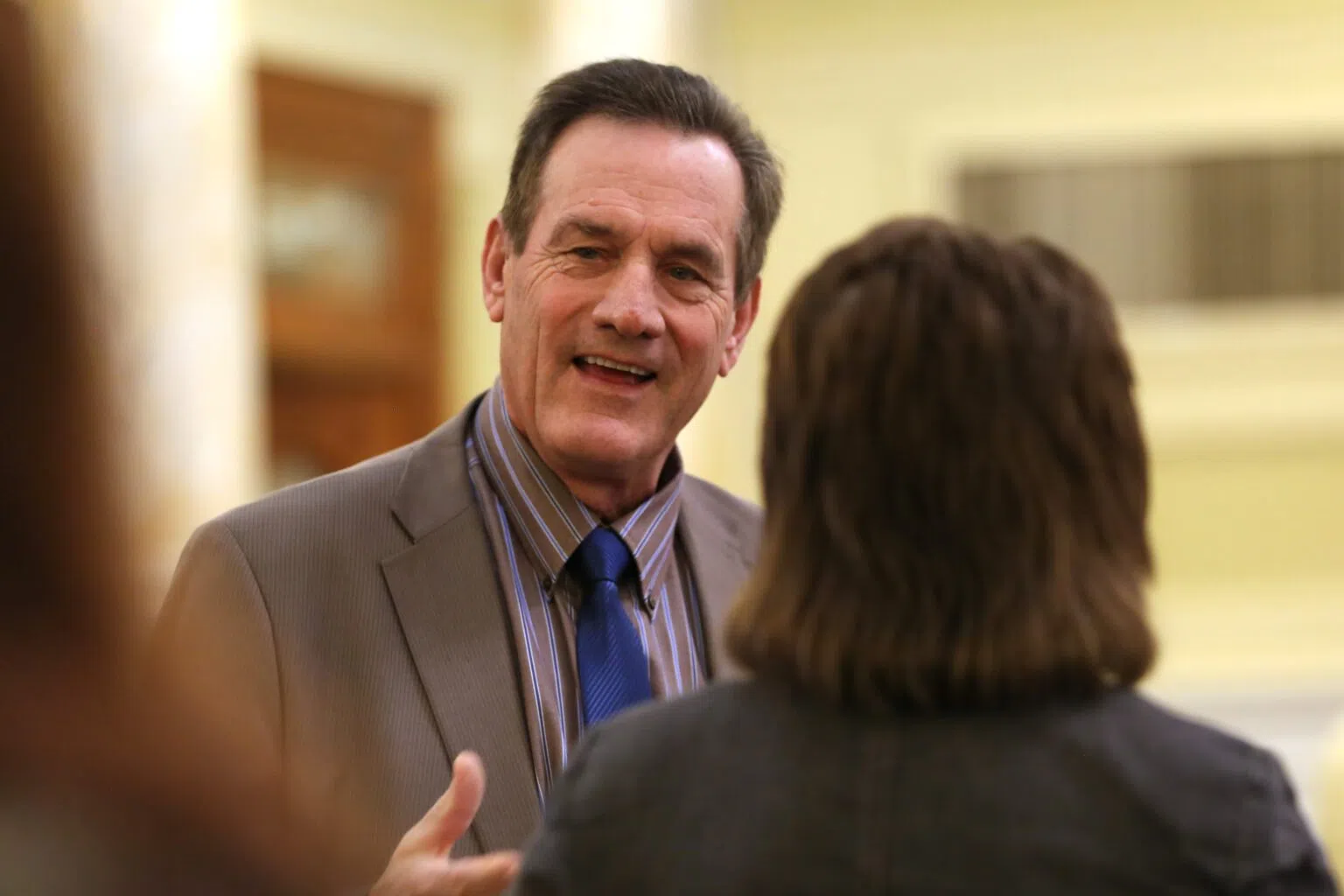
South Dakota Gov. Larry Rhoden chats with legislative staff during the 2025 legislative session on Jan. 21, 2025. (Makenzie Huber/South Dakota Searchlight)
By: Makenzie Huber
PIERRE, S.D. (South Dakota Searchlight) – South Dakota Gov. Larry Rhoden has thrown his support behind a plan to use revenues from an upcoming increase in the statewide sales tax rate to offset homeowner property taxes — something his administration opposed earlier this legislative session.
The shift in positions is part of a broader agreement between the executive branch and legislative leaders on how to best address property tax relief.
Rhoden’s preferred approach to property taxes had, until this week, focused on a bill to let counties use a half-percent sales tax to offset property taxes.
“This relief should be felt in both the short term and the long term,” Rhoden told lawmakers on the House State Affairs Committee on Wednesday. “It should be realized for all South Dakota homeowners and targeted even more to those that were hit the hardest with rising taxes. And it should also make property taxes more predictable and transparent for South Dakotans.”
The plan ties together five bills:
- Senate Bill 245, which would put revenue from a scheduled sales tax increase from 4.2% to 4.5% next year into a relief fund for owner-occupied property taxes, and use nearly $56 million in one-time money to seed the fund.
- Senate Bill 96, the Rhoden-recommended bill on voluntary county sales tax increases.
- House Bill 1253, which caps annual property assessment growth at 5% for five-year increments, resetting assessments back to market value every five years.
- House Bill 1323, which gives citizens 10 more days to gather signatures to refer a school board’s decision to opt out of the state’s property tax cap.
- House Bill 1051, which reduces the maximum tax levies for school districts.
Four of the five bills were endorsed Wednesday by legislative committees. HB 1051 awaits a hearing with the Legislature’s Joint Appropriations Committee.
Sales tax increase to offset property taxes proposal revived
Senate Bill 245 was introduced as a vehicle bill, meaning a bill with boilerplate language that can be used to introduce new policies late in the legislative session.
The bill’s vague original language earned Senate support on Feb. 24. The House State Affairs Committee amended it to reintroduce a concept similar to one that failed in the Senate last month 16-17.
In addition to capturing increased sales tax revenues to deposit into a “homeowner property tax reduction fund,” the new bill would seed that fund with $56 million in one time money. The fund would be used to reduce tax levies for school districts.
House Speaker Jon Hansen, R-Dell Rapids, is sponsoring the bill. Hansen and Rhoden are competing against each other, along with U.S. Rep. Dusty Johnson and Toby Doeden, for this year’s Republican nomination for governor.
Hansen said he’d hoped to keep the state’s sales tax rate at 4.2% and use other means to reduce property taxes statewide. He told lawmakers on the committee that the “next best thing” is to dedicate the scheduled increase toward lowering property taxes.
The original bill to capture the increased sales tax to offset property taxes was Senate Bill 118, which the Rhoden administration opposed.
Steven Kohler, with the state Bureau of Finance and Management, told lawmakers at the time that diverting sales tax money would remove lawmakers’ discretion to use the revenue for funding increases to education, Medicaid providers or state employees.
Senate Majority Leader Jim Mehlhaff voted against SB 118 but told South Dakota Searchlight after Wednesday’s meeting that he supports SB 245.
“I don’t love everything about it,” Mehlhaff said, pointing specifically to the $56 million it allocates in one-time money. “But I’m willing to support it to deliver some property tax relief.”
The bill passed the House State Affairs Committee 11-2. It’ll head to the House floor next. If it passes, the Senate would need to vote to accept the amendments.
County sales tax bill passes committee
SB 245 would result in up to 15% average reduction in property taxes per household across the state, South Dakota Bureau of Finance and Management Commissioner Jim Terwilliger told lawmakers on Wednesday.
Senate Bill 96, the governor’s proposal to allow counties to set up to a half-percent sales tax, would add another reduction, depending on the county, Terwilliger said. Some counties, based on the governor’s website outlining the proposal, could save more than 20% per household — as high as 35% in Bennett County.
Combined, the two bills make “a very, very powerful package,” Terwilliger said. Savings would appear as a credit on property tax bills, he said.
Counties would be able to implement a new half-percent tax either by a vote of a county commission or a vote of the public.
Nathan Sanderson, executive director with the South Dakota Retailers Association, spoke against the bill, saying the organization prefers Senate Bill 245. Another member of the public, John Cunningham, said the bill provides more relief to wealthy homeowners, rather than low income renters or homeowners.
The bill passed 12-1 and heads to the House floor.
Effort caps assessment increases during five-year periods
House Bill 1253, introduced by Rep. Scott Odenbach, R-Spearfish, originally sought to require counties to use an eight-year market average to set taxable values for non-agricultural properties.
It was amended on Wednesday to cap annual increases at 5%. Currently, properties are assessed on market value annually. If the bill passed, homeowners would be protected from unpredictable increases in assessments each year. The bill would reset assessments at the market value of the property after five years.
The goal, Odenbach told members of the Senate Taxation Committee on Wednesday, is to prevent double-digit increases in property taxes seen in recent years and improve transparency in how mill levies that impact property taxes are set.
South Dakota Department of Revenue Secretary Mike Houdyshell spoke in support of the amended bill after opposing it earlier in the legislative session. Setting a reassessment period establishes a “catch up provision” to equalize properties, Houdyshell said, something other assessment cap bills proposed this session and last did not do.
Opponents included directors of equalization from across the state and representatives of farming and business groups. They said the bill would shift the property tax burden onto agricultural properties.
Pennington County Director of Equalization Shannon Rittberger said the change would cost thousands of dollars in software changes, and said he expects public outrage when assessments reset to market value, which could cause increases of more than 5% that year.
“I don’t like this bill because I don’t think it’ll change property taxes,” Rittberger said. “It’ll move it around and it’ll head toward that cliff.”
Houdyshell said there are likely “mechanical and logistical” details that will need to be worked on before the bill can be signed by the governor.
The bill passed 5-2 and heads to the Senate floor.




Comments