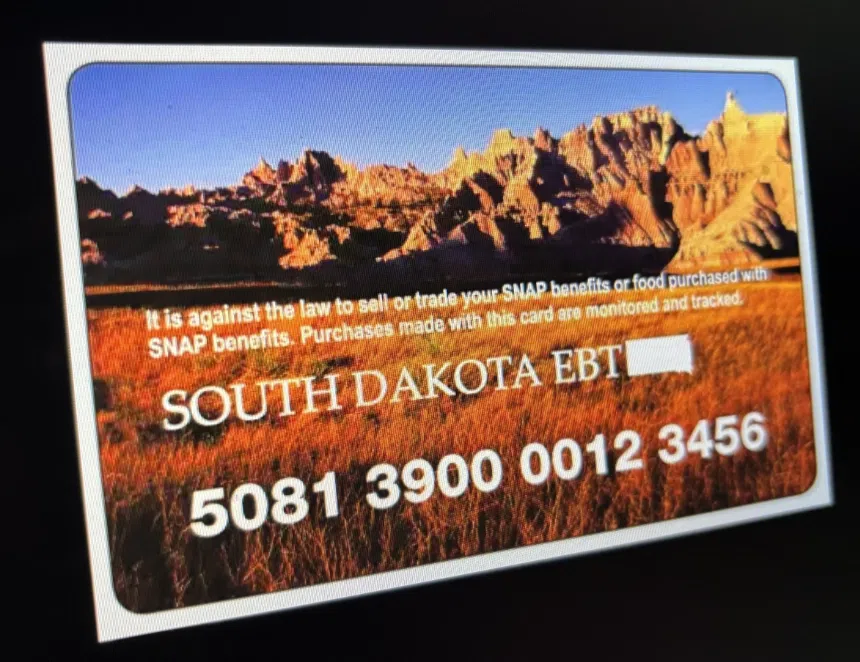
The website of the South Dakota Department of Social Services displays a sample EBT card, which is what participants in the Supplemental Nutrition Assistance Program use to buy food. (Screenshot by South Dakota Searchlight)
PIERRE, S.D. (South Dakota Searchlight) — South Dakota will move to ban the purchase of sugary drinks with food assistance benefits after Republican Gov. Larry Rhoden signed a bill he’d opposed into law in the face of its veto-proof support in both chambers of the South Dakota Legislature.
House Bill 1056 will require the state to seek a waiver from the federal government to remove sweetened beverages, with the exception of milk and some fruit juices, from the list of items that can be purchased through the Supplemental Nutrition Assistance Program.
SNAP is a federal program for people with low incomes that delivers monthly benefits through cards that function like debit cards. Nearly any kind of consumable food or drink, save prepared foods and alcohol, is eligible for purchase through SNAP.
Proponents of banning the use of SNAP for sweetened drinks argued that program participants are often also covered by Medicaid, a federal health insurance program for those with low incomes or disabilities, and that the drinks contribute to health and dental problems taxpayers pay to treat. The cost of Medicaid is split between the state and federal government.
Under the waiver, SNAP benefits could still be used for milk and some fruit juices, but not for any other kind of sweetened beverage, including diet drinks or sports drinks like Gatorade and Powerade.
Rhoden opposed the ban as it moved through the state Senate and House of Representatives. The administrative costs associated with restricting soda purchases would be too high, he said. A fiscal note prepared by the Legislative Research Council said hiring the staff and paying for the software necessary to implement a ban would cost the state $310,000 in the first two years, and about a quarter million dollars annually thereafter, though representatives from Rhoden’s office told lawmakers during committee hearings that the cost could be higher.
Other opponents, including the South Dakota Retailers Association, suggested some stores would opt out of accepting SNAP benefits in the face of administrative complications.
The bill’s proponents said the state will easily recoup any losses by paying less in medical care for soda-related health problems.
The bill passed the House of Representatives 58-11 and passed the Senate 27-6. Both margins were higher than the two-thirds support necessary to override a gubernatorial veto.
In a news release announcing his decision to sign HB 1056 into law, Rhoden said he agrees “with the Legislature’s and the Trump Administration’s goal of encouraging healthier food choices.”
“However, I disagree that a state waiver is the right approach. Lasting SNAP reform requires federal action, not a patchwork of state waivers,” Rhoden’s statement said.
Former President Joe Biden’s administration had opposed waivers for state-level SNAP soda bans, but President Donald Trump’s administration has signaled its intention to process them.
Rhoden pointed to the 2026 passage of a resolution by state lawmakers urging the federal government to review SNAP nutrition guidelines as evidence that “90% of the Legislature recognizes that SNAP reform must occur at the federal level.” Seven of South Dakota’s 101 lawmakers voted against the resolution.
Any federal action on SNAP would invalidate state-level waivers, Rhoden’s press release said, and South Dakota will bear the administrative costs in the meantime.
“If the federal government finally does its job and fixes this problem, this law should be repealed to avoid more costs to South Dakota taxpayers,” Rhoden said.
In a statement sent to South Dakota Searchlight, HB 1056’s prime sponsor said she and her fellow lawmakers sent the right message on SNAP with their support for the bill.
“The Legislature passed this bill with veto-proof margins because the facts were clear and the need was urgent,” said Rep. Taylor Rehfeldt, R-Sioux Falls. “Following the president’s call for states to strengthen the integrity of the SNAP program and encourage healthier choices, lawmakers led to deliver a policy that promotes better outcomes and protects taxpayers, even though the governor opposed the effort every step of the way.”



Comments