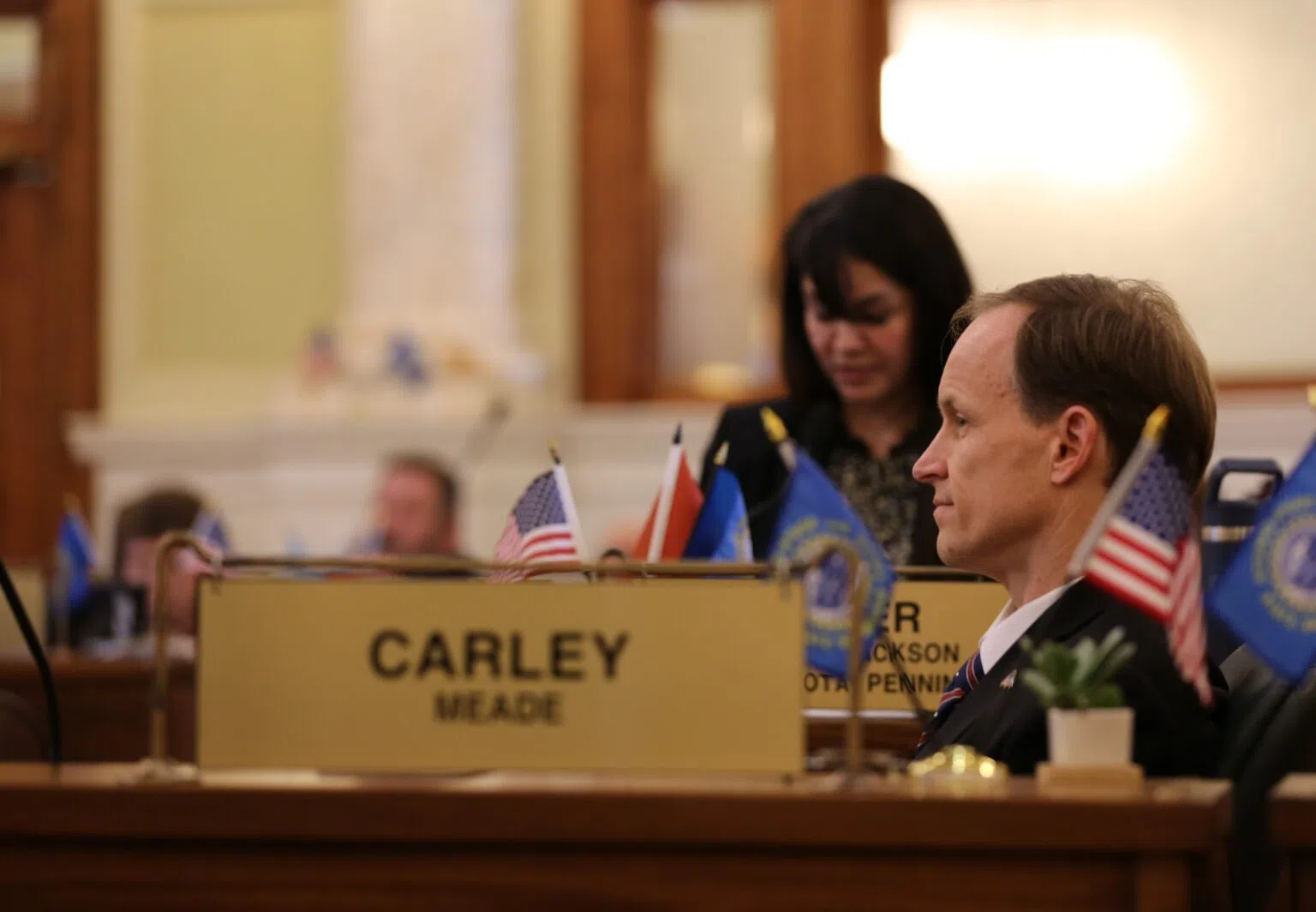
State Sen. John Carley, R-Piedmont, foreground, listens on Jan. 28, 2025, in the South Dakota Senate. (Joshua Haiar/South Dakota Searchlight)
By: Joshua Haiar
PIERRE, S.D. (South Dakota Searchlight) — Republican state Sen. John Carley of Piedmont said his unexplained absence from the entire Senate floor session during one of the busiest days of South Dakota’s annual legislative session — which led his colleagues to launch a search for him — was because of a medical appointment.
“I had an eye doctor visit,” Carley told South Dakota Searchlight in a text message Wednesday morning, after his Tuesday afternoon absence.
When asked follow-up questions, Carley said he “had an unexpected health issue come up.”
The Senate Journal for Tuesday lists Carley as missing 24 votes that afternoon. That included votes on two data center-related measures that were narrowly defeated — one to alter a sales tax rebate program to include data centers, and another to exempt backup generators, such as those used by data centers, from needing a state permit.
Data centers are buildings housing servers to process data for artificial intelligence and other technologies. South Dakota lacks the kind of massive data centers that have proliferated elsewhere, and there have been competing proposals this legislative session to incentivize them with tax exemptions and rebates, or more strictly regulate their power usage, water use for cooling, noise and other impacts.
Carley’s absence was especially significant because the Senate has effectively been reduced from 35 to 34 members this session due to the ongoing health-related absence of Sen. Arch Beal, R-Sioux Falls. That creates the chance of tie votes.
Bills need a majority of the members-elect — 18 votes — to pass in the Senate.
Data center bill drama
Supporters of the two data center bills had been hoping for at least a 17-17 split that Republican Lt. Gov. Tony Venhuizen, presiding over the Senate as its president, could break in favor of passage. In fact, both bills were up for reconsideration Tuesday after one of them had suffered a tie vote the previous day, and the other one had previously failed 17-16 with a different senator absent. Carley voted against both bills Monday.
With Carley gone Tuesday, a tie was impossible, as was the potential for the lieutenant governor to break a tie in favor of passage, and both bills failed on the last day for bills to pass their chamber of origin. That’s called Crossover Day, which is one of the most active days of the session.
In addition to saying he had an eye appointment, Carley added in his response to South Dakota Searchlight that “I also find it ironic that being absent worried some that the executive branch might not be able to break a tie, and by default it was actually me representing the request of my constituents because an absence now is more powerful than a no vote.”
The data center bills could still come back as amendments to other bills during the final few weeks of the legislative session.
Senators did not appear to know that Carley would be gone Tuesday, or where he was. Sen. Mike Rohl, R-Aberdeen, invoked a “call of the house” to compel Carley to the floor, and Venhuizen dispatched the Senate’s sergeant-at-arms on a search.
After a break of about 40 minutes, while the rest of the senators waited, the sergeant-at-arms returned with a report stating that Carley was not answering his phone — not even for the governor, who had been enlisted to make a call — and could not be found. The search included reviewing footage from Capitol security cameras that showed Carley in the building earlier in the day, as well as an unsuccessful search for Carley’s vehicle in the parking lot.
Reaction ranges from criticism to comedy
Senate President Pro Tempore Chris Karr, R-Sioux Falls, and Senate Majority Leader Jim Mehlhaff, R-Pierre, declined to comment Wednesday on whether Carley should face any disciplinary action.
Senate Minority Leader Liz Larson, D-Sioux Falls, said she didn’t have enough information to say whether Carley should be disciplined.
“But as a general rule, you should be in your seat,” Larson said. “Or let people know you’ll be gone.”
The South Dakota Supreme Court recently confirmed the lieutenant governor’s ability to break tie votes in the Senate. That came about after Karr challenged that authority, and the governor requested the court’s opinion on the matter.
Sen. Mykala Voita, R-Bonesteel, said the Supreme Court’s advisory opinion has warped Senate incentives in a way that rewards gamesmanship. She said with one member excused and the chamber effectively reduced to an even number, a 17-17 tie hands the deciding power to the executive branch via the lieutenant governor, rather than requiring a true majority of elected senators.
In that environment, Voita said, “your absence matters more than your ‘no’ vote,” because walking away can prevent a tie and block approval.
Karr said the Supreme Court decision, requested by the executive branch, incentivized the behavior. He worries that a precedent has been set for the remainder of the session through next month, and that future absences could result in more “call of the house” motions attempting to compel the attendance of senators.
“Two other branches interfered and have now created an incentive for gamesmanship,” Karr said.
The Senate approved a bill Tuesday that would ask voters to remove the lieutenant governor’s role as president of the Senate. That bill awaits action by the House.
Sen. Casey Cratree, R-Madison, sponsored the two data center bills that were defeated on Tuesday. On Wednesday, he introduced the Senate to his wife, Ashley, an optometrist who was visiting and watching from the gallery.
“And we know how important those eye doctors are,” Crabtree said. “So, I thought I’d have her come in here and make sure nobody needed to go anywhere else.”




Comments