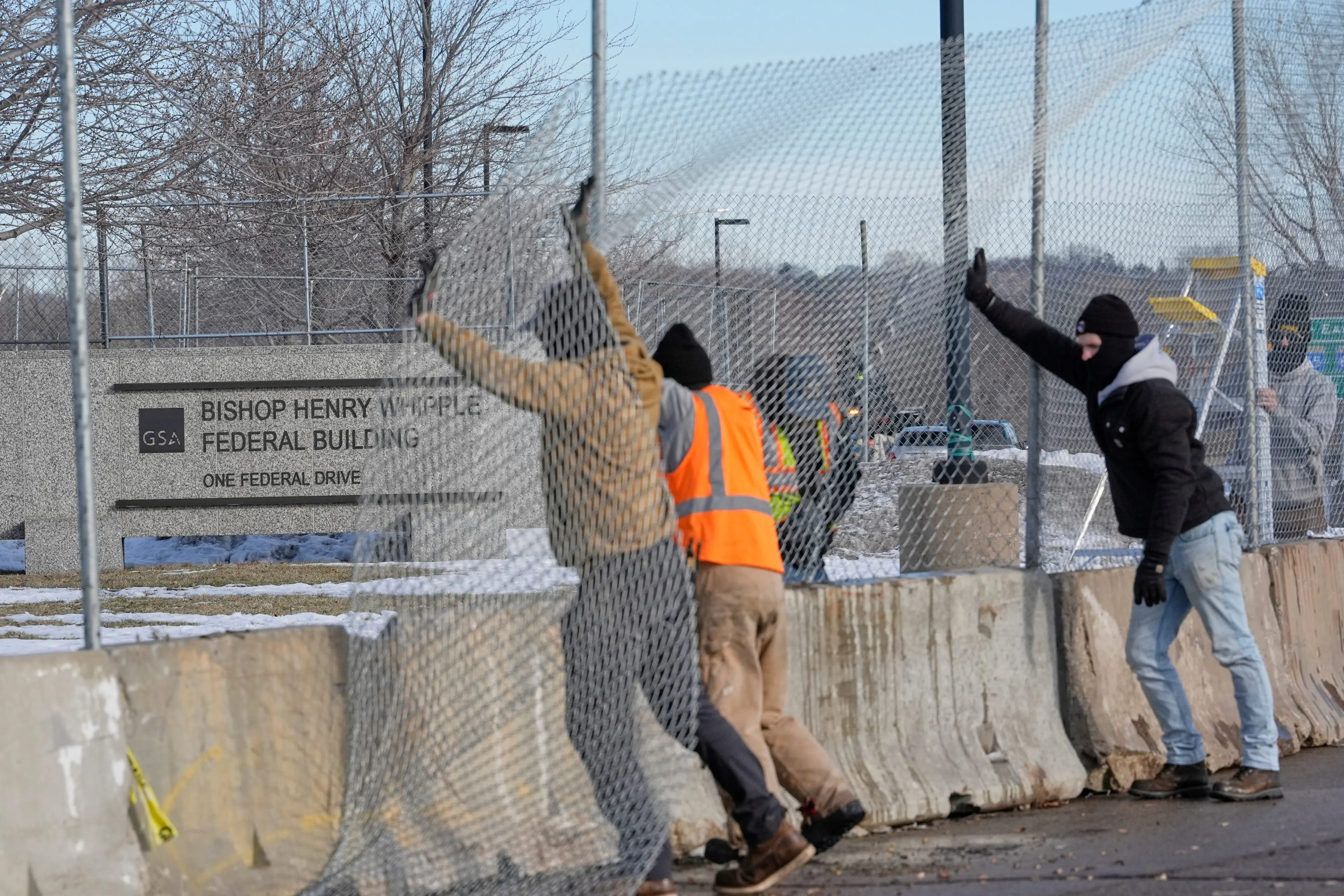
Masked workers put up fencing around the Bishop Whipple Federal Building, Monday, Jan. 12, 2026, in Minneapolis. (AP Photo/Jen Golbeck)
ST. PAUL, Minn. (Minnesota Reformer) — A federal judge in Minnesota ordered officials with U.S. Immigration and Customs Enforcement and the Department of Justice to appear before him and explain why they should not be held in contempt.
U.S. District Judge Jeffrey Bryan’s order refers to “numerous unlawful violations of court orders,” specifically the government’s repeated failure to return property taken from immigrants who were illegally detained during Operation Metro Surge.
Bryan issued the order on Thursday and called for the top Department of Justice official in Minnesota, U.S. Attorney Daniel Rosen, along with representatives from ICE to appear at a contempt hearing on March 3 in St. Paul.
The order combines 28 cases in which immigrants were illegally detained and then released without all of their personal belongings — cash, cellphones, jewelry, driver’s licenses, work permits, passports, clothing, and other identification and immigration documents — as ordered by the court.
It’s the latest escalation in a tense showdown between the federal judiciary and the Trump administration, which has faced a blizzard of habeas petitions challenging unlawful detentions of immigrants as it seeks to carry out mass deportations.
“I was shocked by the order,” said Taylor Volkman, an attorney on one of the cases listed in the order. “It really underscores the recklessness that the federal government had in coming to the Twin Cities … they had no plan to deal with the aftermath.”
The federal incursion of some 3,000 immigration agents in Minnesota yielded more than 4,000 arrests, according to the Department of Homeland Security.
But many of those arrests were carried out without warrants under the Trump administration’s legal theory — contrary to three decades of precedent — that any immigrant without legal status can be treated as if they were just apprehended at the border and held in detention pending immigration hearings.
Judges have ruled again and again — in hundreds of cases in Minnesota alone — against that interpretation and ordered detainees released.
The government has often failed to comply with those orders by delaying the release of people illegally detained, withholding their possession or not alerting their attorney before releasing them, sometimes in the bitter cold in the middle of the night without warm clothes.
The Department of Homeland Security has swiftly flown detainees to Texas or New Mexico after being arrested in Minnesota in what one federal judge called a “pattern of obfuscation” to make it harder for detainees to secure legal representation.
As people are returned to Minnesota, oftentimes their property is misplaced in the transfer.
At a hearing on Wednesday, U.S. District Judge John Tunheim grilled federal attorneys and an ICE official about why they hadn’t returned the belongings of an asylum-seeker from Colombia, saying it was “outrageous” that they had failed to return her wallet, phone and other possessions for over two weeks.
Her attorney said she has had to rely on food donations since her release from ICE custody, having been detained during a routine immigration appointment in Minneapolis, sent to Texas and then ordered released by a judge.
Tauria Rich, ICE’s deputy field office director in St. Paul, said people’s belongings are sometimes mistakenly sent to a different detention facility. She promised the woman’s belongings, which had just been located, would be on a flight from Texas the next day. And if the items didn’t make that flight, Rich said they would overnight it with FedEx.
“We do understand the hardship it creates when they’re released and don’t have access to their phones or their bank funds,” Rich said.
Tunheim said he would defer any decision on sanction despite the federal government having already missed multiple deadlines.
As of Thursday afternoon, the woman’s attorney Paschal Nwokocha said they have not received the items.
The federal government is usually given some deference in federal court, but judges are issuing increasingly scathing rebukes of ICE and the DOJ for failing to comply with their orders.
Across the country, federal judges have issued 35 similar “show cause” orders since August, requiring federal officials to explain why they should not be held in contempt for violating orders regarding immigrant detainees, according to an analysis by the New York Times.
“What I really want is for the government to be held to account and to be forced to explain why they don’t think they have to abide by court orders,” said Daniel Suitor, an attorney on another one of the cases cited in the order. “As a private practitioner … I would be destroyed by a federal judge if I just disregarded an order.”
On Feb. 20, Bryan gave the federal government five days to return all the personal property to the 28 individuals and file declarations “by an individual with personal knowledge” confirming the property was returned.
Yet as of Thursday when the order was issued, Bryan said the government had not complied.
The Department of Justice and ICE did not immediately respond to requests for comment.
Bryan noted that in some cases, federal officials said they weren’t “aware of any property return issues,” but said that wording was evasive and suggested the officials had no idea if they had followed the court’s order.
If the federal government is able to comply with the order to return property by the March 3 hearing date, then Bryan said he would consider canceling the hearing. Otherwise, the U.S. attorney and ICE officials must “show cause” for why they didn’t follow his order and should not be held in civil or criminal contempt.
It’s unclear exactly who could face sanctions, with numerous top Trump administration officials named as respondents, including Homeland Security Secretary Kristi Noem, U.S. Attorney General Pam Bondi and Acting ICE Director Todd Lyons.
Last week, U.S. District Judge Laura Provinzino imposed a $500 fine on Special Assistant U.S. Attorney Matthew Isihara for each day the government did not return the identification documents of an immigrant arrested in Minnesota but released in Texas. The government swiftly returned the man’s documents and no fines were imposed on the attorney.




Comments