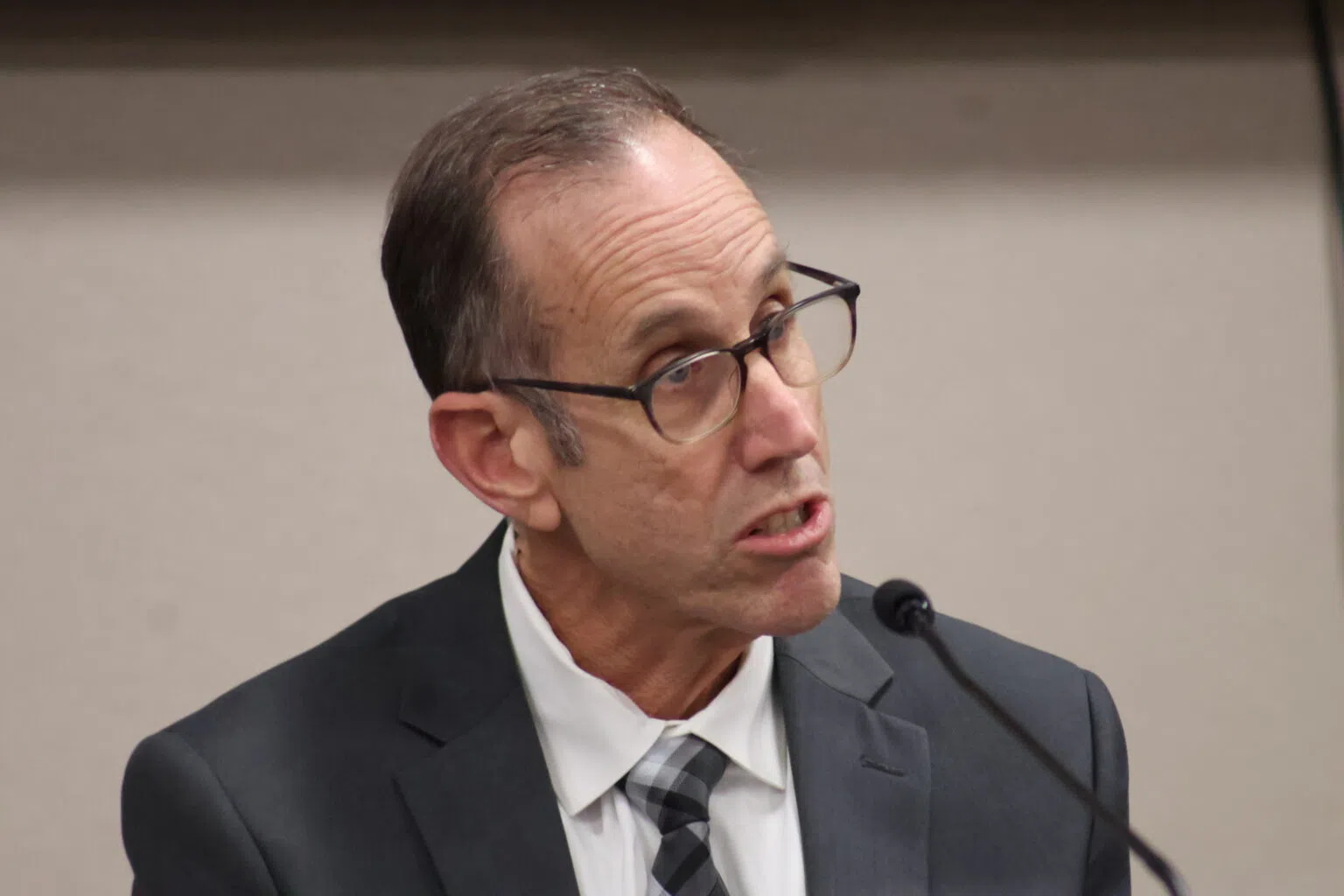
Luis Casas, a pediatric endocrinologist suing North Dakota over its ban on gender-affirming care for minors, testifies in court on Jan. 30, 2025. (Mary Steurer/North Dakota Monitor)
BISMARCK (North Dakota Monitor) — A North Dakota doctor is appealing a district court judge’s ruling last fall that upheld the state’s ban on gender-affirming care for minors.
South Central District Court Judge Jackson Lofgren in October found that the 2023 law, which makes it a crime to prescribe puberty blockers and other treatments to adolescents, does not violate the state constitution.
Attorneys representing the plaintiff, pediatric endocrinologist Dr. Luis Casas, announced in a Thursday press conference they will be asking the North Dakota Supreme Court to review Lofgren’s decision.
They ultimately want the high court to find Lofgren used the wrong legal framework to analyze the suit, and to send the case back to him for reconsideration.
Lofgren’s ruling was guided in part by his finding that transgender people do not qualify for special legal protections and that the gender-affirming care ban does not discriminate on the basis of sex.
Unless judges find that a law affects a protected group or restricts an important right, they are generally very deferential to the Legislature, experts told the North Dakota Monitor previously. In these cases, it’s very difficult to prove a law violates the constitution.
The plaintiffs are asking the North Dakota Supreme Court to find Lofgren should have applied a stricter standard to the health care ban. In that case, the law would have to clear a higher hurdle to be found constitutional, said Jess Braverman, legal director for Gender Justice, which represents Casas in the case.
“We believe that the North Dakota Constitution does not allow politicians who are not qualified to practice medicine to override the deeply personal and private medical decisions that families make for their kids,” Braverman said.
Lofgren, in his October opinion, frequently cited the U.S. Supreme Court’s decision upholding a ban on gender-affirming care for minors in Tennessee.
Braverman said the U.S. Supreme Court’s ruling doesn’t dictate whether or not North Dakota’s health care ban is allowed under North Dakota’s constitution.
They said the North Dakota Constitution isn’t supposed to be interpreted as “in lockstep” with the federal Constitution.
“It’s an independent document drafted by a separate group of people who were asserting their state’s rights to independence,” said Braverman.
The lawsuit was originally brought against the state of North Dakota by three families with transgender children, in addition to Casas. Lofgren later dismissed the families and children from the suit, finding they did not have standing to bring it. That left Casas as the sole plaintiff.
The plaintiffs argue the law is a form of sex discrimination because it bars minors with gender dysphoria from accessing medical treatments that are otherwise available to kids to treat other medical conditions. They also say the statute infringes on North Dakotans’ rights to autonomy and self-determination under the state constitution.
Attorneys for the state of North Dakota argue that the law is constitutional because the state has an interest in regulating the medical profession and protecting minors.
Lofgren presided over a seven-day court trial in early 2025 that included testimony from doctors, as well as two transgender teens and their parents who were initially plaintiffs in the case.
“Despite years of litigation, the state was never able to present even one family who has ever been harmed as a result of this care in the state of North Dakota,” Braverman said Thursday. “Instead, the court heard stories of transgender kids who went from hopeless to thriving as a result of this care.”
Aside from finding Lofgren used the incorrect legal standard in analyzing the case, the North Dakota Supreme Court could also decide to uphold the district court’s decision. Or, it could find Lofgren applied the right framework but disagree with his conclusion that the law is constitutional, Braverman said.
Attorney General Drew Wrigley in a statement to the Monitor said his office “looks forward” to defending Lofgren’s ruling before the North Dakota Supreme Court.
“The District Court’s decision is firmly grounded in settled law and affirms the Legislature’s responsibility to protect the long-term health of children,” he said.
The law makes it a class A misdemeanor to administer medications — including puberty blockers and hormone therapy — to children for the purpose of providing gender-affirming care.
Providers who violate this part of the law could face up to 360 days in jail, fines of up to $3,000 or both.
The law also makes it a class B felony to perform transition-related surgery on a minor — which means up to 10 years in prison and a maximum $20,000 fine. In hearings on the bill, health care professionals testified that transition-related surgeries are not performed on minors in North Dakota.




Comments