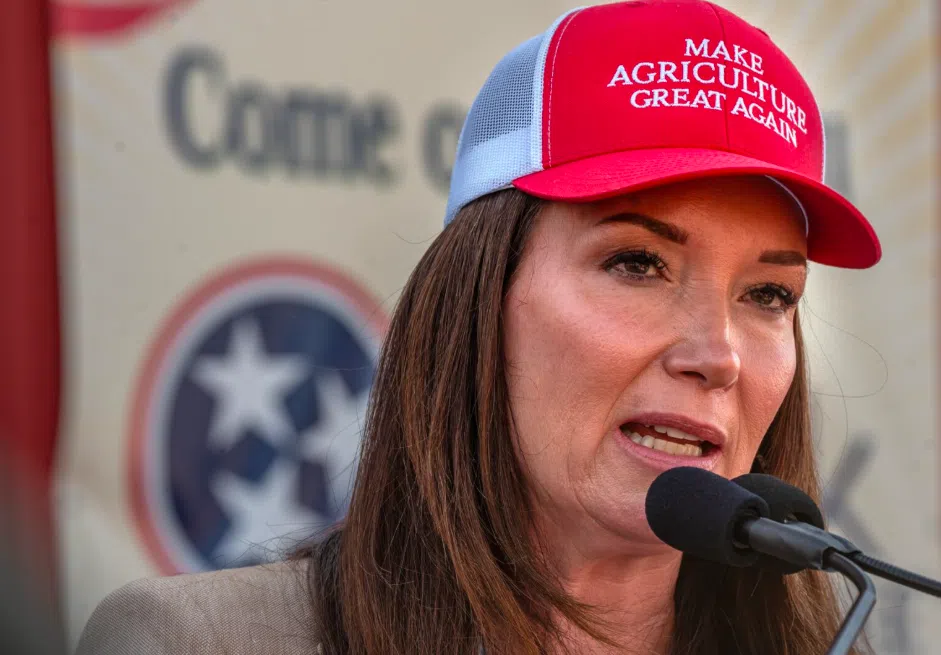
U.S. Agriculture Secretary Brooke Rollins, speaking at a Future Farmers of America event Aug. 18, 2025 at the Tennessee State Fair. (Photo by John Partipilo/Tennessee Lookout)
WASHINGTON (North Dakota Monitor) – The U.S. Department of Agriculture will transfer a large office building to the General Services Administration in a step toward shrinking the department’s footprint in and around Washington, D.C., Secretary Brooke Rollins said Wednesday.
More than 70% of offices at the USDA’s South Building, in Washington, sit empty on any given day, while deferred maintenance costs have piled up past $1 billion, Rollins said at a press conference in front of the building.

The Department of Agriculture South Building at 1400 Independence Ave. SW in Washington, D.C., was designed by the Office of the Supervising Architect of the Treasury and built between 1930 and 1936. (Photo courtesy of the General Services Administration)
“Behind me, along this entire city block in bricks and mortar, is what government that has grown too big, too bloated and too disconnected from its citizens looks like,” Rollins said. “That all changes starting today, because today we are officially starting the process of turning the South Building back over to the General Services Administration.”
The department will also vacate leased space at an office in Alexandria, Virginia, USDA Deputy Secretary Stephen Vaden said.
The moves are part of a plan the department outlined in July 2025 to shift its workers out of the capital region, reducing the workforce in D.C., Maryland and Virginia from 4,600 to around 2,000 while expanding regional hubs throughout the country.
Rollins said Wednesday the move was the “next step to right-size our federal real estate footprint to root out waste, fraud and abuse.”
Sen. Joni Ernst, an Iowa Republican who has long advocated for shrinking the federal government, applauded the move and urged department officials to consider her state as a target for relocation.
“Let’s just keep on draining the swamp, and, Secretary Rollins, moving our federal workers closer to the people that they represent,” Ernst said. “And I would say that the great state of Iowa is a good place to start.”
Workforce to relocate
Workers in the department’s Food and Nutrition Service who currently report to the Virginia office will relocate to Washington, D.C., Vaden said.
The broader reorganization would ramp up over the summer, allowing employees with school-aged children to finish the academic year in the capital area and complete their relocation in time for the next school year, he said.
That will require a series of steps required by laws, regulations and union contracts, Vaden said.
The July plan said the effort to spread the USDA workforce out from D.C. would take years. It included expanded regional offices in Raleigh, North Carolina; Kansas City, Missouri; Indianapolis; Fort Collins, Colorado; and Salt Lake City.
The department would also maintain administrative support locations in Albuquerque, New Mexico, and Minneapolis and agency service centers in St. Louis; Lincoln, Nebraska; and Missoula, Montana, according to a July 24 memo.
South Building future unclear
GSA Administrator Edward Forst said the move represented “a very preliminary stage” and declined to provide a timeline for the transfer to be complete.
“I don’t want to commit to a time frame other than I have two years and 10 months left in this job,” he said. “And we’re going to get a lot done in that time frame.”
Vaden said the USDA reorganization would be complete by the end of 2026.
Forst said USDA’s transfer of the South Building triggered a long and comprehensive process to find a new use. The agency would consult with stakeholders, including the private sector, and that the district’s prosperity was among its priorities.
“We’re committed to economic prosperity for D.C.,” he said. “That’s one of our initiatives. We also talk to the private sector and others about the best case use and how we also deliver the best results for the American taxpayer. So it is a long, it’s a comprehensive process. We want to be good listeners, and then we’ll execute on this.”




Comments