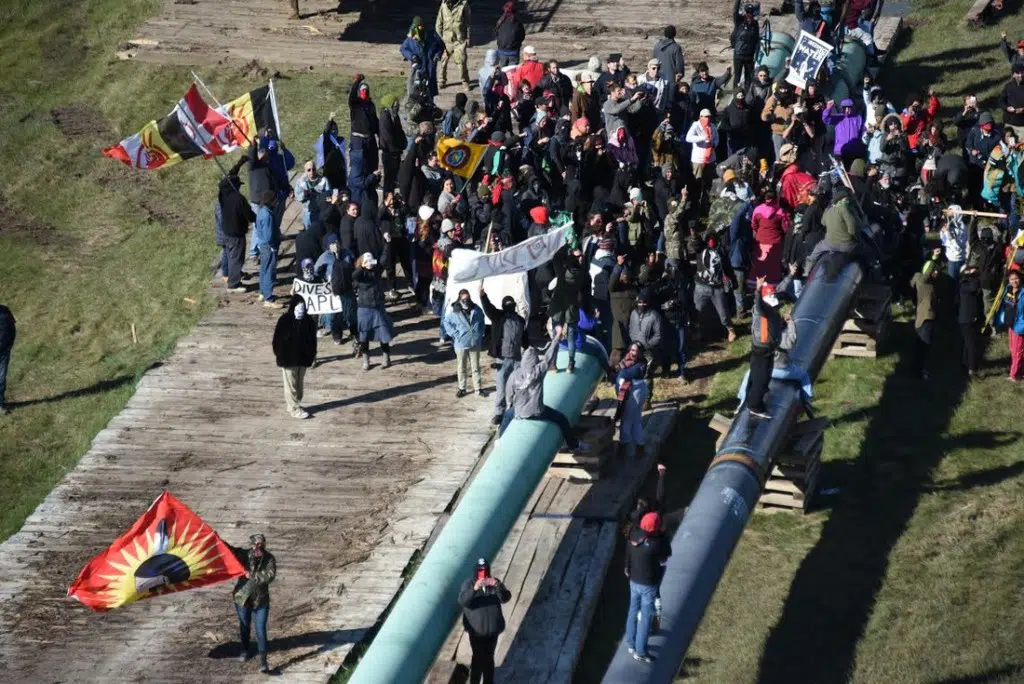
DAPL Protest in 2016
BISMARCK, N.D. (AP) — A North Dakota judge has said he will order Greenpeace to pay damages expected to total $345 million in connection with protests against the Dakota Access oil pipeline from nearly a decade ago, a figure the environmental group contends it cannot pay.
In court papers filed Tuesday, Judge James Gion said he would sign an order requiring several Greenpeace entities to pay the judgment to pipeline company Energy Transfer. He set that amount at $345 million last year in a decision that reduced a jury’s damages by about half, but his latest filing didn’t specify a final amount.
The long-awaited order is expected to launch an appeal process in the North Dakota Supreme Court from both sides.
Last year, a nine-person jury found Netherlands-based Greenpeace International, Greenpeace USA and funding arm Greenpeace Fund Inc. liable for defamation and other claims brought by Dallas-based Energy Transfer and subsidiary Dakota Access.
The jury found Greenpeace USA liable on all counts, including conspiracy, trespass, nuisance and tortious interference. The other two entities were found liable for some of the claims.
The lawsuit stems from the pipeline protests in 2016 and 2017, when thousands of people demonstrated and camped near the project’s Missouri River crossing upstream of the Standing Rock Sioux Tribe’s reservation. The tribe has long opposed the pipeline as a threat to its water supply.
Damages totaled $666.9 million, divided in different amounts among the three Greenpeace organizations before the judge reduced the judgment. Greenpeace USA’s share of that judgment was $404 million.
Energy Transfer previously said it intends to appeal the reduced damages, calling the original jury findings and damages “lawful and just.” The Associated Press emailed the company for comment on the judge’s Tuesday action.
In a financial filing made late last year, Greenpeace USA said it doesn’t have the money to pay the $404 million ordered by the jury “or to continue normal operations if the judgment is enforced.” The group said it had cash and cash equivalents of $1.4 million and total assets of $23 million as of Dec. 31, 2024.
Greenpeace declined to comment on the judge’s Tuesday filing, but Greenpeace USA interim general counsel Marco Simons reiterated that the organization couldn’t afford the judgment.
“As mid-sized nonprofits, it has always been clear that we would not have the ability to pay hundreds of millions of dollars in damages,” Simons said Wednesday.
Simons added that the case is far from over and expressed optimism about the group’s planned appeal.
“These claims never should have reached a jury, and there are many possible legal grounds for appeal – including a lack of evidence to support key findings and valid concerns about the possibility of ensuring fairness,” Simons said.
Greenpeace has said the lawsuit is meant to use the courts to silence activists and critics and chill First Amendment rights. The pipeline company has said the lawsuit is about Greenpeace not following the law, not free speech.
At trial, an attorney for Energy Transfer said Greenpeace orchestrated plans to stop the pipeline’s construction, including organizing protesters, sending blockade supplies and making untrue statements about the project.
Attorneys for the Greenpeace entities said there was no evidence to the company’s claims and that Greenpeace employees had little or no involvement in the protests and the organizations had nothing to do with Energy Transfer’s delays in construction or refinancing.




Comments