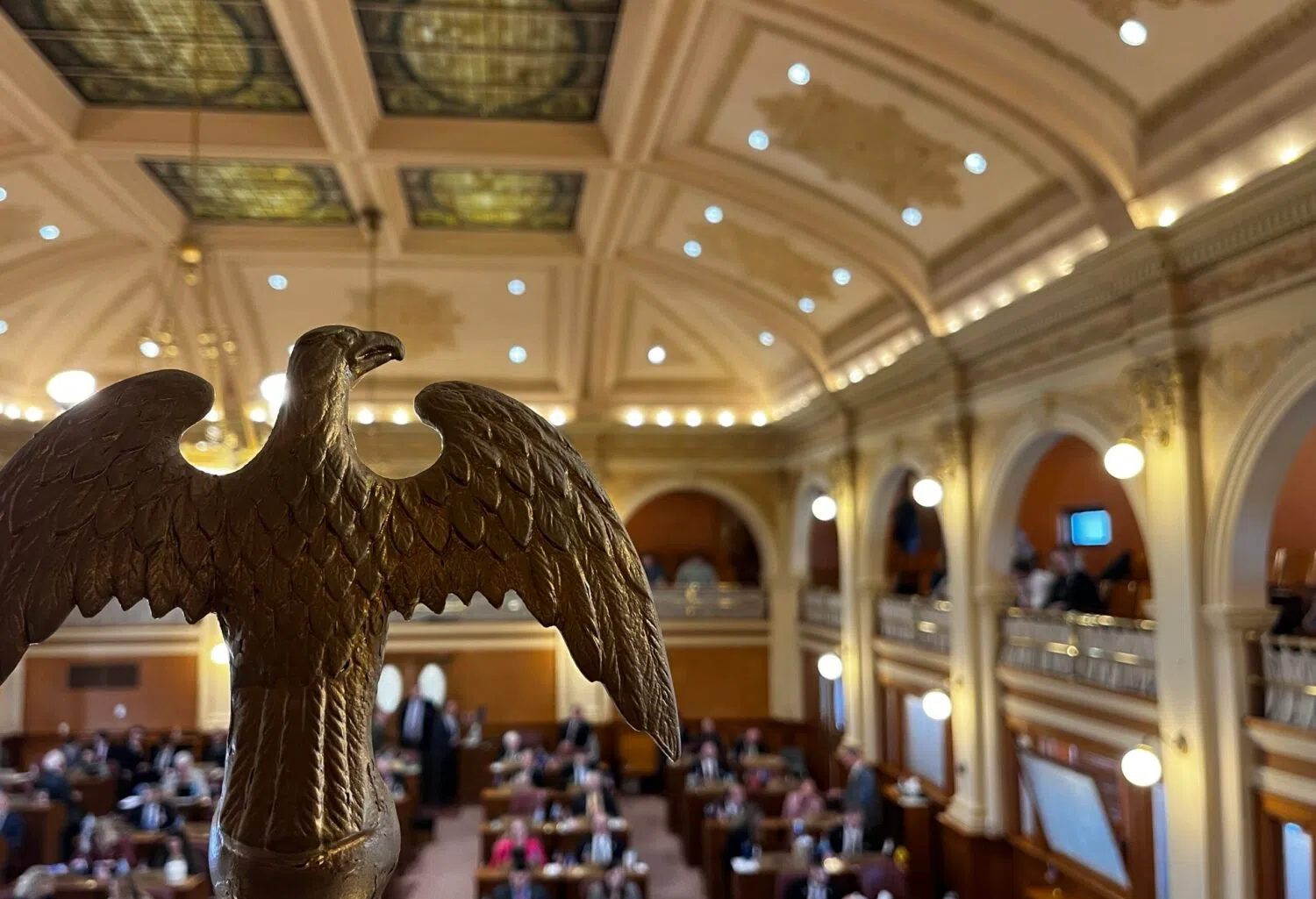
The South Dakota House of Representatives chamber at the Capitol in Pierre. (Joshua Haiar/South Dakota Searchlight)
By: Joshua Haiar and Seth Tupper
PIERRE, S.D. (South Dakota Searchlight) — A member’s unexplained absence and an unsuccessful search for him contributed to the defeat of two bills intended to incentivize data centers Tuesday during a chaotic afternoon for South Dakota state senators.
“It’s not a good look for the Senate,” said Sen. Tim Reed, R-Brookings.
The absent senator was John Carley, a Republican from Piedmont and an opponent of both bills. As the fate of the data center legislation hung in the balance due to a close margin of support and opposition, senators invoked rules pausing proceedings and launched an effort to find and return Carley to the chamber.
After a break of about 40 minutes, the Senate’s sergeant-at-arms returned with a report noting that Carley was not answering his phone — not even for the governor, who was enlisted to attempt a call — and could not be found. The search included reviewing footage from Capitol security cameras that showed Carley in the building earlier in the day, and looking for but not finding Carley’s vehicle in the parking lot.
Some senators interpreted Carley’s absence as a deliberate attempt to tank the bills. Based on prior close votes that were up for reconsideration, supporters of the bills had been hoping for at least a 17-17 tie vote that the lieutenant governor — presiding as president of the Senate — could break in favor of the legislation. Tie votes have been frequent this legislative session due to the health-related absence of Sen. Arch Beal, R-Sioux Falls, which has effectively reduced the number of senators from 35 to 34.
With Carley absent, there was no possibility of a 17-17 vote, and the chance that the bills would fail increased.
Tension began with Monday votes
Both of the bills were from Sen. Casey Crabtree, R-Madison. One would have altered a sales tax rebate program to accommodate data centers, and the other would have exempted backup generators — a common feature of large data centers — from permitting by the state Public Utilities Commission as long as the backup generators are not connected to the grid.
Data centers have been a controversial issue this legislative session as lawmakers have been split over whether to incentivize or discourage the construction of large data centers in the state. While some lawmakers have promoted the economic opportunities of data centers, others have expressed concern about data centers’ extreme electrical power demands and other potential impacts.
On Monday, Crabtree’s bill to provide sales tax rebates for data centers failed 17-16, one vote short of the 18 votes needed for passage, with Beal excused and an unexplained absence by Sen. Tom Pischke, R-Dell Rapids.
Pischke returned to the Senate chamber after Sen. Michael Rohl, R-Aberdeen, invoked a rule requiring Pischke to be brought back. Crabtree’s bill regarding backup generators then failed on a 17-17 tie vote that Republican Gov. Tony Venhuizen opted not to break.
Rohl later told South Dakota Searchlight that he had invoked the rules to ensure “all members were on the floor voting and not hiding in back offices.”
Pischke told Searchlight that when the Senate is split 17-17, allowing the lieutenant governor to cast the deciding vote effectively lets the executive branch determine the outcome of legislation in the Senate.
“The more opposition that you have to a piece of legislation, the more likely it is that the executive branch gets its way,” Pischke said. “That is wrong.”
After the failed votes Monday, Crabtree announced his intent to seek reconsideration of both bills, setting up a showdown for Tuesday. That was the last day for bills to pass their chamber of origin.
Struggle continues Tuesday
On Tuesday, Crabtree moved for reconsideration of the backup generation bill, but Senate President Pro Tempore Chris Karr, R-Sioux Falls, challenged the motion. Karr said the bill had already been reconsidered once and wasn’t eligible for another reconsideration. Venhuizen said the bill was eligible because it had been amended.
Karr appealed that ruling, and his appeal was supported 20-13 with Beal excused and Carley absent. That effectively defeated the backup generation bill.
Before the Senate moved on to the tax rebate bill, Rohl invoked the rules again in an attempt to force Carley back to the chamber, leading to the sergeant-at-arms’ fruitless search for Carley while other senators waited.
After the sergeant-at-arms returned, Karr moved to proceed without Carley, and the Senate voted to do so, 19-14.
Senators then took up Crabtree’s motion to reconsider the sales tax rebate bill. Rohl unsuccessfully tried to have the bill moved later on the agenda. That effort failed 16-17. Crabtree’s motion to reconsider the sales tax rebate bill then failed by the same vote tally.
Both data center bills are dead for now but could be resurrected as amendments to other bills between now and the end of the legislative session next month.
The chaotic scene Tuesday played out in front of Republican former Gov. Dennis Daugaard, who is also a former lieutenant governor and former state senator. Daugaared, the father-in-law of Lt. Gov. Venhuizen, was visiting and watched the Senate from the gallery.
Daugaard disapproved of the actions of Pischke and Carley.
“Both were, I believe, intentionally absent from their seats to avoid voting,” Daugaard said in response to Searchlight questions. “This was a parliamentary maneuver on their part, so that they could avoid voting. And I really think that’s a discredit to the citizens of their districts, who elected them.”
Pischke, in comments to Searchlight, drew a distinction between his own brief absence Monday and Carley’s “missing the whole day” Tuesday, which Pischke said he does not condone.




Comments