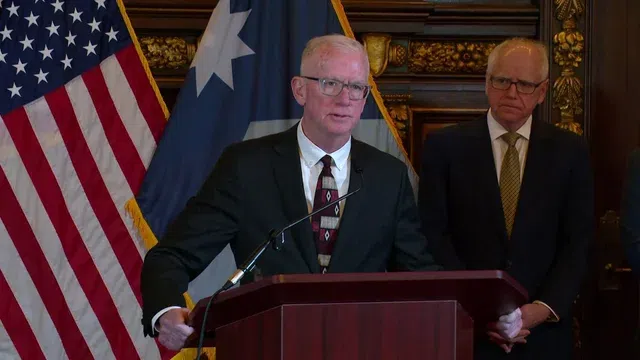
ST. PAUL, Minn. (KFGO-CBS) — The man tasked by Gov. Tim Walz with investigating the causes of and solutions to Minnesota’s ongoing fraud problem says the root of the issue goes back half a century, but the problems are fixable.
Director of Program Integrity Tim O’Malley released his 56-page Roadmap to Program Integrity and Fraud Prevention Monday morning, shortly before speaking to the media.
“I can’t imagine that people in leadership the past 50 years were not aware of this. The fact that this goes back so long is distressing,” O’Malley said.
However, O’Malley says it can be repaired.
“This is achievable. here’s no doubt in my mind that this can be fixed, but it’s going to take a concerted effort,” O’Malley said. “It’s going to take coordination within the state agencies, it’s going to take action by the Legislature, it’s going to take everybody in the executive branch and the legislative branch to take responsibility for failures in the past and to come up with something, some of these recommendations to prioritize and fund them. It will also take, and this is right out there, it will also take input from the stakeholders, from providers and recipients.”
O’Malley pointed to a lack of accountability, a culture of compassion over compliance and ill-executed plans as some of the causes for the state’s fraud crisis.
“We can learn from the past. Both the executive and legislative branches have the opportunity to fix this,” he said. “Everybody needs to be held accountable.”
While O’Malley is “impressed with the work being done right now” to combat fraud, he said there is much more the state needs to do to dam the leaks in the system effectively.
“There will always be people committing fraud. That will always happen,” O’Malley said. “The vulnerabilities gave them the opportunity to do this, and that’s where the state needs to focus its resources.”
The next step, O’Malley said, is to appoint an independent watchdog to ensure the recommendations put forth in his roadmap are actually put in place and followed.
“I think now is the time that something very positive could come out of this,” he said.
Walz appointed O’Malley in December, saying O’Malley would “work across state government to strengthen fraud protection and protect taxpayer dollars.” On Monday, O’Malley said Walz “has not interfered or tried to influence my work in any way.” He also said he has “not found any evidence that there was corruption within the government.”
The $250 million Feeding Our Future fraud scheme and allegations of fraud in other state programs prompted Walz’s announcement of the program in December. Its inception came weeks before Walz dropped his bid for a third term as governor, citing the increased scrutiny over state fraud as a sap on his political energy.
O’Malley is a former FBI agent, attorney, judge and superintendent of the Minnesota Bureau of Criminal Apprehension. The fraud prevention program was created with the aid of WayPoint, an outside forensics company.
The DFL and GOP have both indicated fighting fraud is a priority during this legislative session, but efforts to create an independent state watchdog face an uncertain future as lawmakers clash over what it should look like.
O’Malley said he has not reviewed any of the Legislature’s current proposals.
Roadmap plots path to reform
O’Malley’s roadmap “outlines a comprehensive strategy to prevent, detect and respond to fraud, waste and abuse across Minnesota’s executive agencies.” It was created after reviewing documents, interviewing state employees and leadership and meeting with “whistleblowers, service providers and private citizens.”
“The review confirmed what federal and state investigators have asserted: Minnesota has experienced significant, pervasive and long‑running fraud schemes, often involving coordinated networks of dishonest providers and recipients,” the roadmap states. “Those fraudsters took advantage of opportunities brought about, in part, because the state did not fulfill its obligations to maintain sufficient oversight and internal controls to ensure program integrity.”
The plan identifies nine “pillars of reform,” each with accompanying recommendations: leadership, accountability and culture, program processes and controls, administrative, investigative and prosecutorial coordination, training and workforce development, legislative actions, technology and data modernization, oversight and independent monitoring, stakeholder collaboration and engagement, resource and capacity building.
“Every executive branch leader, as well as every state employee, provider and recipient, plays a role in maintaining program integrity,” the roadmap reads. “State departments and agencies need to better balance their program integrity roles with their commitment to service provision.”
O’Malley recommends strengthening every step of the process, from enhancing background checks at enrollment to better stop fraud before it occurs to tougher enforcement methods and aggressiveness in recovering fraudulent funds. It also emphasizes better training for employees, modernized technology like real-time monitoring tools and the aforementioned independent monitor.
“Someone has to call balls and strikes and not feel any concern about offending anybody or causing concerns or problems for any individual or agency,” he said.
The report does note that “reforms must ensure that vulnerable Minnesotans continue receiving essential services from legitimate providers,” something O’Malley echoed in his news conference.
“We cannot put in place guardrails and measures that are overly burdensome on the legitimate providers,” he said. “These services are essential.”




Comments