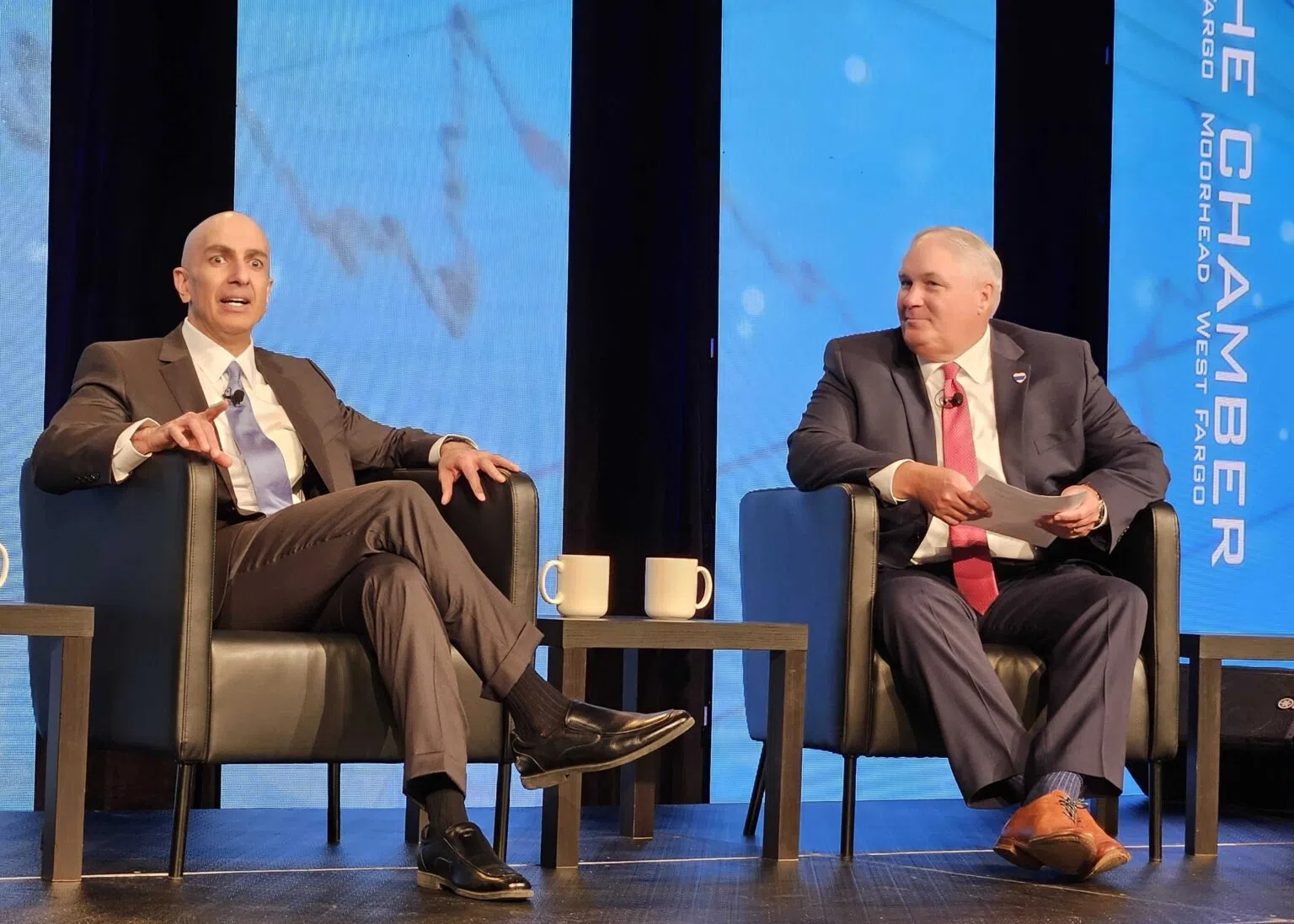
Neel Kashkari, left, president and CEO of the Federal Reserve Bank of Minneapolis, speaks Feb. 19, 2026, in West Fargo, North Dakota, at the Midwest Economic Outlook Summit. At right is Jim Ryan, chairman and CEO of Old National Bank. (Photo by Jeff Beach/North Dakota Monitor)
By: Jeff Beach
WEST FARGO (North Dakota Monitor) — North Dakota is seeing some improvement in workforce availability, but the supply of skilled labor in the construction industry will likely remain tight with immigration policy a key factor, a top federal economy official says.
Neel Kashkari, president and CEO of the Federal Reserve Bank of Minneapolis, said Thursday that a change in federal immigration policy in the last year is one of the factors limiting the availability of construction workers.
The Trump administration in September last year imposed a $100,000 fee for new H-1B visa petitions. Previously fees had ranged from $2,000 to $5,000.
“We know that immigrants have filled a lot of construction jobs, historically,” Kashkari told attendees of the Midwest Economic Outlook Summit in West Fargo. “This is a big policy change.”
With fewer workers to build apartment buildings and homes, less housing will be built and the construction costs will be higher, he said.
Kashkari noted that the big factors on construction and housing costs are labor and the cost of materials.
He said tariffs have driven up the cost of some goods, but that those prices should not continue to go up.
A third factor in housing affordability is interest rates. The Federal Reserve’s main tool in regulating the economy — trying to keep inflation in check but avoid a recession — is setting interest rates.
The Fed will cut interest rates to spur the economy, which it did during the COVID-19 pandemic and the chaos the coronavirus caused on businesses. Kashkari said the rate cuts meant a flood of people buying or refinancing a home at about 3% interest.
When the pandemic waned and the economy accelerated, the Fed pushed interest rates back up as a way to control high inflation.
While the Fed has made some interest rate cuts, a current mortgage rate of around 6% interest makes a home more expensive.
“I hear a lot from families saying, ‘Hey, I can’t afford to sell my home because I’ve got a 3% mortgage, and I can’t trade that in for a 6% mortgage,’” Kashkari said. “So this does have a real effect on everybody.”
Kashkari said another factor limiting the availability of construction workers is the boom in building data centers for artificial intelligence. The data centers require a lot of skilled labor, such as electricians and plumbers. Data center construction likely offers better wages than what those skilled workers can get in home construction or on service calls.
“This is life in a market economy,” Kashkari said. “If there’s a major investment in one sector of the economy, it’s going to draw resources from other sectors.”
Kashkari spent some of his time in the Fargo area visiting with employers.
“What I heard was more of the traditional service workers, they’re more fully staffed in some of those sectors that are less skill specific. And that indicates that, to me, the overall labor market is softer than it was a couple years ago,” he said in an interview.
But for other sectors, like skilled labor and health care, the labor market remains highly competitive.
University of North Dakota economist and professor David Flynn gave his take on the state’s economy during a Federal Reserve of Minneapolis Regional Economic Conference on Jan. 9.
He, too, said more workers were available for some sectors, but with any uptick in demand, it could easily tighten up
“We don’t just have people laying around,” to fill jobs, he said.
The state’s unemployment rate remains low at about 2.6%.
Arik Spencer, president and CEO of the Greater North Dakota Chamber, attributed some of the loosening of the labor market to employers being more cautious about filling jobs.
Spencer was part of the summit’s panel discussion on population and business trends, with immigration being a key topic.
The U.S. Census Bureau says population growth in the United States has slowed significantly because of a decline in international immigration.
Nigel Haarstad, state demographer with the North Dakota Department of Commerce, who recently projected that North Dakota has for the first time surpassed 800,000 residents, said international immigration has been a key driver of the state’s population growth.
Shannon Full, president and CEO of the Fargo Moorhead West Fargo Chamber of Commerce that hosted the summit, said with the southern border of the United States secured, the next step should be reforms in the legal immigration process.
Spencer said a frustration for many businesses is trying to figure out who is willing to work on immigration reform.
“We are a state of immigrants, and it’s important to remember that,” he said.




Comments