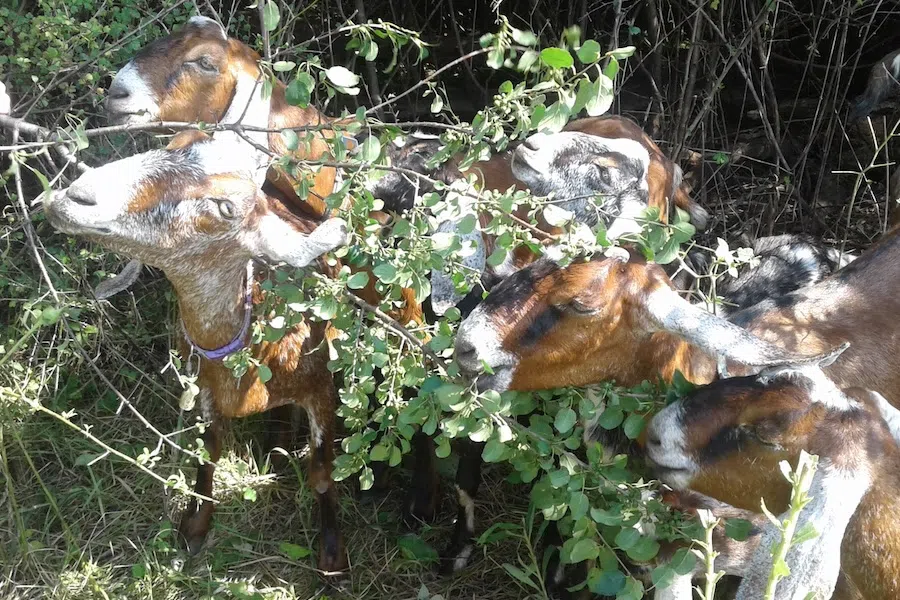
Goats eating buckthorn leaves and twigs during an experimental prescribed browsing session. Credit: Sara Nelson
Goats are increasingly being used in efforts to manage invasive common buckthorn in Midwestern woodlands. New research demonstrates when and how they are best used.
In a new study published in Restoration Ecology, a University of Minnesota research team examined the effectiveness of goat browsing (targeted grazing using goats) as part of a broader restoration strategy, and the potential for collateral damage of goats on native vegetation.
Funding for this project was provided by the University of Minnesota’s Minnesota Invasive Terrestrial Plants and Pests Center, supported by the Minnesota Environment and Natural Resources Trust Fund as recommended by the Legislative-Citizen Commission on Minnesota Resources.
The researchers performed field experiments in which buckthorn-dominated areas were or were not treated with goat browsing across eight sites. All vegetation (including buckthorn, other invasive species and native species) was sampled before, immediately after and at least one year (and up to three years) after browsing ended. The study found:
- Targeted grazing is one more potential tool for woodland restoration. Situations when it may be most useful include limited availability of human labor, prevalence of stakeholders that are strongly opposed to herbicide use and steep or rugged terrain.
- Conversely, use of goats may be ill-suited where there are key native species at high risk of negative impacts, such as threatened or endangered plants, high-priority shrubs or juvenile trees, or other sensitive organisms.
A primary concern of land managers regarding targeted grazing is potential negative impacts on native plants. While such impacts can be substantial in the short-term, the study found that over longer time frames, targeted browsing by goats can increase native plant diversity. However, this potential benefit is tempered by a finding that immediate decreases in buckthorn cover were short-lived, suggesting that land managers will need refined strategies for employing goat browsing to reduce buckthorn on the landscape.
“Is the enemy (goats) of native plants’ enemy (buckthorn) their friend?,” said Dan Larkin, co-author of the study and a professor in the University of Minnesota College of Food, Agricultural and Natural Resource Sciences, and an Extension specialist.
“That’s the question we sought to answer. Goats cause visually impressive damage to buckthorn and native plants alike when they browse. But then both more or less bounce back within a year. Goat browsing can be a useful element of the Swiss Army knife of woodland restoration, but they need to be used in the right way at the right time as part of a broader, multi-pronged strategy.”
University of Minnesota news release




Comments