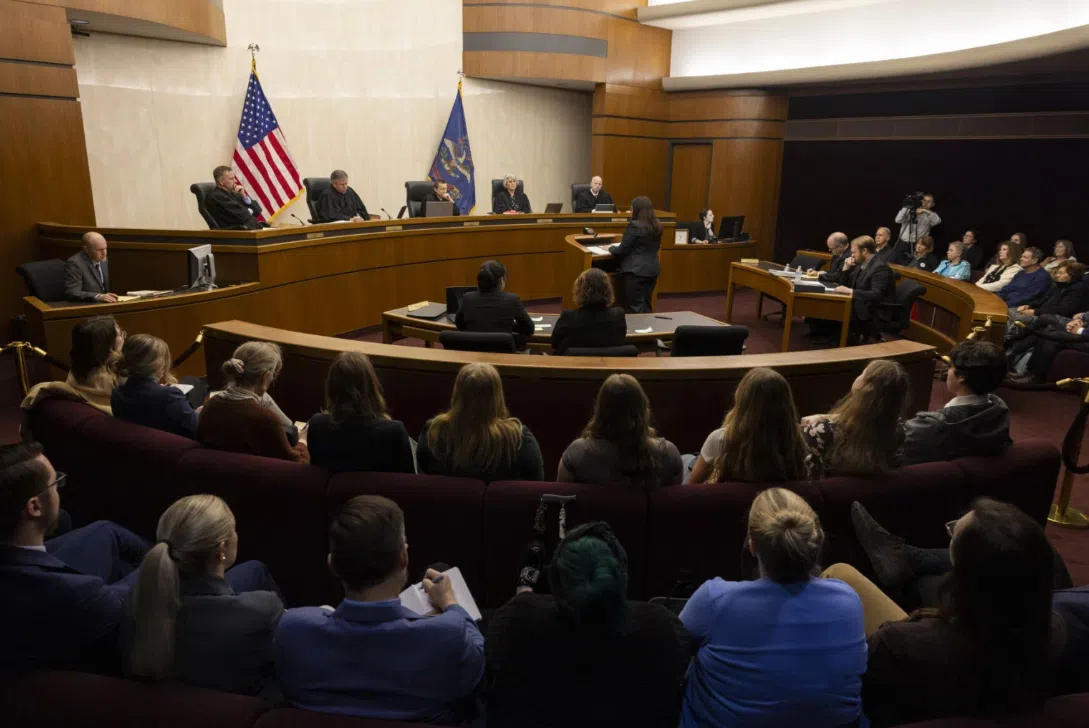
The North Dakota Supreme Court hears arguments March 15, 2025, over a challenge to the state’s abortion ban. (Pool photo by Tanner Ecker/Bismarck Tribune)
BISMARCK, N.D. (North Dakota Monitor) – North Dakota courts this year sided with the state in two civil rights lawsuits challenging sweeping restrictions on abortion and transgender medical care adopted by the Legislature in 2023.
Meanwhile, a district court judge sided with landowners in a lawsuit challenging the constitutionality of a law that affects underground carbon storage. Other ongoing cases include a lawsuit from two tribes against the state’s redistricting map, which could get review from the U.S. Supreme Court, and a free speech challenge against a North Dakota law regulating campaign advertisements.
Abortion ruling
North Dakota’s near-total abortion ban survived its review before the North Dakota Supreme Court after the justices failed to reach the supermajority vote required to declare it unconstitutional.
Three of five justices in a November opinion found the law unconstitutionally vague, but a vote of four is needed to strike it down.
The law makes abortion illegal in all cases except rape or incest if the mother has been pregnant less than six weeks, or when the pregnancy would be considered a serious physical health threat under “reasonable medical judgment.” It was signed by former Gov. Doug Burgum in April 2023 just weeks after the Supreme Court struck down a previous abortion ban.
The decision reversed a fall 2024 district court decision that declared the ban unconstitutionally vague and found that women have a right to seek abortions until the point of fetal viability.
The three justices that found the law unconstitutional were Daniel Crothers, Lisa Fair McEvers and Daniel Narum, a district court judge who sat on the case in place of Douglas Bahr, who recused. Chief Justice Jon Jensen and Justice Jerod Tufte found the law constitutional.
Citing testimony from doctors, Crothers wrote in the majority opinion that the law is too vague for medical professionals to understand how it works. He said this also means the state will not be able to enforce it fairly.
Tufte in his dissenting opinion wrote that the ban is not unconstitutionally vague. He said that plaintiffs argued their case based on hypotheticals could not point to any situations where the law had harmed North Dakotans because of vagueness.
Tufte also noted that when North Dakota adopted its constitution in 1889, abortion was illegal except when necessary to save the life of the mother. He said if North Dakotans want broader protections to abortion access, they need to amend the constitution.
Ban on gender-affirming care for minors
A North Dakota judge this fall found the state’s ban on gender-affirming care for minors is constitutional. He found that the state had an interest in passing the law because the science behind gender-affirming care is unsettled and adolescents may not be able to understand the risks.
The law makes it a crime to prescribe puberty blockers and hormone therapy to adolescents to treat gender dysphoria.
A group of families with transgender kids and a pediatric endocrinologist filed suit over the ban in 2023, arguing that it infringes on personal autonomy and discriminates on the basis of sex.
Before the case went to trial in January, Lofgren dismissed the transgender teens and their families from the case, finding that they don’t have standing to participate in the suit. That left pediatric endocrinologist Luis Casas as the sole plaintiff.
Some of the kids and their parents still testified during the trial about how gender-affirming care had changed their lives for the better. Casas and other medical experts also testified against the ban.
Expert witnesses for the state, some of which had their credibility disputed in other lawsuits, said that gender-affirming medication has not been proven safe for minors.
The plaintiffs have not said whether they will appeal the ruling to the North Dakota Supreme Court.
Landowner lawsuit
A district court judge earlier this month sided with a landowner group and ruled that a law related to the underground storage of carbon dioxide is unconstitutional.
The Northwest Landowners Association in 2023 filed a lawsuit against the state of North Dakota and the Industrial Commission, the state agency charged with permitting carbon dioxide storage projects.
The law enabled the Industrial Commission to force landowners to allow carbon dioxide to be stored under their property, without their consent, as long as a company secured permission from the owners of at least 60% of the affected land area.
Northeast Judicial District Judge Anthony Swain Benson wrote in his opinion that the law is unconstitutional because it enables a government-authorized taking of property without “just” compensation determined by a jury. In this case, the property is pore space – cavities in underground rock formations where emissions can be trapped.
The decision could have implications for multiple existing and planned carbon dioxide storage projects in the state, including Summit Carbon Solutions’ proposed interstate pipeline. Summit’s project would transport emissions from ethanol plants in five states to North Dakota to be injected into the ground at the intersection of Mercer, Morton and Oliver counties.
North Dakota Attorney General Drew Wrigley said on Dec. 17 the state is considering whether to appeal the ruling to the state Supreme Court. The state and companies that intervened in the case, including Summit, will have 60 days from the date of the judge’s order to decide whether to appeal. The order has not been issued yet.
Other challenges to state laws
Also in 2025, an appeals court overturned a North Dakota federal court’s decision related to redistricting. A federal judge had previously found that the state’s 2021 redistricting plan unlawfully diluted the power of Native American voters.
The Turtle Mountain Band of Chippewa, Spirit Lake Nation, and three tribal citizens filed suit over the map in 2022, arguing that the new district lines had caused them to lose representation in the state Legislature.
The tribes officially petitioned the U.S. Supreme Court to hear the case in September. The court has not made a decision whether to review the lawsuit.
The 8th Circuit Court of Appeals not only overturned U.S. District Court Judge Peter Welte’s decision that sided with the tribes, but it also found that private groups do not have the right to challenge state or local governments over allegedly discriminatory voting practices. The appellate court said only the U.S. Department of Justice can bring such cases.
The tribes say that if the ruling is allowed to stand, it would not only limit their representation in the North Dakota Legislature but be a detriment to racial equality across all seven states in the 8th Circuit.
The state of North Dakota says its 2021 map is not discriminatory and supports the 8th Circuit’s decision. It has argued that allowing private plaintiffs to bring such lawsuits destabilizes state district maps.
In a separate case, a former North Dakota lawmaker recently sued the state in federal court over a law that makes it a crime to lie or make intentionally misleading statements in political ads, arguing it violates the First Amendment of the U.S. Constitution. Brandon Prichard, a former state representative who is partly known for his attacks on incumbent Republican lawmakers, claims in the lawsuit that he and his wife have been subject to multiple unfair investigations under the law. The lawsuit names Attorney General Drew Wrigley, Burleigh County State’s Attorney Julie Lawyer as well as the North Dakota Ethics Commission and its executive director, Rebecca Binstock, as defendants. The case is still in its early stages. Some of the defendants have filed motions asking the judge to dismiss the suit.



Comments