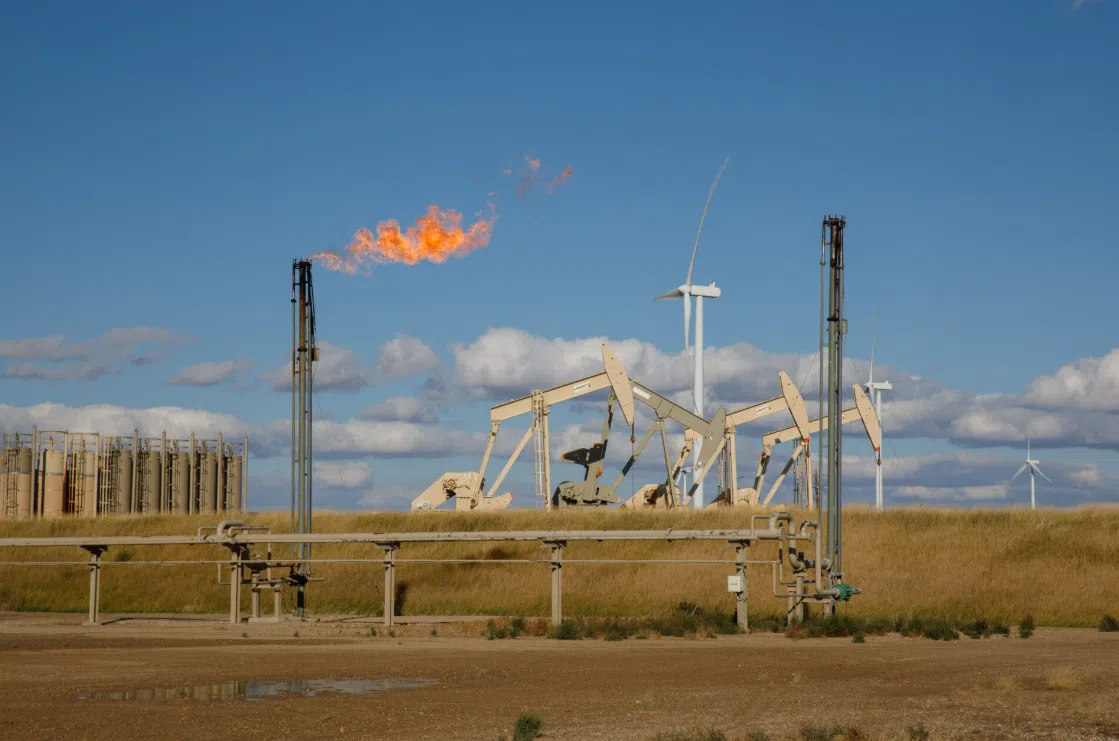
Natural gas and other energy infrastructure is pictured in Williams County, North Dakota, in September 2024. A state program aims to invest Legacy Fund dollars into North Dakota infrastructure. (Photo by Kyle Martin/For the North Dakota Monitor)
BISMARCK, N.D. (North Dakota Monitor) – The first investment of North Dakota Legacy Fund dollars into an in-state infrastructure project could be made in early 2026 and help bolster a proposed pipeline to export natural gas out of the Bakken oil field.
The state has allocated $150 million from the Legacy Fund for investment in “asset-based projects,” such as infrastructure, real estate and agriculture. The Legacy Fund, which invests state oil and gas revenue, was recently valued at $13 billion.
“We have billions and billions of dollars of infrastructure that needs to be worked on in North Dakota,” said Rep. Mike Nathe, R-Bismarck, the primary sponsor of the 2021 bill that led to the program’s creation. “This tranche of money will definitely help us take care of that need.”
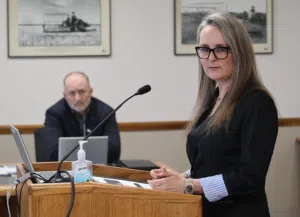
Jodi Smith, executive director of the North Dakota Retirement and Investment Office, listens to a lawmaker’s question during a meeting of the Legacy and Budget Stabilization Fund Advisory Board on Oct. 22, 2025. (Photo by Jacob Orledge/North Dakota Monitor)
That program, officially called the North Dakota Real Assets Fund and informally known as the in-state infrastructure investment program, has not made any investments yet. GCM Grosvenor, a New York investment firm, was hired this summer to manage the fund.
GCM Grosvenor will make investments in increments of $10 million and $25 million. The firm plans to deploy around $50 million over the next three years.
The firm is in the early stages of reviewing four opportunities and will likely make decisions on two possibilities in 2026, said Michael Rose, one of two managing directors for infrastructure alongside Scott Litman. The pair briefed lawmakers on the program’s status on Oct. 22.
The first possible project is a natural gas pipeline proposed by Intensity Infrastructure Partners that would connect McKenzie County to Rainbow Energy’s planned industrial park in central North Dakota. The second is a network of crude oil and natural gas gathering pipelines in the Bakken.
GCM Grosvenor is avoiding projects where the state’s investment would represent a significant portion of the total financing. The team is focusing on opportunities where the state’s investment will represent a small slice of the total cost and the project is nearly ready for construction.
That’s aligned with state officials’ goal of leveraging small, diverse investments to attract additional funds from outside North Dakota.
“We want to bring outside capital in to benefit the state,” said Sen. Brad Bekkedahl, a Republican from Williston, during the Oct. 22 meeting.
GCM Grosvenor manages infrastructure investments for 150 clients. Stephen Brewster, managing director of client services for GCM Grosvenor, said the firm has the ability to make larger investments in a project, beyond what it manages for the Legacy Fund.
“That’s a great opportunity for the state,” Brewster said. “If the investment is good enough for North Dakota, and we’re the ones reviewing it, it should be good enough for other clients as well.”
GCM Grosvenor is the second outside firm hired to invest Legacy Fund money in the state. The North Dakota Growth Fund, managed by 50 South Capital, was established in 2021 and is authorized to invest up to $250 million in private equity funds and private companies with the goal of stimulating North Dakota’s economy while still generating a return on investment. The firm has invested $73.6 million as of June 30.
North Dakota also uses Legacy Fund money to support two different low-interest loan programs through the Bank of North Dakota.
No political influence
A key principle underlying the in-state investment of Legacy Fund money is to insulate the decision-making from political influences.
“We did not want North Dakota politicians influencing and directing money for investment because of their goals, or their friends’ goals, or their connections’ goals,” Bekkedahl said.
That’s one reason external investment firms like GCM Grosvenor have been hired to manage these investments. The firm, by design, has the autonomy to invest the $150 million without approval from state officials on any given project.
“We should not be biasing the decision through any of our political influences and or personal preferences for a project,” said Jodi Smith, executive director of the state Retirement and Investment Office. “And so that’s why we have Grosvenor because they will look at it independently from us and make a determination if it’s still a good investment of the fund.”
The policy also limits the state’s oversight of how the Legacy Fund is invested. The Retirement and Investment Office, which oversees the in-state investment programs, only has one concrete remedy if state officials are not satisfied with GCM Grosvenor’s decisions.
“We would always have the right, if we didn’t like what we were seeing, to terminate them as a manager,” said Lance Ziettlow, a portfolio manager with the Retirement and Investment Office.
GCM Grosvenor has to abide by the state’s investment policy, developed by the State Investment Board and the Legacy and Budget Stabilization Fund Advisory Board, which includes guardrails such as a $25 million limit on any single investment. But the state is by and large relying on GCM Grosvenor’s internal due diligence process to ensure the $150 million is invested wisely.
The firm’s due diligence process is designed to assess a broad range of risks and benefits associated with each project, Litman said in an email. The firm typically invests in fewer than 10% of the deals it investigates, he said.
“We bring deals to a vote of our Investment Committee and Operational Due Diligence Committee, and only after the approval of each committee will we consider making an investment,” Litman said.
Natural gas pipeline moving forward
The natural gas pipeline is the opportunity that is furthest along GCM Grosvenor’s review process, with a decision anticipated in the first three months of next year.
The pipeline is being developed by Oklahoma-based Intensity Infrastructure Partners. The company was one of two that applied for a $500 million financial guarantee from the North Dakota Industrial Commission, but commissioners instead chose a competing pipeline project from WBI Energy.
Intensity announced in June the pipeline would be a partnership with Rainbow Energy, the owner of Coal Creek Station in Underwood, to help provide power to a planned industrial park on the property.
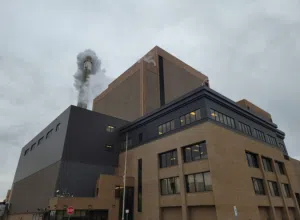
Coal Creek Station, near Underwood, is owned and operated by Rainbow Energy Center. (Photo by Jacob Orledge/North Dakota Monitor)
Rainbow Energy is negotiating with a data center developer interested in building in the nascent industrial park, said Jessica Bell, vice president of external affairs, during a November presentation. The data centers would be powered by a combination of the coal-fired power plant and a planned natural gas power plant.
Bell declined to specify the companies Rainbow is working with during her November presentation to lawmakers. A spokesperson for Intensity did not return requests for comment.
GCM Grosvenor’s Rose said they have interest in the Intensity pipeline as an investment opportunity because of how advanced the project is and the “steady cash flow” it will generate once built.
“There’s no real risk here,” Rose said.
Both Intensity’s pipeline and the network of gathering pipelines were brought to the firm’s attention by EIV, a venture capital firm GCM Grosvenor often works with. EIV is investing around $100 million of its own funds in each project, Rose said.
GCM Grosvenor also is considering investing in the Davis Refinery proposed by Meridian Energy Group as well as two manufactured housing communities in Williston. The firm had also done due diligence on investing in multi-family housing in North Dakota, Colorado and Minnesota, though that deal is no longer available.



Comments