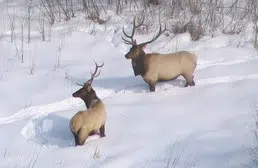
After the Minnesota DNR’s aerial elk survey last winter revealed lower than expected elk numbers, we made the decision to reduce elk harvest opportunities for state hunters.
For the 2025 elk hunt, the Minnesota DNR issued four elk licenses: two either-sex tags in a September 9-day season, and two antlerless tags in a September to early October 9-day season. Given the reduction in available state permits, we did not make tags available for the 10-year applicant history pool or for eligible agricultural landowners who reside within elk range. Elk hunting was only open for Zone 30 in northern Kittson County, where the Caribou-Vita elk herd resides. The Caribou-Vita herd is considered an international herd, as it spends time on both sides of the U.S.-Canada border throughout the year.
Hunters harvested two bulls in Zone 30, successfully filling both of the state-issued either-sex licenses. No antlerless elk were harvested with either of the state-issued antlerless licenses.
The Red Lake Band of Chippewa also hunts elk within the boundaries of the 1863 Old Crossing Treaty Area. The 2025 Red Lake elk season is currently ongoing, running from Sept. 15 to Dec. 31, and harvest is capped at five either-sex and five antlerless elk for Tribal members.
The conservative tag allocation in 2025 reflects ongoing efforts to protect and stabilize Minnesota’s small elk herds while still providing carefully managed hunting opportunities. Managers will use the upcoming aerial survey and harvest data to guide future decisions and continue working toward long-term herd resilience.
Update on the elk life history project
elk collars lined up and ready for fitting to wild Minnesota elk this winter
These GPS collars have been programmed and tested, and are ready to be deployed on elk starting in January in northwest Minnesota.
What are we doing?
This winter a team of scientists, biologists and wildlife managers from the Minnesota DNR, Red Lake Nation and Fond du Lac Band of Lake Superior Chippewa will gather in far northwest Minnesota with a collective goal — to put GPS collars on up to 25 cow and 15 bull elk. These collars will record locations of elk every 3 hours and transmit locations via satellite to the research team on daily basis for the next 4 years. Pregnant cows will also be outfitted with specialized transmitters that will send an alert to the team when they’ve given birth. This will allow the team to quickly find the newborn calves so they can also be collared and tracked.
Why are we doing this?
Using GPS collars to track the locations of adults and calves will provide information on how elk in northwest Minnesota use the landscape, how that use changes depending on the time of year, food availability, and different life events such as calving and the rut. Locations from GPS collars will also provide information about when elk move between our different elk herds and how that might contribute to genetic diversity within our small elk population. The GPS collars also help the team gather vital information to help identify causes of death by sending a mortality alert after the collar has stopped moving for several hours. The mortality alert system helps the team find elk quickly after death and hopefully before scavengers or decomposition can impact evidence at the scene.
What else can we learn?
In addition to gathering information on how these elk live (and die), we will also use GPS collared animals to help improve how we count elk during our annual population estimates. Having known locations of collared animals while we fly our survey can help us understand how many elk we miss, and potentially in what conditions we miss them. For instance, we might miss more elk when they are in thick pine forest versus when they are in open prairie or shrubby areas. We can then build in “corrections” to our estimates that account for these unobserved animals.
We are excited to kick off this project, to meet our goals this winter of capturing and collaring 40 adult elk and then regrouping to start the planning process to do it all over again with 40 new elk in winter 2027!
What elk eat and how elk enhance habitat for other wildlife
a bull elk with grass in its mouth
Photo courtesy of Danielle Brigida/USFWS
Elk in the upper Midwest (Minnesota, Wisconsin and Michigan) inhabit a mix of forested and open landscapes. Here in Minnesota, elk are found in the Tallgrass Aspen Parkland region which is made up of a combination of brushlands, grasslands and aspen patches.
Elk are herbivores, and like white-tailed deer, are a class of herbivores called ruminants. This means their digestive systems operate much like cattle, with four-chambered stomachs that allow for the breakdown and digestion of grasses, shrubs, and woody materials like the shoots, stems, and bark of trees.
Some ruminants eat mostly grasses and forbs (flowering herbaceous plants), and we call these animals “grazers” while others eat mostly shrubs and other woody plants, and we call these animals “browsers.” In Minnesota, we have three species of large herbivores — elk, deer and moose. The diets of these species all have some overlap, but elk tend to eat more grasses and forbs than deer. Deer typically have fewer grasses and forbs and more woody species in their diet than elk, but less woody foods in their diet than moose, which eat mostly shrubs and twigs.
an elk, white-tailed deer and moose amongst the plants they would graze or browse on
This graphic shows where elk, white-tailed deer, and moose fall along the spectrum of grazing animals to browsing animals. Grazers eat mostly grasses and forbs while browsers eat mostly woody plants, but there are many animals that have a mixed feeding strategy and eat grasses, forbs, shrubs, and trees.
During snow-free months in northwest Minnesota, elk diets are dominated by grasses and forbs. As winter sets in and green plants get buried under snow, they switch to woody browse, including twigs, bark, and branches from shrubs and trees. Winter is when elk and deer diets are most similar in northwest Minnesota. When available, elk also take advantage of agricultural crops near the edges of wildlands.
Because elk graze large quantities of grasses and forbs, they prefer open meadows and brushy areas. Their eating style also means elk can play an important role on the landscape by maintaining many small forest openings, through grazing and browsing. These small openings maintained by elk are used by species like songbirds, turkeys, deer and grouse. As a large herbivore, their eating habits are similar to a lawn mower — light maintenance over time means brushy growth and tree regeneration doesn’t overtake these important openings. Check out the DNR elk webpage for more about Minnesota elk.
Prescribed fire as a tool to maintain elk habitat
burnt ground and oak trees standing with the sun shining through
The scene after recent fall prescribed fire on Skull Lake WMA, photo courtesy of Austin Denman/The Nature Conservancy
The landscapes of northwest Minnesota require disturbance to maintain open, grassland habitats. Prescribed fire is one of the tools we use to help keep our prairie habitats a diverse array of grasses and forbs — food that elk love to eat. Elk are grazers that tend to seek out grasses and forbs, whereas browsers like white-tailed deer feed more often on shrubs and woody plants.
In Kittson County, DNR wildlife staff partner with The Nature Conservancy to implement prescribed fire in Minnesota’s elk range. These planned events require extensive training, staff and equipment to pull off. A burn plan is written, reviewed, and approved that details how a fire will be controlled using a sufficient number of trained staff, types of fire equipment, and in what weather conditions.
A recent example is a prairie-oak savanna plant community in Skull Lake Wildlife Management Area. This site requires fire every 3-5 years to maintain these habitats. This past fall, we burned a few targeted acres of dry sand dune and oak savanna plant communities. In particular, these acres had areas where brush was encroaching and were mechanically mowed in mid-summer. We then came back in the fall with 10 staff and equipment to implement a prescribed fire. Thirty-five acres were burned to help clean up and reduce the woody debris from the mechanical mowing. It should also give us that one-two punch to set back the woody encroachment. Keeping woody vegetation mowed helps grasses and flowering plants thrive, which in turn attracts elk and many other species of wildlife.




Comments