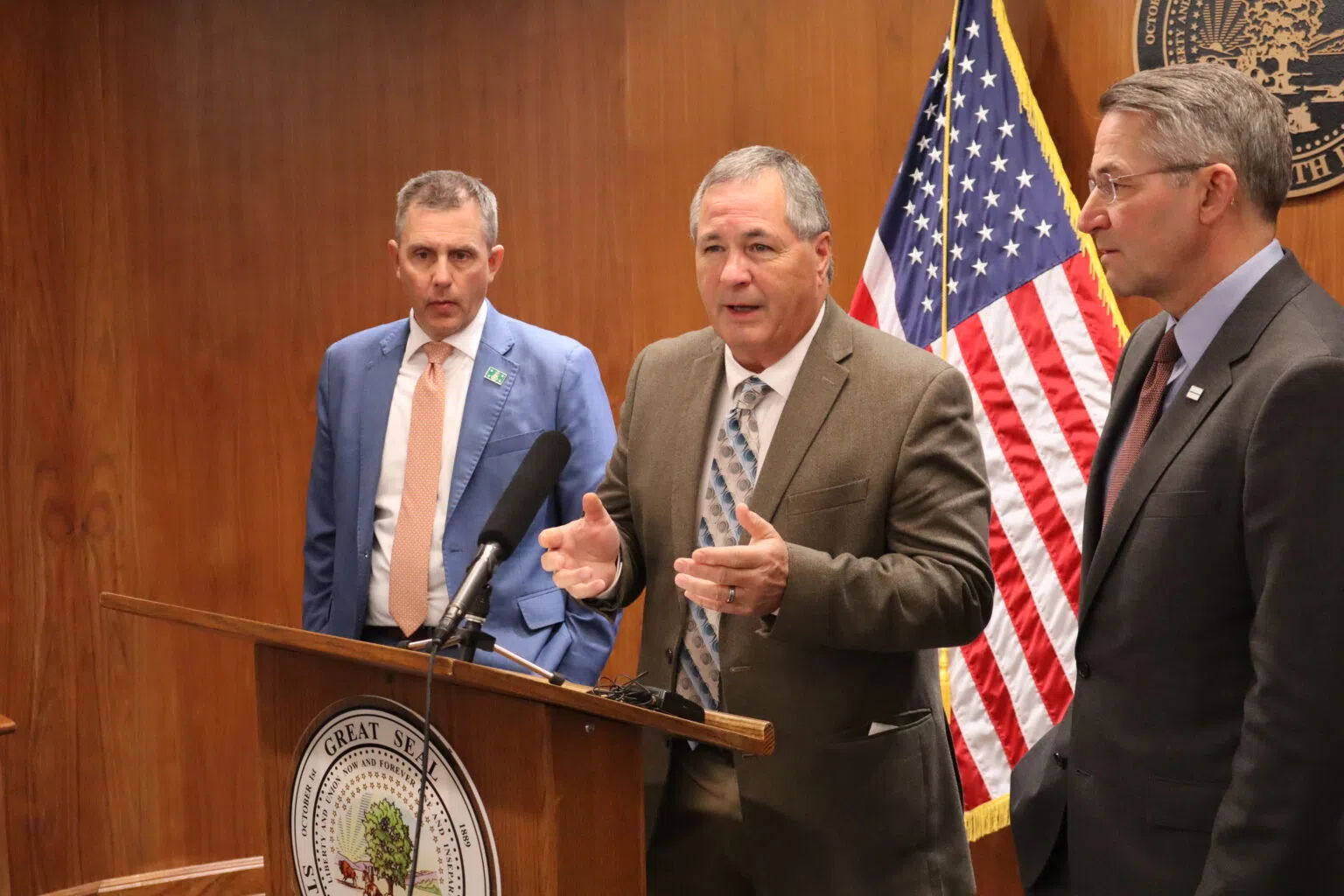
Agriculture Commissioner Doug Goehring, center, discusses two loan programs developed by the Bank of North Dakota to provide financial relief to agriculture producers in the state. Gov. Kelly Armstrong, left, Attorney General Drew Wrigley, right, and Goehring compose the North Dakota Industrial Commission. (Photo by Jacob Orledge/North Dakota Monitor)
By: Jacob Orledge
BISMARCK, N.D. (North Dakota Monitor) – The North Dakota Industrial Commission on Tuesday gave the state bank a green light to proceed with two loan programs aiming to provide relief to agricultural producers hit by a combination of tariffs, low commodity prices and high costs, as well as a series of summer storms.
The state-owned Bank of North Dakota is setting aside $300 million for the 2026 Farm Financial Stability Loan Program, the larger of the two initiatives. Farmers and ranchers who experienced an operating shortfall in 2024 or 2025 will be eligible to apply for low-interest loans through their local banks and credit unions.
“Ag is still the foundation of every single community in our entire economy in North Dakota,” said Gov. Kelly Armstrong, chair of the Industrial Commission, which oversees the Bank of North Dakota. “In these uncertain times, we need to help stabilize that foundation the best we can.”
Kaylen Hausauer, financial institutions market manager for the Bank of North Dakota, said the final interest rates available for the loans will likely be around 4.3% or 4.4%, below the bank’s current base rate of 7%. Up to 75% of the loan amount will be provided by the Bank of North Dakota, but ag producers will apply through their local lender.
“This fits right in our mission,” said Don Morgan, CEO of the Bank of North Dakota. “It is a balanced help for our agricultural industry, and it is a time when the industry is extremely stressed.”
The loans will help agricultural producers restructure existing debts, convert recent operating losses into loans with extended repayment schedules and ensure they have money on hand going into the 2026 planting season.
“We’re headed in the right direction, and I do believe that we as a state probably have the most to offer our farmers and ranchers by providing this type of backstop,” said Doug Goehring, agriculture commissioner and member of the Industrial Commission alongside Armstrong and Attorney General Drew Wrigley.
Armstrong said there are farmers in the state who would be unable to continue farming next year because of their financial situation if this program were not implemented.
The Department of Agriculture’s mediation program is aware of a number of farmers who are having financial problems as a result of storm damage, market headwinds and other factors, Goehring said.
“It’s all compounded,” Goehring said.
The second program approved Tuesday, the 2026 Grain Inventory Loan Program, will help local farmers who are stuck with leftover inventories from the 2025 harvest. Farmers can apply for short-term financing of the leftover crop, allowing them to hold on to it until prices improve.
“The short-term loans will benefit all producers, especially young and beginning farmers, who often lack the equity and working capital of older, more established producers,” Armstrong said.
The Bank of North Dakota has allocated $100 million for the program. The loan rates are slightly below market rate.
“We don’t want to incentivize them to hold on to the grain longer than needed,” Hausauer said. “But it is a tool to use if needed.”
These programs are only possible because of North Dakota’s unique advantage of having a state-owned bank with the resources to provide relief to the agriculture industry in times of stress, the governor said.
“We’re committed to deploying those tools as needed to provide a lifeline to the hard-working farmers and ranchers who grow the food we put on our tables at Thanksgiving and all year round,” Armstrong said.
Producers can begin applying for either program through their local bank or credit union beginning at noon Dec. 9. The application deadline will be June 30, 2026.
“It might put our producers in a better position financially than other producers around the country,” Goehring said.




Comments