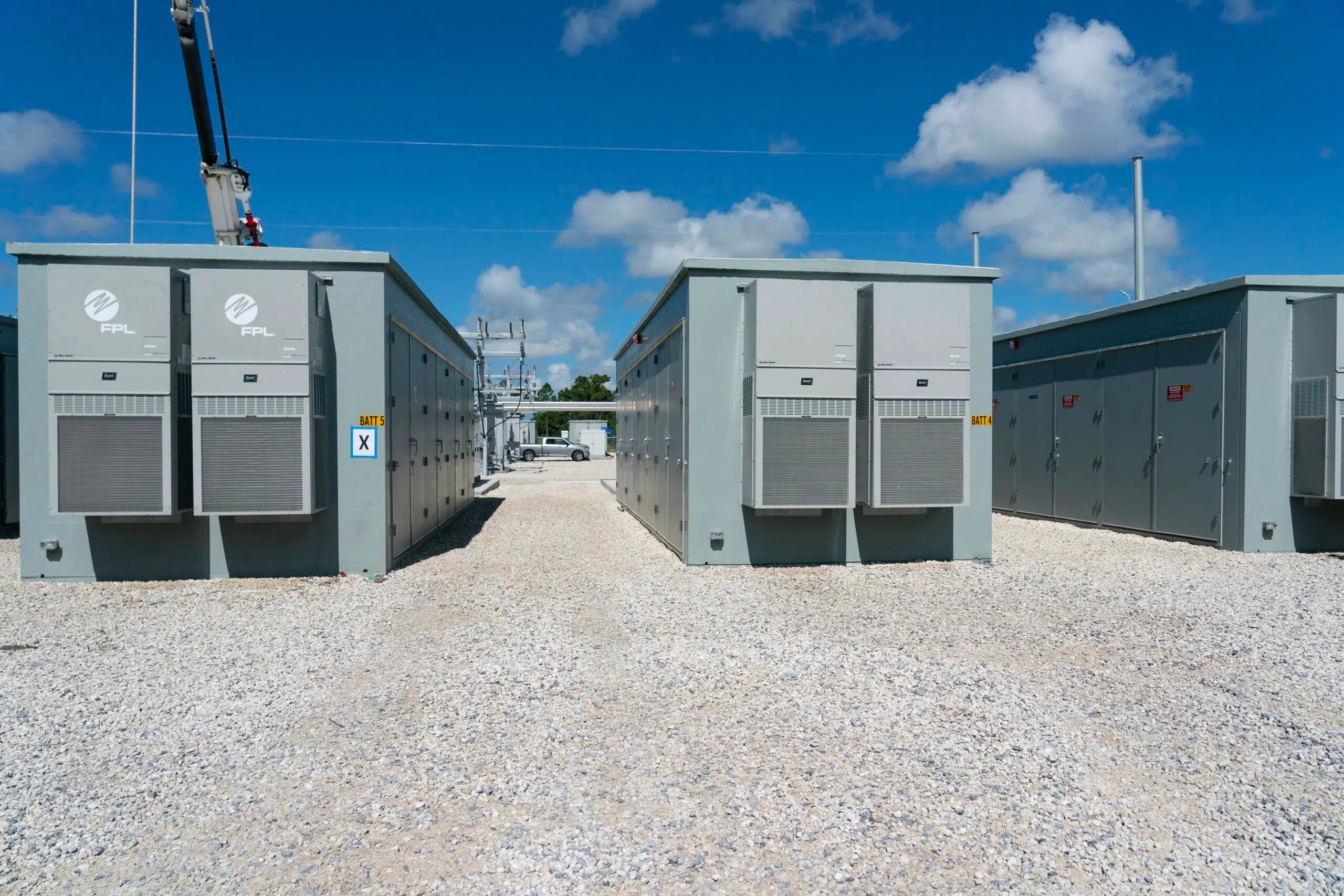
FPL Manatee Solar Battery Construction Update in Manatee Energy Storage Site in Parrish, Fla. on August 12, 2021.
By: Peyton Haug
LINTON, N.D. (North Dakota Monitor) – For the first time, North Dakota utility regulators are considering proposals for massive battery storage sites that would serve as backstops for renewable energy sources.
Battery Energy Storage Systems hold energy when it’s produced in excess, such as when wind farms see especially windy days, or when solar panels absorb more sun energy than what’s in demand. Energy harvested by the batteries is later used when those resources are in deficit.
Such technology has been materializing across the country in recent years, receiving generous production tax credits from the federal government.
In theory, the sites could help reduce congestion on the power grid and potentially alleviate cost fluctuations that can otherwise cause price spikes for customers. But it’s too early to tell whether that’s the case for projects being proposed in North Dakota, according to Director of Utilities for the Public Service Commission Victor Schock.
The first-ever project under consideration is being proposed by NextEra, a company with several wind farms across the state including a location in Emmons County. That wind farm is where the company is looking to put its $181 million battery storage site, according to its application to the Public Service Commission.
Chair Randy Christmann said he’s apprehensive of normalizing battery storage systems in the state: “I just don’t know how the benefit compares to what it’s costing.”
He said he’s concerned about the grid becoming “reliant” on energy stored in the lithium-ion batteries, especially since the materials typically come from “adversarial” countries.
China produces the majority of the world’s lithium-ion batteries, according to the U.S. Energy Information Administration.
NextEra told the North Dakota Monitor in an emailed statement that the specific battery system has not been finalized for the Emmons County project, but the company has “secured arrangements to source a U.S.-made battery for a significant portion” of its portfolio.
The massive battery units would have the capacity to store 140 megawatts, the amount of electricity used by approximately 13 average homes in one year, according to the U.S. Energy Information Administration.
Overall, the project would use 24 acres already housing an adjacent wind farm, with construction beginning May 2026 and, if the project is approved, operations starting as early as December that year. It would bring around 150 construction jobs and one to three permanent jobs, the company estimates.
Over the 25-year span of the operation, the county is estimated to reel in $7.2 million in property taxes in addition to the nearly $4 million county application fee.
Emmons County Commissioners and NextEra representatives discussed the permitting costs and taxation at length during a public hearing in August before they approved the project later that month.
During the nearly four-hour meeting, members of the public raised concerns primarily centered on transparency from the company and the safety of the facility.
Some residents said the company had previously been disingenuous in gathering easements for its wind farm; others mentioned how, if the battery storage system were to malfunction and catch on fire, the response would likely be delayed due to the remoteness of the site’s location.
In response, NextEra representatives told the residents they are working with local first responders and volunteers.
In an emailed statement, the company did not share specific data related to safety of battery storage systems but said its systems are extensively monitored and have physical safeguards to minimize any damages should any issues arise.
Commissioner Christmann said he is eager to learn more about the project during its hearing, which is open to the public and scheduled for 9 a.m. Thursday at the Emmons County Courthouse Auditorium in Linton.
On the other end of the state, in Burke County, NextEra is proposing a second battery storage site with 100 megawatts in capacity. The nearly $129 million site would occupy 21 acres and also attach to existing wind energy infrastructure, according to application documents.
Construction is expected to last six months and yield around 100 jobs, with two permanent positions for operations.
The second project’s formal, public hearing is scheduled for 10 a.m. Dec. 19 at the Bowbells Memorial City Hall.




Comments