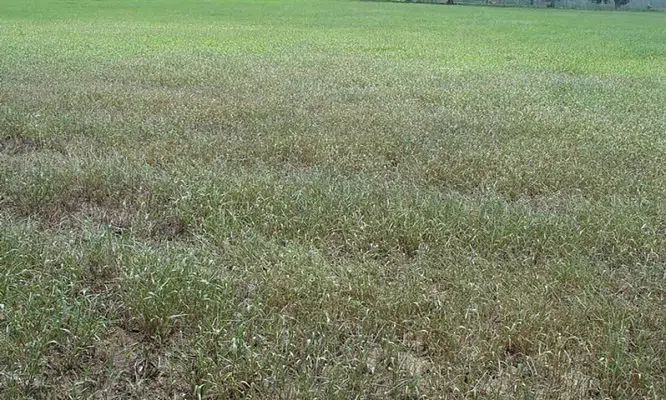
South Dakota State University entomologists have started to receive reports of pastures and alfalfa that have been heavily fed on by fall armyworm caterpillars. Typically, populations of fall armyworms are not an issue in South Dakota. However, fall armyworm populations have been very large in many states during 2021, and they have now moved into South Dakota. Fall armyworms do not overwinter in South Dakota and have to migrate to the state throughout the summer. Strong southerly winds carry the moths from the Southern United States each year.
Fall armyworms have a wide host range, but they primarily feed on grasses. They can also be problematic in alfalfa, soybean and vegetables. They get their name because the caterpillars can show up in large populations after hatching and move through fields quickly. Although the caterpillars are primarily defoliating the plants, older and larger caterpillars may destroy plants by feeding on the growing point.
Fall armyworm caterpillars may be an issue for emerging winter wheat this year. It is possible that we may see another generation of caterpillars this fall. This will be dependent on temperatures and the first hard frost. Fall armyworm caterpillars do not develop when temperatures drop below 55 degrees Fahrenheit. Scouting fields until temperatures are no longer favorable for the caterpillars will ensure that extensive feeding does not occur and early movement into wheat fields is detected.
The most effective way to determine if you have fall armyworms in your pastures or alfalfa is to use a sweep net. Scouting should occur in the early morning or evening, as the caterpillars are nocturnal feeders. If fall armyworm caterpillars are observed in the net, then determine how many caterpillars are in a square foot by examining the soil surface and the plant tissue. Repeat this process for four to five locations throughout the field. While scouting, also examine plants for signs of defoliation to determine if and where fall armyworm caterpillars are active. The defoliation injury caused by fall armyworm caterpillars will cause the leaves of the plants to have a ragged appearance.
Fields should be scouted until the first hard frost or daily high temperatures drop below 55 degrees Fahrenheit. Newly emerging winter wheat fields should be closely monitored this year to ensure that fall armyworm caterpillars don’t reduce stands.
SDSU Extension News Release




Comments