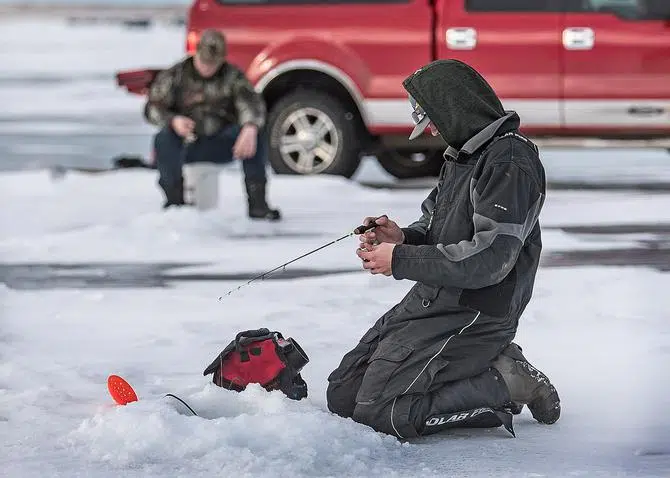
Some North Dakota anglers got an early start to ice fishing this
season, and there’s still a lot of winter hard-water fishing opportunities to
come.
To provide a general overview of what to expect, here’s some excerpts
from a recent interview with North Dakota Game and Fish Department fisheries chief
Greg Power on the agency’s weekly webcast, Outdoors Online.
How did the weather from early fall into December affect winter
fishing?
We came off the wettest September
ever and then the cold weather followed in October and into early November. We had
people ice fishing before Halloween. It was the earliest ice-up in recent
memory. Unfortunately, the second half of November warmed up. Warmer temperatures coupled with running
water and wind, caused unsafe ice conditions until early December.
What are the components that create good ice fishing opportunity?
It’s weather dependent with fish
populations, and then it’s weather when it comes to ice fishing. In an open
winter where you don’t have a lot of snow and access onto the lakes is good,
we’ll have about 25 percent of our entire annual fishing effort is ice fishing.
How are fish populations going into the winter?
Today’s fish populations are based
on conditions from the past three years, and during that period we were drying
out. So, our perch populations are not where they were 10 years ago. Where
we’ve seen a shift in the last 10 years for sure is walleye fishing. And we
actually will probably have a few more very good walleye fishing lakes this
winter versus last. The pike numbers are still fairly strong. They’re probably
down from, again, five or 10 years ago, but there is ample pike opportunity out
there. So all things considered, the fish are there.
What does the excessive precipitation this fall mean to fisheries?
Our waters throughout virtually all
of the state are probably at or very near record high elevations. In the long-term,
the water will be good for fish but more immediately we may have some access
issues as winter moves along. The cattails that surround many of our waters
will catch even more snow than normal. But
again, it bodes well for the future, as far as the water part of it.
Do the high water levels influence potential winterkill?
At this point we are in good shape,
especially with all that new water. If we hadn’t had this new water and lakes
had frozen up, and we had a normal winter, we probably could have lost another
30, 40 lakes. The worse recipe for winterkill is an early ice up, immediately
followed by the water receiving lots of snow. Couple that with this time of the
year, when the day length is the shortest, means there is less light penetration
into the water resulting in the lack of photosynthesis. And without photosynthesis,
there is no dissolved oxygen produced by aquatic plants, resulting in winter
kills of fish. Right now, we don’t
really have a lot of concern, but that can change through winter.