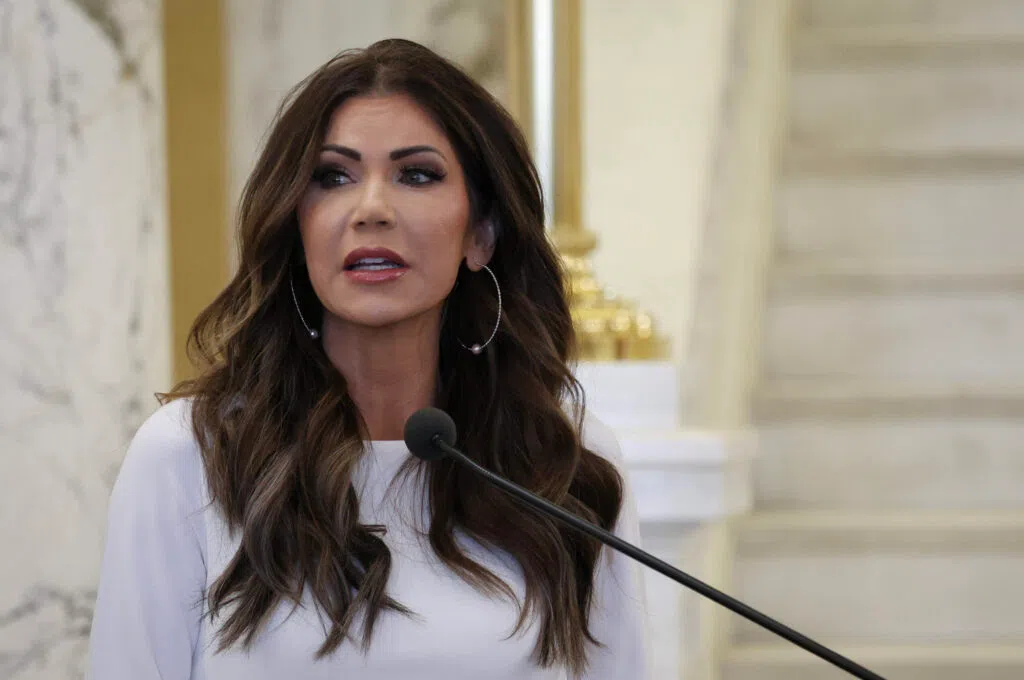
Gov. Kristi Noem speaks during a bill-signing ceremony March 6, 2024, at the Capitol in Pierre. (David Bordewyk/South Dakota NewsMedia Association)
PIERRE, S.D. (South Dakota Searchlight) — Twelve of the 19 people granted early release from prison by former South Dakota Gov. Kristi Noem without a customary review by a state board have since been charged with new crimes.
Nine of them have pleaded guilty to one or more of those charges.
During her time in office, Noem issued 27 total commutations. Those clemency orders, which can release a person from prison or shorten their sentence to make them eligible for parole, are typically reviewed by the state Board of Pardons and Paroles before a governor considers them.
But with 19 of the commutations she signed, Noem did something no governor had done in roughly two decades since former Gov. Bill Janklow: issue them to inmates who lacked an endorsement from the board.
Since then, the 12 people who have been accused of new crimes have largely faced drug charges. Seven of the charges were felonies.
Meanwhile, five of the eight people whose commutations from Noem were screened by the board have since been released. Of those five, one has been charged with a new crime.
Noem process
It’s unclear how the 19 people who got commutations without the board’s recommendation got their names in front of Noem.
Each of those commutations came around Christmas in 2022 and 2023, and granted immediate freedom to all 19 recipients. The eight commutations issued after the board’s recommendation offered shorter sentences and a shot at early release, not immediate freedom.
Noem’s administration never responded to questions about her commutations. She left office in early 2025 for a post in the Trump administration.
Noem did not respond to inquiries for comment on this story.
Her office issued a press release in 2022 about the seven commutations she’d issued on Christmas Eve. South Dakota Searchlight soon learned she’d gone around the board, that victims’ families were not notified, and that one person who was released early had been denied a recommendation by the board.
Three of the seven people released that Christmas have since pleaded guilty to new charges: one for drug possession, another for misdemeanor domestic violence, and another for driving under the influence.
South Dakota Searchlight only counted charges for which a person can be jailed or imprisoned in its tally. Some of the people who’ve been released have picked up traffic citations. A fourth person on the list of early releases in 2022, for example, who’d been imprisoned for vehicular homicide and vehicular battery, was cited for exhibition driving. Another was cited twice for violating weight restrictions in a commercial vehicle.
On Christmas Eve of 2023, Noem issued 12 more instant-release commutations without the board’s recommendation, all to people imprisoned for ingestion of a controlled substance. About a year later, lawmakers would vote to reduce ingestion to a misdemeanor for first and second offenses. Gov. Larry Rhoden signed the bill into law.
Noem talked about the commutations in her State of the State address in January 2024, saying the people “qualified” for a commutation, and that “we will continue to evaluate these second-chance opportunities for those who can prove they deserve them.”
Nine of the 12 people released in 2023 have since been charged with new offenses. Six were charged with drug possession after release. Two others were charged with drug distribution. One of those two pleaded guilty to drug possession in 2024, was imprisoned and released again before her arrest for the distribution of hydrocodone. On April 2, she was sentenced to 10 years in prison, with five suspended, for that crime.
In total, nine of the 12 people charged with new crimes after being granted no-review early release during Noem’s time in office have since pleaded guilty to new charges, and two have pending cases. One of them was charged with domestic violence, but the charge was dismissed.
Standard process
Governors in South Dakota have the exclusive state constitutional authority to issue commutations, and also pardons, which scrub an old conviction from a free person’s criminal record entirely. Noem issued 348 pardons.
The commutation process usually starts with an application to the Board of Pardons and Paroles, not the governor, a standard practice Noem pledged to follow with an executive order in 2019, but later strayed from.
Applicants to the board must first clear an initial two-person screening panel, then earn the recommendation of the full board. Both initial and full-board screenings include a review of the person’s record in and out of prison, an interview with the inmate, and interviews with the applicant’s supporters and opponents.
If five or more members of the nine-person board recommend a commutation, all the materials and a recording of the applicant’s full board hearing are sent to the governor’s office for review.
Five of the eight people who got reduced sentences from Noem after board recommendations have since been released from prison.
One, Mark Milk, was charged with aggravated eluding of a law enforcement officer, a felony, in March after a short pursuit in central Sioux Falls. Milk remains in custody at the Minnehaha County Jail as he awaits trial.
A message to Milk’s attorney with the Minnehaha County Public Defender’s Office was not returned.
Milk pleaded guilty to manslaughter in 1994 for killing a man in the aftermath of a fight in Winner and was given a life sentence. Noem commuted his sentence in 2022 after a unanimous recommendation by the board.
High bar for board recommendations
One more person who got a board-reviewed commutation from Noem, John Proctor, will be released soon.
Proctor’s parole hearing in April offers a window into the level of personal growth and transformation the board tends to expect before recommending a commutation.
On April 14, the board voted 6-2 to release Proctor, who killed a Meade County woman’s stepson in a 1973 murder-for-hire plot. Proctor was 19 at the time, newly married with a daughter on the way, and recruited for the $2,000 job from his home in Nevada.
Acting on the board’s recommendation, Noem commuted Proctor’s sentence in July 2024.
Proctor is now 72, a born-again Christian with a theology degree he earned as a prisoner in Oregon, where he was moved in the 1980s to be closer to his family as he served his life sentence for the South Dakota killing. He works as a licensed supervising electrician and maintenance man at the prison’s workshops, and spends many of his evenings sitting with hospice patients to make sure, he told the board, that “they don’t die alone.”
Call for change from gubernatorial candidate
Gov. Larry Rhoden, who took over for Noem when she left South Dakota for a job in the Trump administration, has issued 90 pardons and two commutations.
U.S. Rep. Dusty Johnson, one of three candidates running against Rhoden in the June 2 Republican primary for governor, brought up commutations at a campaign event last month.
Johnson pledged to create a public safety task force if elected, and mentioned that the group would discuss ways to “reform the clemency process” and “help ensure violent criminals are prevented from repeatedly harming the public.”
Johnson, who later told South Dakota Searchlight he was unaware of Noem’s decision to release inmates without board approval, said the state ought to consider adjusting its laws to require a board review for all acts of executive clemency.
In a follow-up statement, Johnson clarified that such an adjustment would require a change to the South Dakota Constitution.
“At the federal level, I’ve seen pardon abuses from presidents of both parties,” Johnson said. “It’s convinced me that state pardons should require experts at the table, and I support a constitutional amendment making that the case.”
Rhoden hasn’t issued any pardons or commutations that weren’t first reviewed by the board. In a statement to Searchlight, he said “I expect that to continue to be the case,” but also said the state constitution “is not broken, and I do not support changing it.”
“I respect the review and recommendation of the members of the Board of Pardons and Paroles. They have experience and expertise in this area, but they are not elected or accountable to the people,” Rhoden said.
He called clemency “an important check and balance on the judicial branch to give a second chance,” and a responsibility he does not “take lightly.”
Aberdeen businessman Toby Doeden and Jon Hansen, speaker of the state House of Representatives, are also seeking the Republican nomination for governor. Neither responded to Searchlight questions about clemency.




Comments